Kingdom of Spain
The Kingdom of Spain is a historical and present-day state on the Iberian Peninsula, which was gradually formed as a unified monarchy by the union of the Castilian and Aragonese crowns at the turn of the 15th and 16th centuries. In European history it ranked among the most influential powers of the early modern period and built a vast overseas empire.
The Kingdom of Spain did not arise from a single act but through a long process in which various state formations converged and competed on the Iberian Peninsula. A key milestone was the dynastic union of Castile and Aragon following the marriage of Ferdinand II of Aragon and Isabella I of Castile (the so-called Catholic Monarchs). Their reign is usually associated with the strengthening of royal power, the completion of the Reconquista with the conquest of Granada in 1492, and the beginning of overseas expansion, which fundamentally transformed both the European and global economy. Nevertheless, the individual lands of the crown long retained their own institutions and rights, so it was more a union of crowns than a modern unified state.
In the 16th century, Spain reached the peak of its power under the reign of Charles V of Habsburg and especially his son Philip II. Overseas possessions in America, control of important European territories and the flow of precious metals from the New World strengthened the monarchy's prestige and military capacity. At the same time, new challenges emerged: costly wars, the maintenance of a vast empire, religious conflicts and structural financial problems. Spanish power manifested itself not only in diplomacy and the army but also in culture - the Golden Age brought an extraordinary flourishing of literature, fine arts and learning.
History
From the 17th century onwards, the limits of the empire became increasingly apparent. Lengthy conflicts, competition from other European powers and economic imbalances led to a gradual weakening of its international standing. A major turning point came with the War of the Spanish Succession at the beginning of the 18th century, after which the Bourbon dynasty took the throne. It sought to modernise and centralise the monarchy, which brought reforms but also tensions between the centre and the historical lands with their own traditions. In the 19th century the Spanish state struggled with political instability, alternating regimes and the gradual disintegration of the colonial empire, as a large part of the American possessions gained independence.
In the 20th century, Spain underwent profound upheavals, including a civil war and the subsequent authoritarian regime. After its end, parliamentary monarchy was restored and a democratic transformation took place, during which the monarchy became a constitutional institution. Modern Spain is also an example of a state that deals with regional diversity: the historical lands and autonomous regions have a strong identity, linguistic and cultural distinctiveness and sometimes also pronounced political ambitions. The history of the Kingdom of Spain thus shows a long road from a dynastic union and overseas superpower to a modern European state built on constitutional order and membership of international structures.
State symbolism and coins
For numismatics, the Kingdom of Spain is an exceptionally rich subject, because its monetary history reflects both the rise of the empire and the later transformations of the state. In the early modern period, among the best-known Spanish strikes were silver coins associated with world trade, especially the real and its multiples, which spread far beyond Europe thanks to overseas silver flows. Later periods brought further monetary reforms and new denominations, with coins often bearing royal portraits, the state coat of arms and titulature, which enable more precise dating and identification of the monarch.
In the modern era, monetary development was reflected in the transition to the peseta and ultimately to the euro, but the collector and historical significance of older strikes remains strong. Spanish coins are valued not only for their metal and craftsmanship but also for their iconography: coats of arms, dynastic symbols and sometimes also motifs associated with the overseas possessions can tell the story of the state and its ambitions in a small format. It is precisely for this reason that Spanish royal strikes are often studied as a source for the history of power, trade and state representation.
In our auction and shop
- Code: SSPAN-Z1996
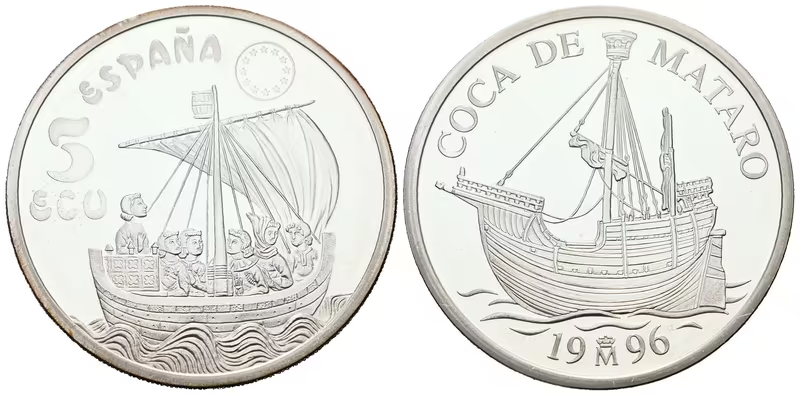
Španělsko, 5 ECU 1996 - Coca de Mataro
Španělské království, Juan Carlos I. (1975-2014) 5 ECU 1996 - Coca de Mataro, X# M17 Ag (.925), 42 mm (33 g), proof. V kapsli. Emise: 43 802 ks. Mincovna: Královská mincovna v Madridu - Španělsko. Fiktivní platidlo / Fantasy mince; pamětní - série…
Skladem 1 ks - Code: SSPAN-C1990B
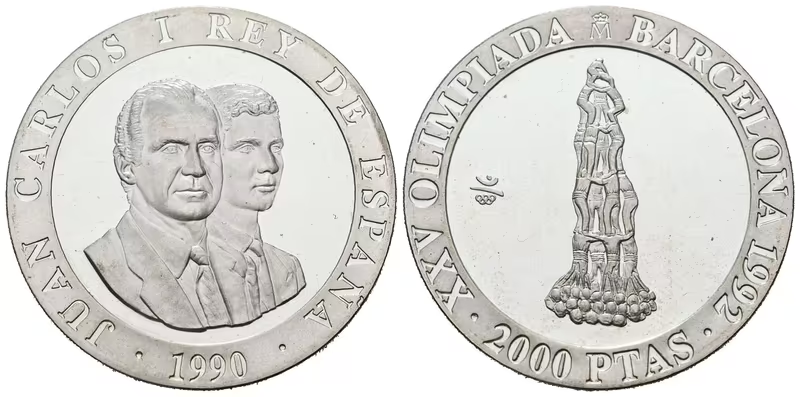
Španělsko, 2000 Pesetas 1990 - Castell
Španělské království, Juan Carlos I. (1975-2014) 2000 Pesetas 1990 - Castell, KM# 863 Ag (.925), 40 mm (27 g), proof, bez kapsle. Emise: 73 510 ks. Hrana: vroubkovaná. Mincovna: Královská mincovna v Madridu - Španělsko. Pamětní neoběžná mince, vydaná k…
Skladem 1 ks - Code: SSPAN-C1990C
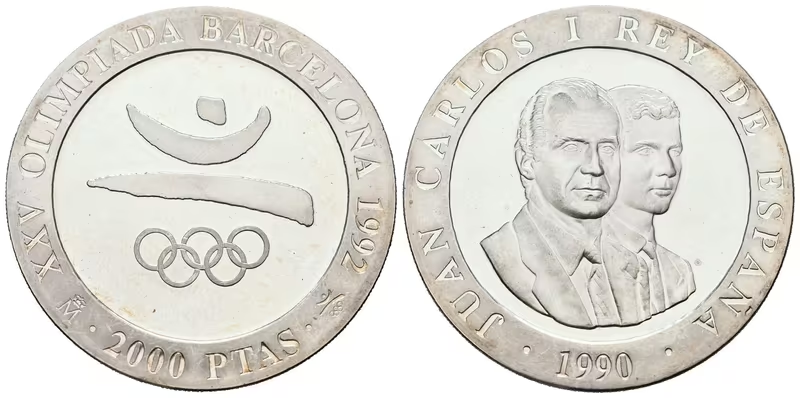
Španělsko, 2000 Pesetas 1990 - Logo
Španělské království, Juan Carlos I. (1975-2014) 2000 Pesetas 1990 - Logo, KM# 859 Ag (.925), 40 mm (27 g), proof, bez kapsle. Emise: 130 993 ks. Hrana: vroubkovaná. Mincovna: Královská mincovna v Madridu - Španělsko. Pamětní neoběžná mince, vydaná k…
Skladem 1 ks - Code: SSPAN-C1990A
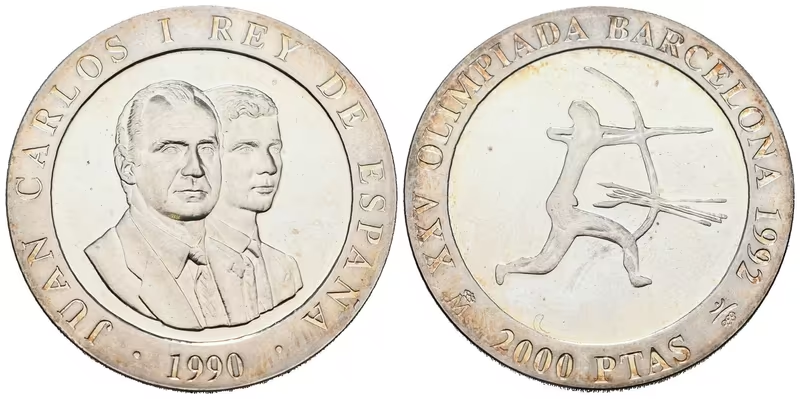
Španělsko, 2000 Pesetas 1990 - Lukostřelba
Španělské království, Juan Carlos I. (1975-2014) 2000 Pesetas 1990 - Lukostřelba, KM# 861 Ag (.925), 40 mm (27 g), proof, bez kapsle. Emise: 87 655 ks. Hrana: vroubkovaná. Mincovna: Královská mincovna v Madridu - Španělsko. Pamětní neoběžná mince, vydaná…
Skladem 1 ks