Isabella I of Castile
Isabella I of Castile (1451-1504), nicknamed the Catholic, was Queen of Castile, whose reign fundamentally changed the history of Spain and of the whole world. Together with her husband Ferdinand of Aragon she completed the Reconquista, supported Columbus' overseas expeditions and carried out a monetary reform that stabilised Spanish coinage.
Isabella was born on 22 April 1451 in the Castilian town of Madrigal de las Altas Torres as the daughter of King John II of Castile and his second wife Isabella of Portugal. When she was only three years old her father died and the throne passed to her half-brother Henry IV. He immediately removed the widowed queen and her children from court into seclusion, where the family lived in near poverty.
After a time Isabella returned to court and gained considerable influence over Henry. She succeeded in persuading the king to name her his successor in place of his daughter Joanna, who was nicknamed La Beltraneja after her alleged real father. Despite Henry's opposition, at the age of eighteen Isabella herself chose her groom - the one year younger Ferdinand, heir to the Aragonese throne. The secret marriage took place on 19 October 1469 in Valladolid. A papal dispensation was needed for the marriage, since the engaged couple were cousins, and to this day it is not certain whether the document presented was not a forgery.
After the death of Henry IV in 1474 civil war broke out for the Castilian throne. Part of the nobility supported Isabella with Ferdinand, part La Beltraneja, who in the meantime had married King Afonso V of Portugal. Isabella and Ferdinand emerged victorious from the difficult struggle and afterwards ruled both kingdoms together. In 1480 Isabella issued the new code Ordenanzas reales, which significantly limited the privileges of the Spanish grandees and strengthened royal power. Within twenty years of her reign the income of the Crown grew more than sevenfold.
History
The most important act of the royal pair was the completion of the Reconquista with the conquest of Granada on 2 January 1492. In the same year Isabella, against initial doubts, supported the expedition of Christopher Columbus. According to one version of the story she even pawned her personal jewels in order to finance the expedition. The Treaty of Santa Fe of April 1492 opened the way to the discovery of America and the rise of the Spanish colonial empire. Isabella died on 26 November 1504 in Medina del Campo and was buried in the Royal Chapel in Granada. In 1990 the process of her beatification was begun in the archdiocese of Valladolid.
Isabella was the driving force of the monetary reform of 1497, which ended the period of monetary chaos in Castile. Under the rule of her half-brother Henry IV over one hundred and fifty mints existed in the country, many of them private and striking coins of doubtful quality. The Pragmatica of Medina del Campo drastically reduced the number of authorised mints to just six royal workshops in Burgos, La Coruña, Cuenca, Segovia, Seville and Toledo.
The reform introduced a new gold standard based on the Venetian ducat. The Castilian gold coin excelente weighed 3.5 grams of gold at high fineness of 23¾ carats. Its value was set at 375 maravedís, that is, approximately 11 silver reales. The silver real weighing 3.43 grams became the basic commercial coin, with its value being 34 maravedís. For small trade the blanca of billon in the value of half a maravedí served.
Significance for coinage
The coins of the Catholic Monarchs depicted on the obverse the crowned busts of both rulers facing each other, thereby symbolising their equal standing. The reverse bore the crowned arms of the united kingdoms. The Latin legend Sub umbra alarum tuarum protege nos (Under the shadow of thy wings protect us) referred to a biblical psalm and emphasised the piety of the royal pair.
In our auction and shop
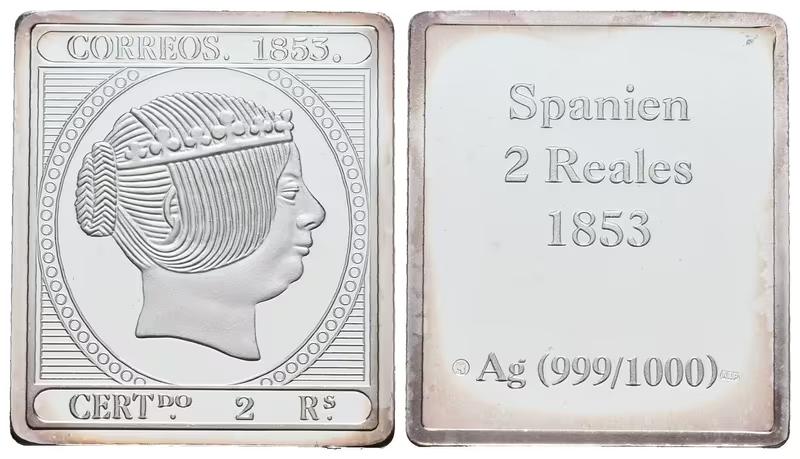
- Code: SZ-NEJ-SPAN-1853
Stříbrná známka - Španělsko - královna Isabela z roku 1853 - Ag 7 g - 999/1000
Stříbrná známka - Španělsko - královna Isabela z roku 1853 - Ag 7 g - 999/1000
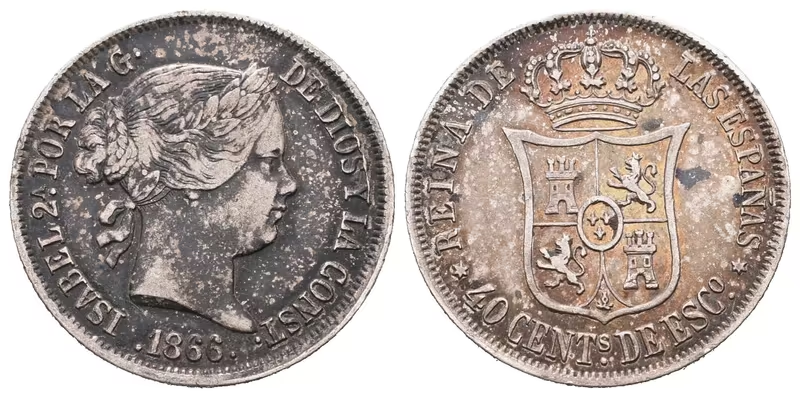
Skladem 1 ks - Code: SSPAN93-C1866
Španělsko, 40 Centimo 1866
Španělsko, Isabella II., 1833 - 1868 40 Centimos de Escudo 1866, KM.628, krásná zachovalost, patina, zbytky lesku, drobné rysky
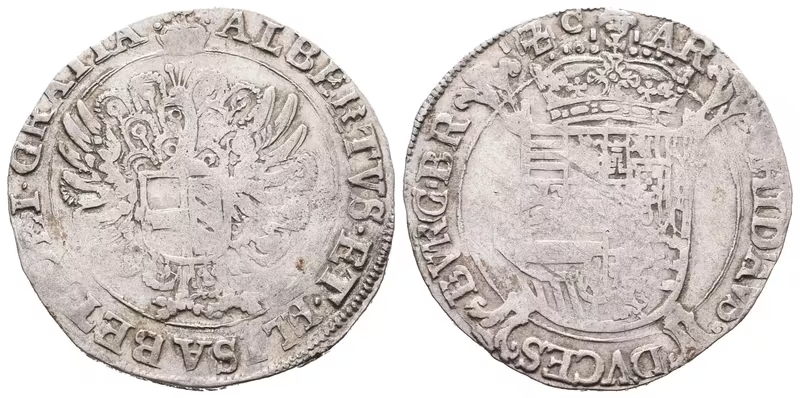
Skladem 1 ks - Code: SNIZSPA-F1612
Španělské Nizozemí, Escalin b.l. (1612 - 1621)
Španělské Nizozemí - Brabantsko, Albrecht V. a Isabella Španělská, 1598 - 1621 Escalin/Schelling b.l. (ražen 1612-1621), minc. Brusel, KM.47, Van.623 var., pěkná zachovalost a patina, dobově ořezaný
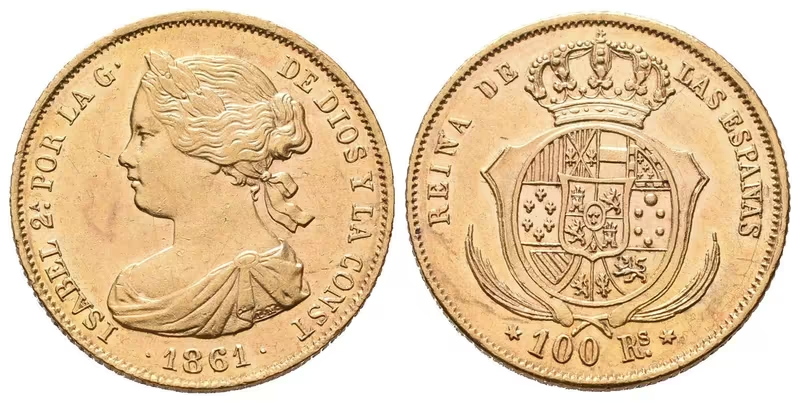
Skladem 1 ks - Code: ZSSZPA-78G1861
Španělsko, 100 Real 1861
Španělsko, Isabela II. (1833 - 1868) 100 Real 1861 Au 0,900, 22 mm (8,34 g), KM. 605.3