Vereinsmünze (Union currency)
The Vereinsmünze (union currency) was a single monetary agreement which from 1857 unified the main principles for striking silver coins between the Austrian Empire, the Principality of Liechtenstein and the states of the German Customs Union (Zollverein). It rested on a common weight base and harmonised rates.
The Vereinsmünze (in German Vereinsmünze) is connected with 19th-century efforts to simplify and bring clarity to the circulation of money in German-speaking Europe. In the area of the German Confederation and neighbouring Austria there existed several monetary zones using different coin standards and conversion rates. This complicated both trade and state finances: the same denomination did not necessarily mean the same silver content in different countries, and in practice various conversions, discounts and local customs were applied. The growing integration of markets, the development of railways and more intensive inland trade therefore increased the pressure for common rules.
The result of the negotiations was the coinage treaty of 24 January 1857, known as the Vienna Monetary (Coinage) Convention. It was concluded by the Austrian Empire, the Principality of Liechtenstein and the member states of the German Customs Union. The agreement introduced a common basis for the minting of silver coins and made it possible for the principal "union" silver coins, when struck to the prescribed parameters, to be accepted throughout the treaty area. It was therefore not the creation of a single new state currency but rather a monetary union that unified the standard and conversion rates and thereby simplified payment transactions.
The key innovation was the abandonment of the older weight unit, the Cologne mark, in favour of a more modern weight base, the so-called Zoll (new) pound of 500 g of fine silver. To this base were tied three concurrently tolerated "national" systems, which were however firmly linked by agreed parities. In the north-German states a standard prevailed by which 30 thalers were struck from one such pound of fine silver; in Austria and Liechtenstein 45 gulden were set; in southern Germany 52.5 gulden. Thanks to this it was possible to convert the value of the principal currency coins clearly and predictably between the individual regions.
History
The symbolic and numismatically best-known result of the treaty was the union thaler (Vereinstaler), and also the double thaler. These coins were intended to serve as large silver currency denominations within the treaty area, easily recognised and useful in trade across borders. Uniformity, however, was not understood to mean a uniform appearance: individual states could use their own motifs and ruler portraits but had to maintain the prescribed metal standard and weight. Alongside silver, the treaty also permitted common gold trade coins (the crown and half-crown), but the core of the system remained the silver standard.
The Vereinsmünze thus represented a practical compromise between political fragmentation and the economic need for unification. In everyday reality it helped to reduce confusion in conversions and strengthened confidence in the "large" silver coins used in trade. In the long term, however, it also depended on the stability of public finances and the monetary discipline of the individual states. Nevertheless, the Vienna Convention of 1857 ranks among the most important European monetary agreements of the 19th century, and its effects are legible in numismatics on the strikes of thalers and on gold and silver denominations of that era.
The Vereinsmünze rested on a simple idea: the principal silver coins were to have a unified metal base so as to be mutually comparable and acceptable across a wider area. The basis was 500 g of fine silver, from which a set number of units was struck in the individual regions. Thanks to this, a firm relation between thalers and gulden in various countries could be expressed, and they could be used in commercial transactions without complicated local "exchange rates".
Standard, coins and how it worked in practice
In practice, in numismatics the concept of the Vereinsmünze is most often encountered with the Vereinstaler. For identification it is important to note the mint mark, year, issuing state and adherence to the standard, while the pictorial side could differ according to the ruler or regional tradition. Coins from this monetary union therefore share a common economic "language" but often have varied artistic expression. Alongside large silver denominations there were also smaller divisions and copper small change, whose circulation was usually more tied to a specific territory, since small coinage tends to be the most sensitive area in monetary unions (because of differing purchasing power and the risk of small coin flowing between states).
For collectors and those interested in the history of money, the Vereinsmünze is interesting because it stands on the boundary between the "old" regional systems and the later national currencies. On one hand it builds on the tradition of the thaler and the gulden as currency coins; on the other it already works with a modern, metric weight base and with an internationally usable standard. For this very reason one often encounters it when describing Austrian and German strikes from the second half of the 19th century.
In our auction and shop
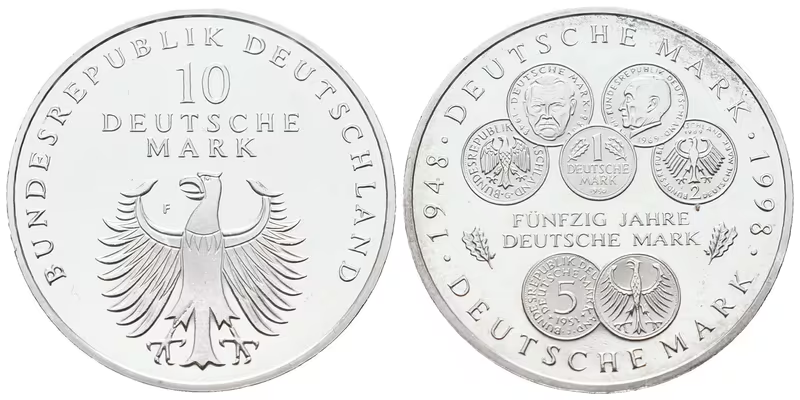
- Code: NG-B1998F
SRN, 10 Marka 1998 F - Měna
Spolková republika (1949 - ) 10 Marka 1998 F - 50. Výročí Deutsche Mark, J.469, ražební lesk, drobné rysky, patina Ag 0,925, 32,5 mm (15,5 g)
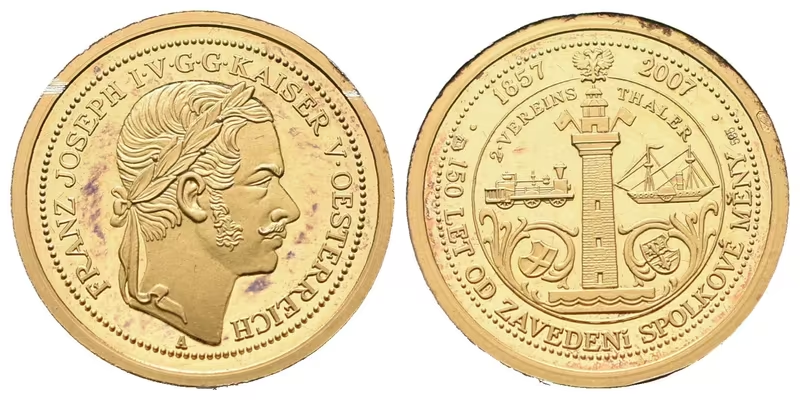
Skladem 2 ks - Code: ZD-2007SPO.E
Dukát 2007 - Spolková měna
Česká republika (1993 - ) Dukátová medaile 2007 - 150 let zavedení spolkové měny 1857 - 2007 Au 0,585, 20 mm (3,5 g), číslo 48, náklad max. 200 ks, etue, certifikát, PROOF