St Wenceslas
St Wenceslas is the most important patron of the Czech lands and a Přemyslid prince who ruled from 921 to 935. As a martyr for the faith and a symbol of Czech statehood, he became a central figure of national identity, and his image adorns countless coins, medals and banknotes.
Wenceslas was born around 907 as the son of Prince Vratislav I and Princess Drahomíra of the Stodorani clan. His upbringing was significantly influenced by his grandmother, Princess Ludmila, who was a fervent Christian and raised her grandson in the spirit of the Christian faith. After Ludmila's murder in 921, probably ordered by Drahomíra, the young Wenceslas took over the rule of the Přemyslid principality. His reign was marked by efforts to Christianise the country and to strengthen relations with the Holy Roman Empire.
Wenceslas's rule was characterised by a peaceable policy and the promotion of the spread of Christianity. The prince founded churches, supported priests and sought to raise the country's culture. His pro-Western orientation and willingness to pay tribute to the Saxon Duke Henry the Fowler, however, aroused opposition from part of the Přemyslid retinue and especially from his younger brother Boleslav. Tensions between the brothers gradually grew and culminated in the tragic events of 935.
On 28 September 935 Wenceslas was invited by his brother Boleslav to a feast at Stará Boleslav on the occasion of the feast of Saints Cosmas and Damian. When in the morning he hurried to church for early Mass, he was attacked at the church door by Boleslav and his retainers. According to the legend, Wenceslas addressed his brother with the words "Brother, what hast thou done?" and died beneath the blows of the swords. This fratricide shook the entire country and reports of miracles at Wenceslas's tomb soon began to spread.
The cult of St Wenceslas began to take shape very quickly after his death. Boleslav I himself, who later came to regret his deed, had his brother's remains translated to the Basilica of St Vitus at Prague Castle. In the 10th century the first Latin legends about Wenceslas's life and martyrdom were composed. Official canonisation probably took place at the turn of the 10th and 11th centuries, when Wenceslas was declared a saint and martyr.
History
In the Middle Ages, the cult of St Wenceslas became the fundamental pillar of Czech state ideology. The Přemyslids, and later the Luxembourgs, used the figure of Wenceslas to legitimise their power. Charles IV elevated St Wenceslas to the perpetual heir and lord of the Czech land, thereby creating the concept of the Crown of St Wenceslas as a symbol of the Czech state. According to this notion, St Wenceslas is the true ruler of the land and earthly sovereigns are merely his deputies.
During the Hussite period, the cult of St Wenceslas went through a crisis, when the radical Hussites rejected the veneration of saints. The moderate Hussites, however, respected Wenceslas as a symbol of Czech statehood. In the period of the Counter-Reformation the cult was renewed and reinforced, and the Baroque brought a new wave of devotion to St Wenceslas. In the 19th century St Wenceslas became a symbol of the national revival, and his statue on Wenceslas Square in Prague became a place of national demonstrations.
The image of St Wenceslas is among the oldest and most frequent motifs on Czech coins. The first strikes bearing his figure appear already on the denarii of Boleslav II from the end of the 10th century. From that time onwards, St Wenceslas iconography became a permanent component of Czech coinage. On mediaeval Prague groschen he is depicted as a standing knight with a banner and shield; this type of depiction became the model for later issues.
In the period of the Habsburg Monarchy, the figure of St Wenceslas adorned thalers, ducats and other prestige issues. Particularly significant are the St Wenceslas thalers from the period of Ferdinand II and the St Wenceslas ducats struck from the 17th century. After the establishment of Czechoslovakia in 1918, the St Wenceslas tradition was preserved and the saint appeared on many coins of the First Republic; the most famous are the St Wenceslas ducats from the years 1923 to 1939.
Significance in numismatics and heraldry
The depiction of St Wenceslas on coins has settled iconography. He is most often shown as a knight in full armour with a banner in his right hand and a shield bearing an eagle in his left. On his head he wears a ducal cap or a helmet, sometimes with a halo. A variant is the equestrian depiction, in which St Wenceslas sits on a horse and wields a banner or sword. On modern issues, portrait depictions also appear based on the St Wenceslas helmet.
In addition to coins, St Wenceslas is depicted on medals, plaques and commemorative issues. His figure also adorns Czech banknotes, for instance the twenty-koruna of the First Republic or modern commemorative banknotes. In heraldry, the St Wenceslas eagle is one of the basic symbols of Czech statehood and appears in the state coat of arms.
In our auction and shop
- Code: ZC512
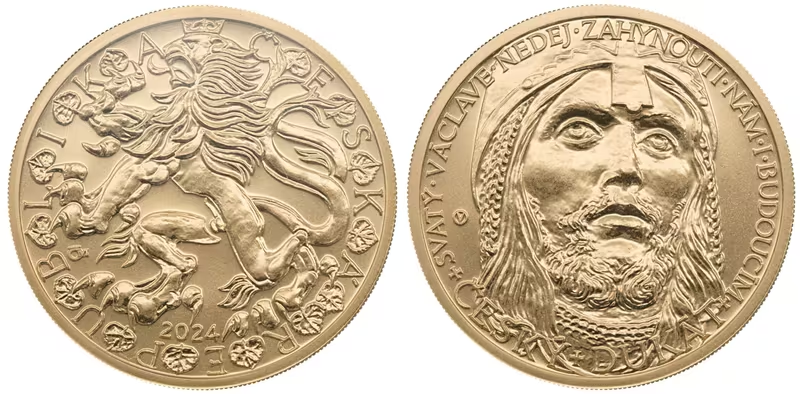
Dukát 2024 - Svatý Václav
Česká republika (1993 - ) Mimořádná zlatá mince Dukát 2024 - Zlatá obchodní mince s motivem svatého Václava (Svatováclavský dukát), autor Vladimír Oppl, Aurea C512, certifikát Au 0,986, 19,75 mm (3,49 g), limitovaný náklad 35 000 ks (běžná kvalita) V…
Skladem 4 ks - Code: ZCM-1968-SADA
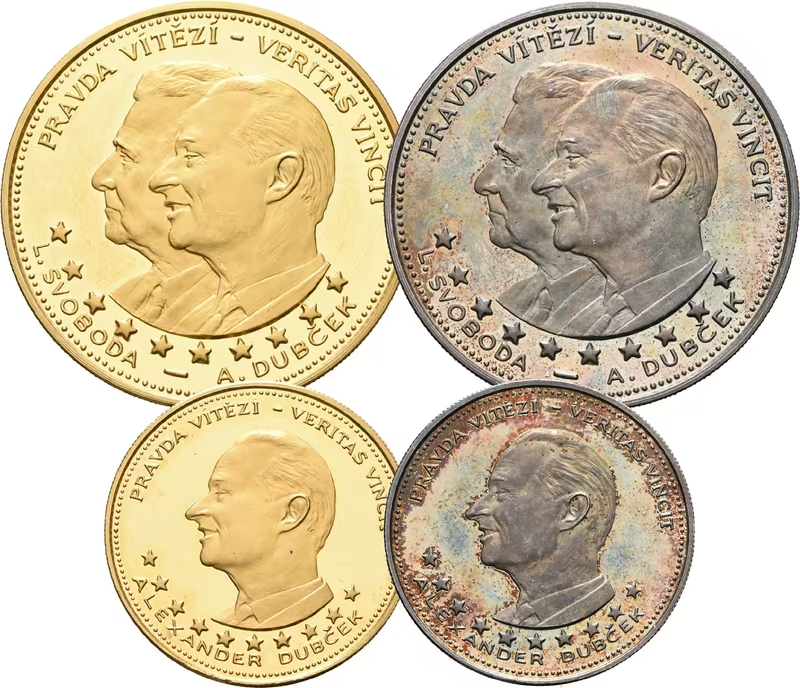
Soubor medailí 1968 - Pražské jaro
Československo (1953 - 1992) Soubor medailí 1968 - Pražské jaro Poprsí Alexandra Dubčeka a Ludvíka Svobody zleva, hvězdy a opis / Svatý Václav na koni, za ním silueta Hradčan, nápis 10 Dukát - Au 0,986, 40 mm (35,09 g), číslo 587, odražek v Ag 1,000, 40…
Skladem 1 ks - Code: RAOPP-2010VAC.2
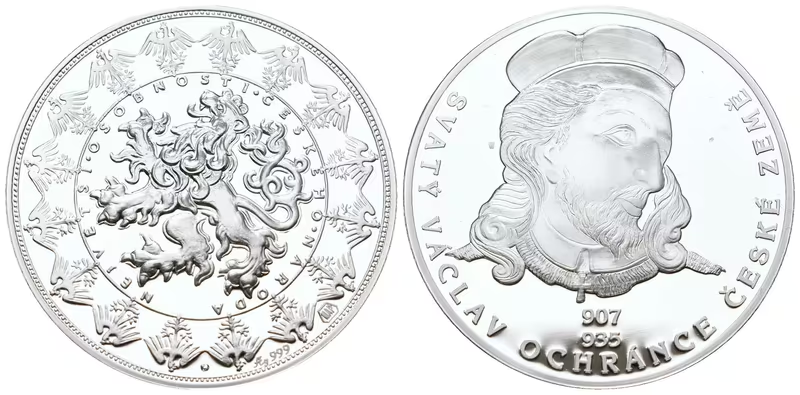
Oppl Vladimír - Svatý Václav bez certifikátu
Oppl Vladimír (1953 - ) AR Medaile b.l. (2010) - Pamětní medaile Svatý Václav ochránce české země Ag 0,9999, 40 mm (29 g), kapsle, bez certifikátu, drobná patina, PROOF jedná se o komisní - druhotný prodej, možné drobné oxidační tečky v ploše Pamětní…
- Code: RAOPP-2010VAC
Oppl Vladimír - Svatý Václav+certifikát
Oppl Vladimír (1953 - ) AR Medaile b.l. (2010) - Pamětní medaile Svatý Václav ochránce české země Ag 0,9999, 40 mm (29 g), kapsle, certifikát, drobná patina, PROOF jedná se o komisní - druhotný prodej, možné drobné oxidační tečky v ploše Pamětní stříbrné…