Tetrassarion
The tetrassarion is a bronze coin from Roman provincial circulation, used mainly in the Greek-speaking eastern provinces. The name refers to the value "four", and on some strikes the denomination is marked with the Greek numeral Δ.
The tetrassarion belongs to the world of the so-called provincial coinage of the Roman Empire. While in Rome itself and in the western provinces imperial coins with more uniformly defined denominations dominated, in the eastern part of the empire a strong tradition of civic and regional currencies was long maintained, tied to Greek reckoning and local customs. It was in this environment that bronze coins arose whose value could also be expressed in Greek numerals, so that they would be intelligible to the general public in marketplaces and in everyday payments.
The name tetrassarion derives from the Greek root for "four" (tettares / tetras), and in a monetary context it refers to the value of four assaria. The assarion was, in many cities of the eastern provinces, a small accounting unit for bronze coins, which made possible a finer division of prices than the silver currency on its own. The tetrassarion thus represented somewhat "larger small change" — a practical denomination, well suited for the everyday purchase of goods and services without having to resort to silver coins.
Numerical marking is an important distinguishing feature for the tetrassarion. On some provincial strikes the denomination appears on the reverse in the form of the Greek numeral Δ (delta), that is, "4". This does not, however, apply absolutely to all issues: some civic mints preferred a different form of marking or did not indicate the denomination directly at all, and the value had to be inferred from size and weight within the local series. For this reason, with tetrassaria one often works with catalogue identification according to the particular city and its system of bronze values.
History
Tetrassaria are most often associated with the 2nd and 3rd centuries AD, that is, the period when provincial coinage in the eastern Mediterranean experienced a marked flowering. Civic mints struck bronze denominations in great quantity, since the local economy required reliable small change for the market and for the collection of fees. The tetrassarion therefore appears in a wide range of cities, from the regions around the Black Sea to Asia Minor. In numismatic descriptions one may encounter connections with emperors such as Hadrian, Commodus or Gordian III, since civic strikes often bore the imperial portrait and titulature on the obverse, while the reverse emphasised local motifs and sometimes the value of the coin.
In practice, it must be borne in mind that the provincial monetary world did not constitute a single "exchange rate". The tetrassarion could play a different role in conversions to silver units in different regions. In some local systems based on the drachma, it has been suggested that it might represent a fractional value of around 0.4 drachmas, but such an expression always depends on the specific regional system and its evolution. It is precisely this diversity that makes the tetrassarion an interesting denomination: it shows how the Roman Empire was able, alongside the imperial currency, to tolerate and make use of local monetary traditions where these supported the functioning of trade and administration.
The tetrassarion was a bronze denomination worth four assaria. Visually, it was often a fairly robust coin, exceeding the smallest bronze values of the city in question in both diameter and weight. For many issues, a weight of approximately 10–16 g and a diameter of around 26–31 mm is reported, which corresponds to the fact that it was designed to "sit well in the hand" and to be easily distinguishable in circulation.
Value, appearance and identification
For identifying a tetrassarion, the combination of three things is crucial: the place of minting, the iconography, and any indication of value. The obverse often features the imperial portrait with a Greek or Latin titulature, while the reverse shows local deities, personifications of the city, temple motifs, or other regional symbols. If the numeral Δ is present on the reverse, this is a very useful marker, as it directly confirms the "four-fold" denomination. The numeral is not always conspicuously placed, however; sometimes it is small and must be sought in the field or beside the motif.
In catalogue practice, tetrassaria are often listed by the cities that struck them (for example in the Black Sea region or in Asia Minor), since it is precisely the civic tradition that decides how exactly the denomination was used. The description of a specific coin therefore commonly includes the mint/city, the ruler, a transcription of the legends, the diameter and the weight. With provincial bronze strikes, the surface condition and the legibility of the inscriptions are additionally important, since corrosion and wear can easily obscure fine details — and it is often precisely these that decide the correct identification of type and value.
In our auction and shop
- Code: BE049-0774
S. Severus, Moesia, Marcianopolis, AE
Septimius Severus (193 - 211) Moesia Inferior, Marcianopolis, magistrát Julius Faustinianus, AE 25 Tetrassarion, Rv: Cybele sedící vlevo na trůně, drží pateru a opírá loket o tympanum, po stranách lvi, opis. Varbanov 774, pěkná patina, drobné vady střížku
Skladem 1 ks - Code: BE049-0809
S. Severus, Moesia, Marcianopolis, AE
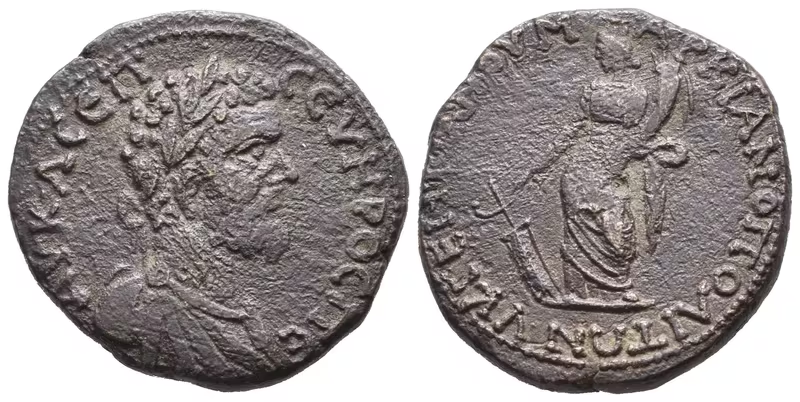
Septimius Severus (193 - 211) Moesia Inferior, Marcianopolis, magistrát Julius Faustinianus, AE 26 Tetrassarion, Rv: Tyché stojící vlevo drží kormidlo a roh hojnosti, opis. Varbanov 809, pěkná patina, exc.
Skladem 1 ks - Code: BE049-0778
S. Severus, Moesia, Marcianopolis, AE
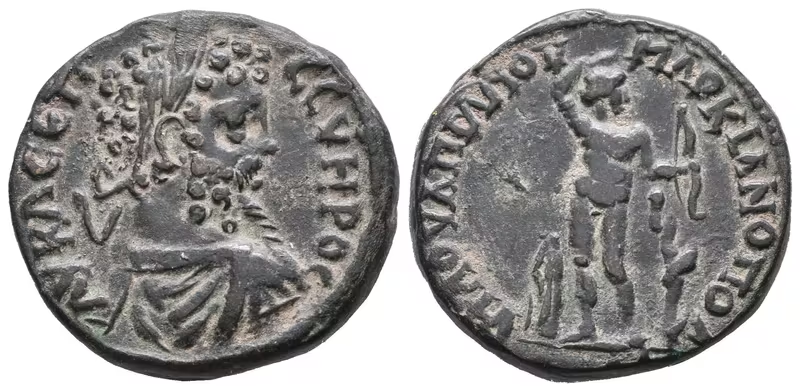
Septimius Severus (193 - 211) Moesia Inferior, Marcianopolis, magistrát Julius Faustinianus, AE 26 Tetrassarion, Rv: Apollo Lykeios stojící čelně, hledí vpravo, drží luk a zvedá ruku nad hlavou. Varbanov 778, velmi pěkná zachovalost a patina
Skladem 1 ks