Tokugawa shogunate
The Tokugawa were a Japanese shogunal family that ruled Japan for more than 250 years during the Edo period (1603–1868), creating the first unified monetary system based on gold, silver and copper coins. This military clan established a stable monetary policy with prestigious koban and ōban strikes, which are among the most valuable Asian numismatic monum…
The Tokugawa clan rose to power after a period of civil wars known as the Sengoku (1467–1615), when Tokugawa Ieyasu (1543–1616) unified fragmented Japan. After his victory at the Battle of Sekigahara in 1600, he gained control over most of the country and in 1603 was appointed shogun by the emperor, thereby founding the Tokugawa shogunate. The capital became Edo (today's Tokyo), while the emperor resided in Kyoto as a symbolic but powerless figure.
One of the first steps of Tokugawa Ieyasu was a monetary reform and the unification of the chaotic financial system. Until then, each principality (han) had struck its own coins of varying quality and weight. In 1601 Ieyasu founded the central mints kinza (for gold) and ginza (for silver), which began producing standardised coins. The most prestigious gold coin became the koban, an oval coin with characteristic stamps and inscriptions.
The Tokugawa monetary system was based on three metals with fixed exchange rates. Gold coins (koban and ōban) served for large transactions and payments to samurai; silver coins of various shapes were used in trade; copper, and later iron, mon coins formed the small change. The system functioned on a triple-standard principle, where one gold ryō equalled 60 silver monme or 4,000 copper mon.
In 1633 the third shogun, Tokugawa Iemitsu, initiated the policy of isolation known as sakoku (the closed country). Japan closed itself off from the outside world for more than two centuries, with the exception of limited trade with the Dutch and Chinese in the port of Nagasaki. This isolation paradoxically contributed to the stability of the monetary system, which was not affected by fluctuations of international markets.
History
During the 17th and 18th centuries, the Tokugawa monetary system underwent several reforms. The most significant was the Genroku reform (1695–1710) under the shogun Tokugawa Tsunayoshi, when the gold content of koban was reduced from 86% to 57% due to a shortage of the precious metal. This devaluation caused inflation but allowed the expansion of monetary circulation in a growing economy.
The 18th century brought the economic flourishing of the merchant class (chōnin) and the development of a monetary economy. The first money-changers and pawnshops arose, issuing paper notes hansatsu backed by coins. Some principalities obtained permission to strike their own copper and silver coins for local circulation, which led to a regional diversification of the monetary system.
The crisis of the Tokugawa regime began in the 19th century with the arrival of the American commodore Matthew Perry in 1853, who forced Japan to open up to foreign trade. The massive outflow of gold and silver abroad caused the collapse of the monetary system. The shogunate attempted to rescue itself by striking new ansei koban coins (1859), but the economic crisis contributed to the fall of the regime.
The Tokugawa shogunate ended in 1868 with the Meiji Restoration, when the young emperor Mutsuhito took over real power. The last shogun, Tokugawa Yoshinobu, abdicated and handed over the government to the emperor. With the fall of the shogunate, the traditional monetary system also expired — in 1871 it was replaced by a modern yen system on the Western model.
Monetary system and types of coins of the Tokugawa period
Gold coins represented the pinnacle of Tokugawa coinage. The most common was the koban, an oval gold coin weighing approximately 18 grams with a gold content varying by period from 57% to 86%. The coin bore stamps indicating the value, period of issue and mint. The rarer ōban was tenfold the value of the koban and was used only for exceptional payments and gifts.
Silver coins took more varied forms. The basic unit was the chōgin, an elongated silver ingot with stamped marks. Smaller silver coins, mameita-gin, were bean-shaped and used for smaller payments. From 1772 rectangular silver coins ichibu-gin were struck with a fixed value of one-quarter of a ryō.
Copper, and later iron, mon coins formed the basis of small change. These round coins with a square hole in the centre followed the Chinese tradition and bore Chinese characters. Many variants existed by period and mint — for example the Kan'ei tsūhō, struck from 1636, was the most widespread copper coin.
The quality and design of Tokugawa coins reflected Japanese aesthetics and craft perfection. Gold koban were produced by the technique of hand hammering, and each piece was individually marked with stamps. The manufacturing process involved up to 16 different steps, including the refining of metal, rolling, striking and weight control.
In our auction and shop
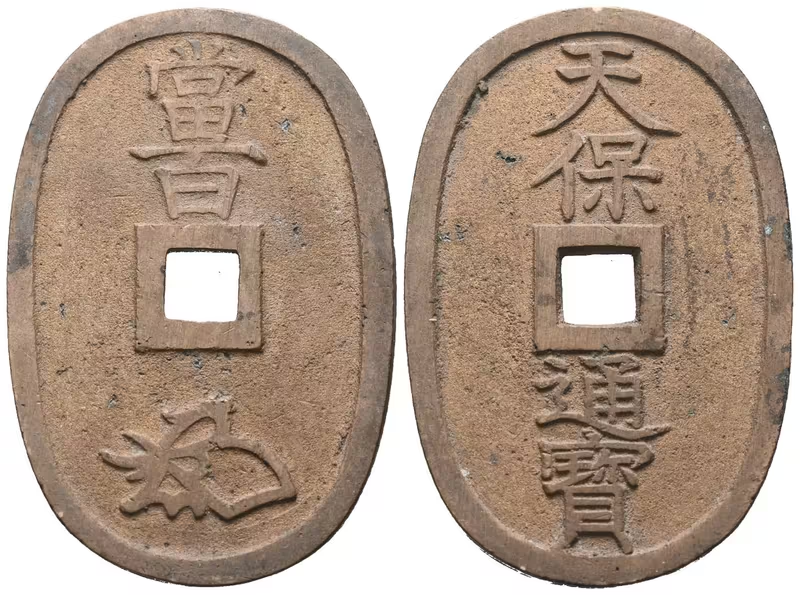
- Code: SJAP93-D1847.2
Japonsko, 100 Mon b.l. "Tenpōtsūhō"
Japonsko - šogunát Tokugawa, Ninkō, 1817 - 1846 100 Mon b.l. (1847 - 1869), KM.C7, tzv. "Tenpōtsūhō" Bronz 49 mm (+- 20,7 g), na hraně 2x punc
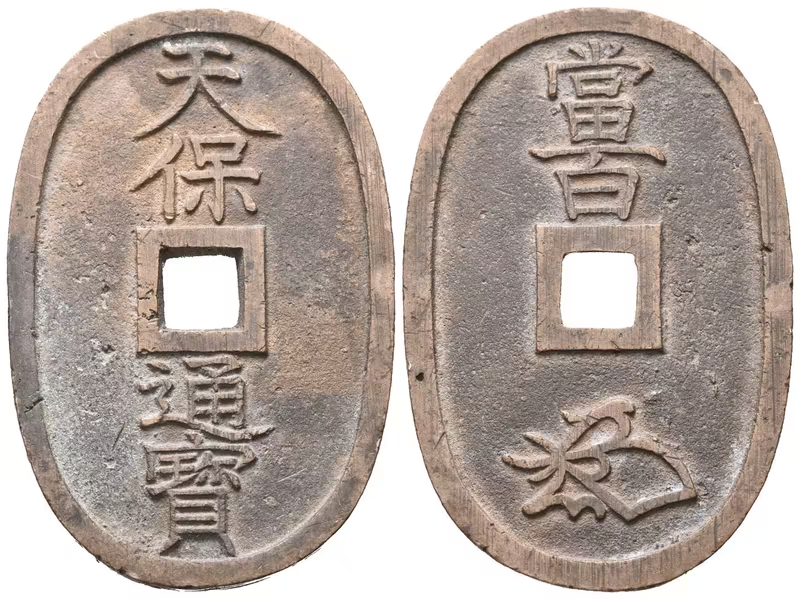
Skladem 1 ks - Code: SJAP93-D1847.6
Japonsko, 100 Mon b.l. "Tenpōtsūhō"
Japonsko - šogunát Tokugawa, Ninkō, 1817 - 1846 100 Mon b.l. (1847 - 1869), KM.C7, tzv. "Tenpōtsūhō", pěkná zachovalost a patina Bronz 49 mm (+- 20,7 g), na hraně 2x punc
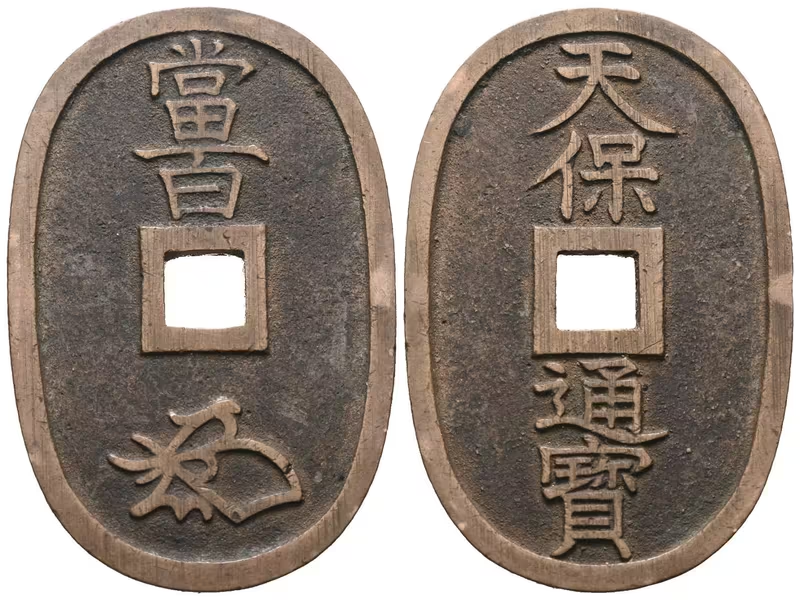
Skladem 1 ks - Code: SJAP93-D1847
Japonsko, 100 Mon b.l. "Tenpōtsūhō"
Japonsko - šogunát Tokugawa, Ninkō, 1817 - 1846 100 Mon b.l. (1847 - 1869), KM.C7, tzv. "Tenpōtsūhō" Bronz 49 mm (+- 20,7 g), na hraně 2x punc
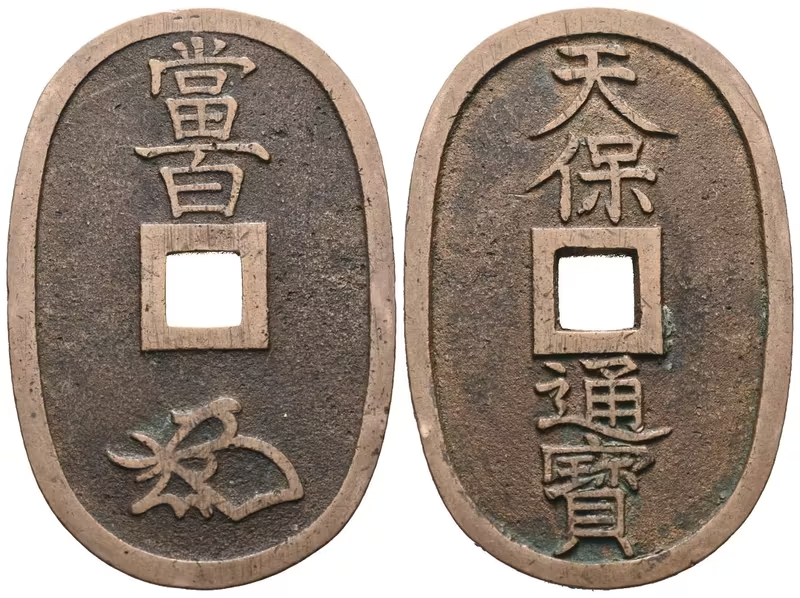
- Code: SJAP93-D1847.1
Japonsko, 100 Mon b.l. "Tenpōtsūhō"
Japonsko - šogunát Tokugawa, Ninkō, 1817 - 1846 100 Mon b.l. (1847 - 1869), KM.C7, tzv. "Tenpōtsūhō" Bronz 49 mm (+- 20,7 g), na hraně 2x punc