Vatican
The Vatican is the smallest state in the world, the seat of the Pope and the centre of the Roman Catholic Church, lying within Rome. It has a special international status and its own numismatic tradition: it issues euro coins and commemorative coins, which rank among the most sought-after modern issues in Europe.
The roots of the Vatican are bound up with the history of the papacy and the position of Rome as the centre of Christianity. In the early Middle Ages, around the papal authority there gradually formed a secular framework of power that gave rise to the Papal States — a territory administered by the Pope not only spiritually but also as a secular sovereign. This state existed for centuries and its administration encompassed taxation, judiciary, army and a separate monetary circulation. Minting and the issue of currency were a natural sign of sovereignty: coins bore papal symbols, Latin inscriptions and often also the heraldry of a particular pontificate.
In the 19th century, however, European unification processes fundamentally transformed the map of the Apennine peninsula. As part of Italian unification the Papal States progressively lost territory and in 1870 papal secular power in Rome was effectively ended. There followed a long period of tension between the Italian state and the papacy, during which the question of the Pope's legal status and his independence was addressed both politically and symbolically. Only in the 20th century did agreement gradually emerge that defined the modern form of Vatican statehood.
The crucial turning point was the Lateran Treaty of 1929, which created the independent state of Vatican City and regulated the relationship between the Holy See and Italy. The Vatican thereby obtained territory on which the Pope could act as an independent head of state, while the Holy See retained its international role as a subject of diplomatic relations. The Vatican thus became a unique case: it is at once a microstate with its own law and administration and the centre of a worldwide church.
History
In the course of the 20th and 21st centuries, the Vatican has left its mark not only on religious history but also on politics and culture. The papacy has become a globally visible institution that influences public debate, charitable activity and international relations. The Vatican is at the same time the custodian of an exceptional cultural heritage — St Peter's Basilica, the Vatican museums and archives — which makes it one of the most important centres of memory in the world.
The Vatican is a monarchy of a special kind: the head of state is the Pope, who combines spiritual authority with a limited secular role within the state. State symbolism draws on elements connected with the papacy, typically the keys of St Peter and the tiara (in modern times more often in heraldic form). These motifs also appear in numismatics, where they function as a clear identification of the issuer.
In modern times the Vatican uses the euro and issues its own euro coins, which are sought after because of low mintages and strong subject matter. The national side features the motif of the current head of state and state symbols; commemorative issues tend to feature themes connected with papal anniversaries, saints, St Peter's Basilica or significant moments of church history. Alongside circulating euro coins there is also a rich programme of commemorative strikes in precious metals, which are collected according to year, theme and execution.
State, symbols and Vatican coins
For collectors, the key distinction with Vatican coins is between ordinary currency and collector's editions. With commemorative coins, mintage, surface quality and completeness of packaging are decisive; any careless cleaning or scratching can noticeably reduce the value. Vatican numismatics is attractive because it combines state sovereignty with strong symbolism and a long tradition continuing from the former coins of the Papal States.
In our auction and shop
- Code: SVAT-E1979
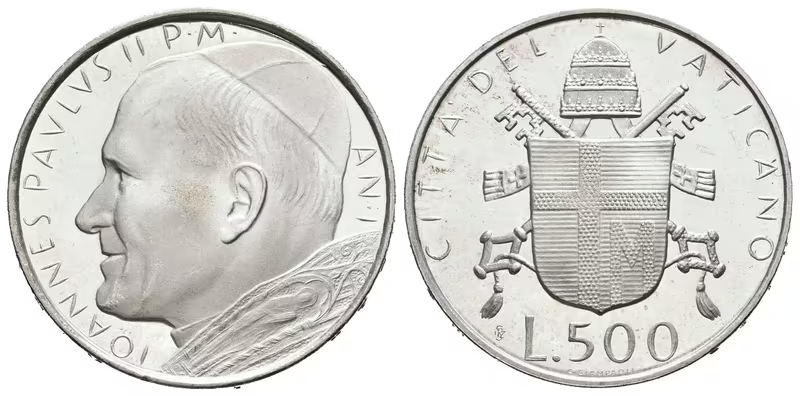
Vatikán, 500 Lire 1979 - Jan Pavel II., papežský erb, tiára, zkřížené klíče
Vatikánský městský stát - Jan Pavel II. (1978-2005) 500 Lire 1979 - Jan Pavel II., papežský erb, tiára, zkřížené klíče Ag (.835), 29,3 mm (11 g), BU, v kapsli. Stav mince odpovídá fotografii.
Skladem 1 ks - Code: RX-VAT1900A
- Code: SVAT90-X2007BK
Vatikán, Sada pamětních oběžných mincí 2007
Vatikán Sada pamětních 2 Euromincí 2007 v běžné kvalitě původní přebal s certifikátem, blistr
Skladem 1 ks - Code: SITAVAT-D1797
Itálie - Vatikán, 2 Baiocchi rok XXIII
Itálie - Vatikán, papež Pius VI., 1775 - 1799 2 Baiocchi Romani, rok XXIII (1797), poslední ročník, KM.1226, patina, vady střížku_R!
Skladem 1 ks