William II of Württemberg
William II of Württemberg was the last king of Württemberg, who reigned from 1891 to 1918 within the German Empire. During his rule the country changed under the influence of the modern age, but the monarchy came to an end in November 1918 during the revolutionary events in Germany.
William II of Württemberg (25 February 1848 – 2 October 1921) came from the House of Württemberg and was born in Stuttgart. He came of age in a period when the German lands were rapidly unifying politically, and the traditional sovereignty of smaller kingdoms was gradually diminishing. After the Franco-Prussian War, in 1871 Württemberg became a federal state of the newly established German Empire, and although it retained its own royal court, administration and provincial institutions, key areas of foreign policy and the military were increasingly bound to the imperial framework.
He ascended the Württemberg throne on 6 October 1891 after the death of the childless king Charles I. As monarch he stood at the head of a country that was no longer an "independent state" in the traditional sense, but an important and economically strong link of the imperial federation. In the last third of the 19th century south-west Germany underwent dynamic development of industry, transport and urban life; with this came a growing need for modern administration, infrastructure investment and the ability to balance social tensions associated with the rapid transformation of society. William II profiled himself in this environment as a monarch who sought to maintain stability and respect for the monarchy without entering everyday politics as confrontationally as was typical of some other European courts.
History
His reign falls in a period when monarchies faced the pressure of mass politics and civil society. In the German lands the role of parliamentary parties, public debate and modern media grew stronger, and with this the form of royal authority changed. William II is generally described as rather measured and personally relatively close to the public, which may have contributed to his being seen as a more "civilian" king compared with showier models of monarchical representation.
The turning point came with the First World War. Wartime mobilisation, economic exhaustion and political crisis culminated in the autumn of 1918 in the collapse of the existing order. As part of the German November Revolution, the monarchies in individual states collapsed one after another, and on 30 November 1918 William II abdicated. With this the monarchy in Württemberg ended, and the country became part of the new republican structure of Germany. William II then lived as a private person and died in 1921 at Bebenhausen. His life's journey thus symbolically closes the period in which the German lands had their own kings, while the 20th century had already brought a quite different model of statehood and political legitimacy.
Coins of William II and their numismatic significance
William II is important for numismatics above all as a "provincial" monarch within the German mark currency. In Württemberg, during his reign, coins were struck with his portrait and titulature that followed the standards of the German Empire. Typically these were silver denominations in marks and gold coins of higher values, struck according to uniform imperial parameters but bearing Württemberg royal identity. This combination – a common monetary system and at the same time provincial portraits – is one of the characteristic features of German coinage before 1918.
On the coins William II appears as a portrait monarch of the late 19th century: an emphasis on a realistic profile, legible inscriptions and state symbols was meant to combine the trustworthiness of the currency with the representation of the state. With ordinary circulating strikes the year, denomination, condition and any die varieties are watched in particular, while with gold coins, alongside collector interest, the precious metal content is also important. Coinage from the period of William II also stands on a "threshold of time": these are among the last coins of the German provincial monarchies before they were swept away, and they are therefore often viewed as a tangible piece of evidence of the end of the old political world.
In our auction and shop
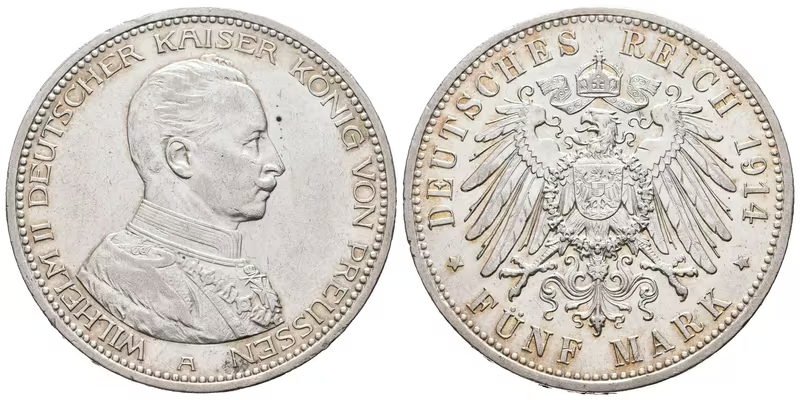
- Code: NBPRU-BX1914.1
Prusko, 5 Marka 1914
Prusko, Vilém II., 1888 - 1918 5 Mark 1914 A, Berlín, KM.536, J.114 , velmi pěkná zachovalost, lesk na Rv., patina, rysky a nep. hranky
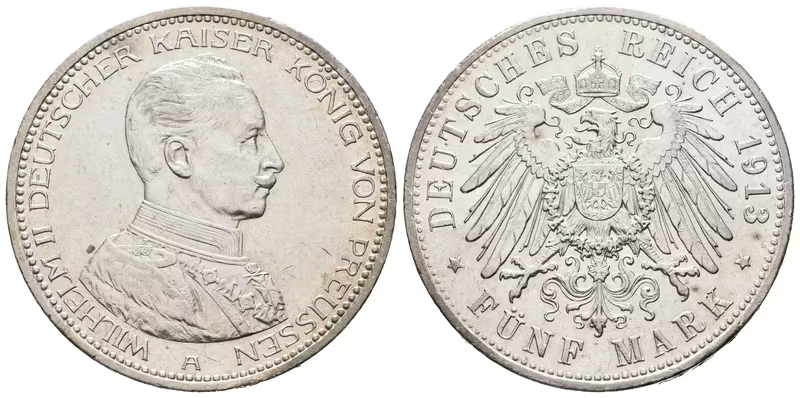
Skladem 1 ks - Code: NBPRU-BX1913A.7
Prusko, 5 Marka 1913
Prusko, Vilém II., 1888 - 1918 5 Mark 1913 A, Berlín, KM.536, J.114 , krásná zachovalost, ražební lesk na Rv., zbytky lesku na Av., patina, rysky a drobné hranky
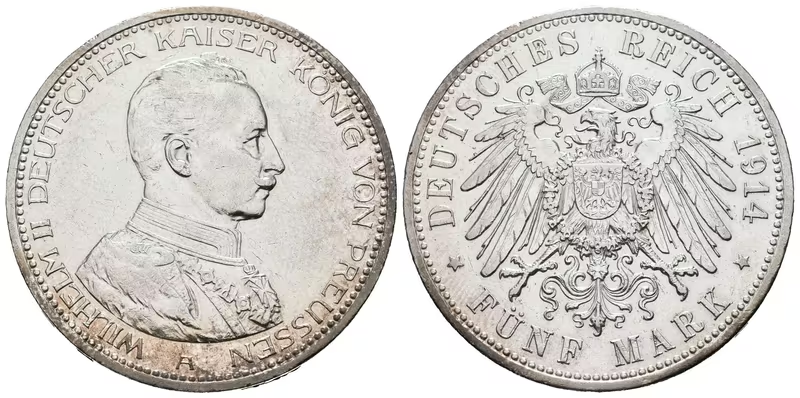
Skladem 1 ks - Code: NBPRU-BX1914
Prusko, 5 Marka 1914
Prusko, Vilém II., 1888 - 1918 5 Mark 1914 A, Berlín, KM.536, J.114 , velmi pěkná zachovalost, lesk na Rv., patina, rysky a nep. hranky
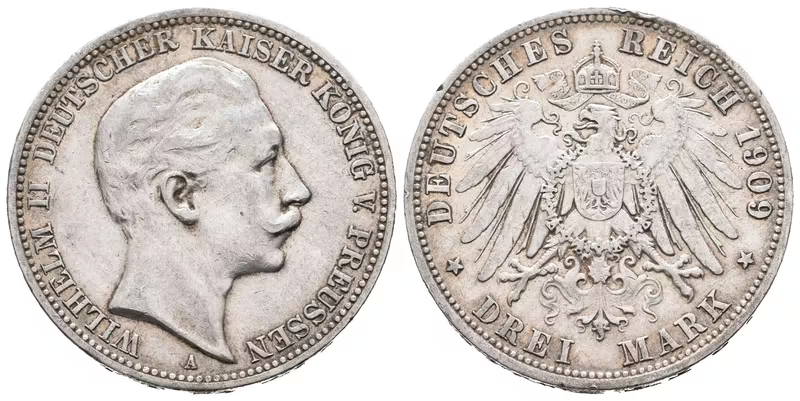
Skladem 1 ks - Code: NBPRU-BY1909A.1
Prusko, 3 Marka 1909 A
Prusko, Vilém II., 1888 - 1918 3 Mark 1909 A, Berlín, KM.527, J.103, patina, zbytky lesku, rysky a hranky
Skladem 1 ks