Walking Liberty
Walking Liberty ranks among the most admired and artistically celebrated designs in the entire history of world coinage. Created by German-born American sculptor **Adolph Alexander Weinman** (1870–1952) for the United States silver half dollar (1916–1947), the motif was resurrected nearly four decades later in 1986 on the obverse of the **American Silver…
Birth of the Design in the Renaissance of American Coinage (1916)
The early 20th century witnessed a deliberate artistic renaissance of U.S. circulating coinage initiated by President Theodore Roosevelt alongside premier American sculptors (Augustus Saint-Gaudens, Bela Lyon Pratt, James Earle Fraser). In 1916 Adolph A. Weinman, a former pupil of Saint-Gaudens, won U.S. Mint competitions for two circulating denominations simultaneously: the dime (Mercury Dime) and the silver half dollar (Walking Liberty Half Dollar).
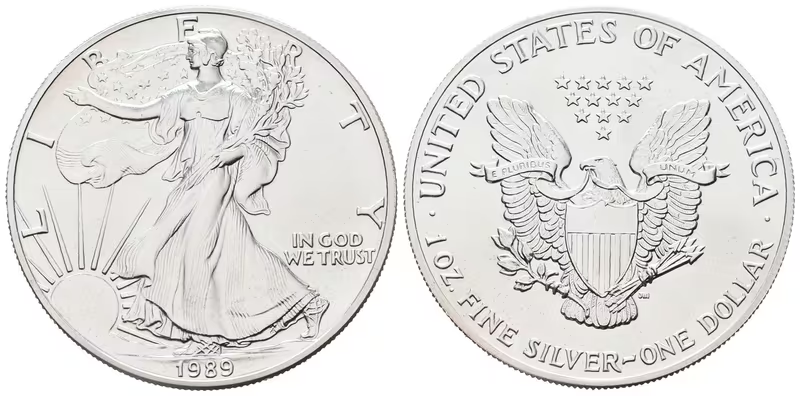
Weinman's obverse depicts a full-length allegory of Liberty draped in the flowing American flag striding purposefully toward the dawn of a new day. In her left arm she cradles branches of laurel and oak (symbolising civic and military glory) while extending her right hand toward the future. On the original half dollar reverse, a powerful bald eagle perched on a rocky crag beside a mountain pine sapling answered the obverse's dynamism.
The Original Walking Liberty Half Dollar (1916–1947)
The Walking Liberty silver half dollar circulated across the United States from 1916 to 1947, succeeded in 1948 by the Benjamin Franklin half dollar. Its technical parameters were:
- Denomination: 50 cents (Half Dollar).
- Metal and fineness: 900/1000 silver (10% copper).
- Weight and diameter: 12.50 g (11.25 g / 0.3617 troy oz pure silver); 30.6 mm diameter.
- Mints: Philadelphia (no mint mark), Denver (
D) and San Francisco (S).
The key rare dates of the circulating series include 1921, 1921-D, 1921-S, 1916-S and 1938-D.
Second Life on the American Silver Eagle (1986) and Gold Centennial (2016)
When the U.S. Congress passed the Liberty Coin Act of 1985 establishing a 1 oz silver bullion coin, the U.S. Mint chose to revive Weinman's Walking Liberty. Expanded onto the sweeping 40.6 mm flan of the American Silver Eagle (compared with 30.6 mm on the half dollar), the subtle Art Nouveau-classical relief achieved full sculptural grandeur. In 2016 the U.S. Mint honoured the design's centenary with a limited 1/2 oz.9999 gold Centennial Walking Liberty Half Dollar, and in 2021 restored Weinman's AW monogram to the Silver Eagle obverse.
In third-party grading (NGC, PCGS), original Walking Liberty half dollars are among the most closely studied 20th-century U.S. issues: strike quality is judged chiefly on the crispness of Liberty's left hand, head and gown lines, notoriously soft on many 1940s San Francisco (S) strikes, so full-strike MS 65 to MS 67 specimens with unbroken velvet lustre command major auction premiums over common circulated pieces.
In our auction and shop
- Code: SUSB-Y1989
USA, American Eagle 1989
One Dollar 1989 - American Silver Eagle Ag 0,9993, 40,6 mm (31,105 g), 1 Oz, běžná kvalita American Silver Eagle je oficiální stříbrná mince ve Spojených státech. Poprvé ji vydala Mincovna Spojených států 24. listopadu 1986 a zobrazuje bohyni svobody v…
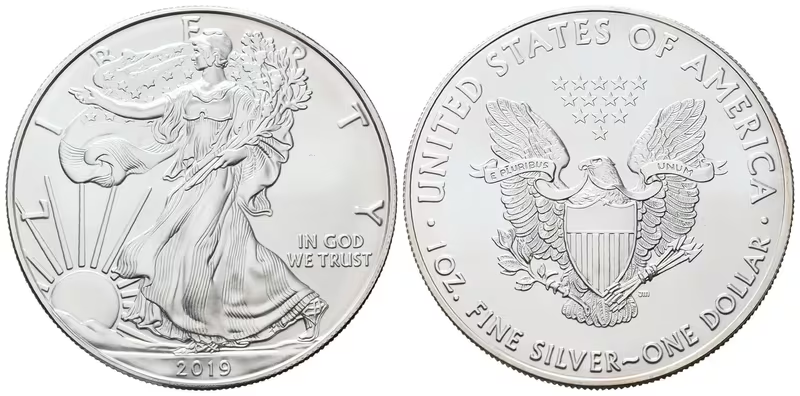
Skladem 2 ks - Code: SUSB-Y2019
USA, American Eagle 2019
One Dollar 2019 - American Silver Eagle Ag 0,9993, 40,6 mm (31,105 g), 1 Oz, běžná kvalita American Silver Eagle je oficiální stříbrná mince ve Spojených státech. Poprvé ji vydala Mincovna Spojených států 24. listopadu 1986 a zobrazuje bohyni svobody v…
Skladem 1 ks - Code: SUSB-Y2015
USA, American Eagle 2015
One Dollar 2015 - American Silver Eagle Ag 0,9993, 40,6 mm (31,105 g), 1 Oz, běžná kvalita American Silver Eagle je oficiální stříbrná mince ve Spojených státech. Poprvé ji vydala Mincovna Spojených států 24. listopadu 1986 a zobrazuje bohyni svobody v…
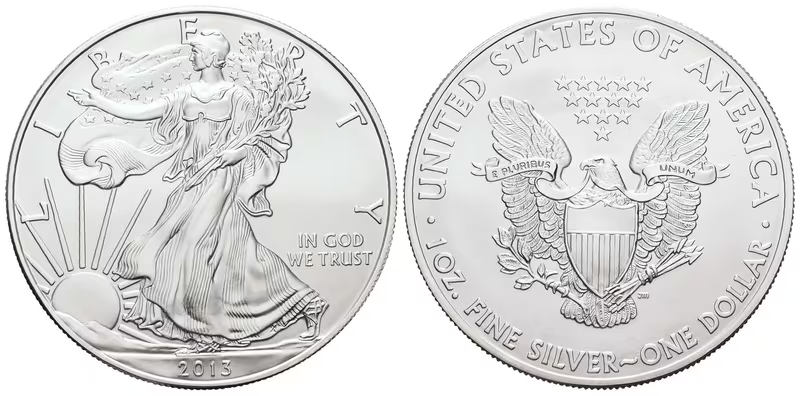
Skladem 1 ks - Code: SUSB-Y2013
USA, American Eagle 2013
One Dollar 2013 - American Silver Eagle Ag 0,9993, 40,6 mm (31,105 g), 1 Oz, běžná kvalita American Silver Eagle je oficiální stříbrná mince ve Spojených státech. Poprvé ji vydala Mincovna Spojených států 24. listopadu 1986 a zobrazuje bohyni svobody v…
Skladem 1 ks