VAT Act
The VAT Act (Act on Value Added Tax) is a Czech legal regulation which determines when VAT is applied to goods and services, who is a payer, and how rates, exemptions and the right to deduction are set. It is key for prices in trade and for the tax obligations of firms.
The VAT Act in the Czech Republic arose as part of the modernisation of the tax system and at the same time as a necessary condition for the functioning of the single European market. Value added tax is harmonised within the European Union: individual states do set specific rates within statutory limits, but they must observe common rules for what constitutes a taxable supply, where the place of supply is and how the deduction of tax is handled. The Czech Act No. 235/2004 Coll. took effect in 2004 and replaced the earlier legal regulation from the 1990s. Its purpose was to unify Czech practice with European rules and at the same time to create a clear "map" of obligations for businesses and state administration.
The basic logic of VAT is based on the fact that the tax is collected gradually at individual stages of production and distribution, but the actual burden is borne by the final consumer. The entrepreneur (payer), on sale, pays VAT on the supplies made, and at the same time can claim a deduction of tax on the supplies received, if they used them for their economic activity. This prevents double taxation in the chain and the tax is "passed on" to the end. The Act therefore regulates in detail what constitutes a delivery of goods and provision of services, what is acquisition of goods from another Member State or importation, and also how the place of supply is determined - that is, in what country VAT is dealt with at all.
Since VAT is at the same time a significant revenue of public budgets, the Act is often amended over time. The modifications react to European changes, to the development of the economy and to the need to restrict fraud. A typical example are mechanisms intended to prevent carousel fraud and fictitious trade, or the refinement of rules for cross-border services and e-commerce. Part of the development of the Czech regulation was also the introduction of control instruments, in particular the control statement, which enables the financial administration to compare data between supplier and recipient and more quickly detect discrepancies.
History
The Act also contains special regimes for selected areas where the ordinary rules are insufficient. These include, for example, the reverse charge for certain supplies, regimes for travel services or used goods, and also the special regime for investment gold. Precisely this is important for the precious metals market: investment gold is, on fulfilment of the conditions in the Act, exempt from VAT, while silver, ordinary gold jewellery, medals or most numismatic items are assessed according to the general rules. The VAT Act is therefore not just a "tax regulation", but also a framework which influences how in practice goods are valued and sold, from foodstuffs to investment metals.
The VAT Act addresses several practical areas which businesses most often encounter. The first is registration: whoever exceeds the statutory turnover threshold (or fulfils other conditions) becomes a payer and must charge VAT. The second is the tax rate - in the Czech Republic a standard rate and a reduced rate are used, with the specific classification of goods and services tied in the Act to annexes and definitions. The third area is deduction: the payer may reduce their tax liability by the input VAT, but only if they have the correct tax documents and used the supply for their economic activity.
Rules for cross-border trade are also important. For goods and services the place of supply is followed and the regime between EU states differs from imports from third countries. In practice, this determines whether VAT is paid in the Czech Republic, in another state, or whether the reverse charge applies. The Act also lays down obligations for reporting: the VAT return, the recapitulative statement for selected cross-border supplies, and the control statement, which complements the verification of the correctness of claims and payments.
How the VAT Act works in practice
For numismatics and precious metals it is key that the Act distinguishes various kinds of "metal value". Investment gold is assessed differently, investment silver differently, collector coins differently, and medals differently again. In practice, therefore, two visually similar items may have a different tax regime depending on whether they are legal tender, an investment product, or a medal without nominal value. Precisely this level of detail is the reason why with precious metals and collector items the exact definition of the goods and correct classification according to the Act is often addressed.
In our auction and shop
- Code: ZD-2020LEV1
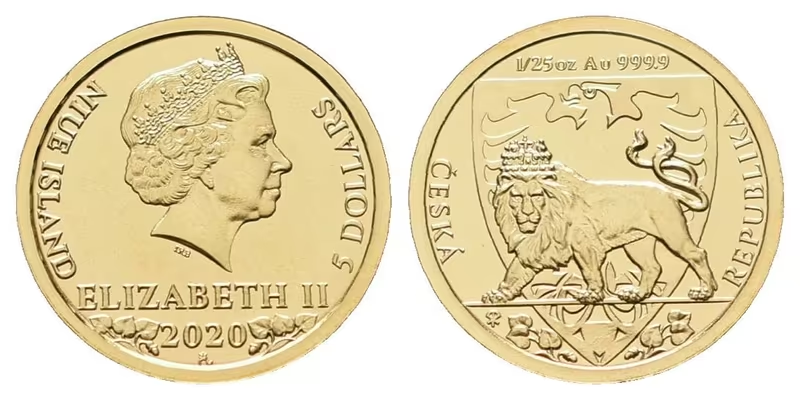
5 Dollars 2020 - Český lev, investiční mince
Česká republika (1993 - ) 5 Dollars 2020 (Asamat Baltaev) - Investiční mince Český lev Au 0,9999, 13 mm (1,24 g), 1/25 Oz Mince "Český lev" České mincovny se razí v zahraniční licenci již od roku 2017. Její cena závisí na spotové ceně zlata a je…