Act on the circulation of banknotes and coins
The Act on the circulation of banknotes and coins (No. 136/2011 Coll.) regulates the rules of how cash in circulation is handled in the Czech Republic, in particular banknotes and coins of the Czech koruna. It deals with protection against counterfeiting, the return of cash to circulation, and the exchange of worn and damaged money.
Act No. 136/2011 Coll. took effect on 1 July 2011 and replaced older regulations which dealt with the receipt and exchange of cash in fragmented form in decrees and partial rules. Its purpose was to unify into a single regulation the principles which are key for the functioning of cash circulation: how to recognise and withhold suspect banknotes and coins, how to ensure that invalid or unsuitable pieces are not returned to circulation, and what obligations the Czech National Bank and other subjects working with cash have.
An important part is constituted by protection against counterfeiting and tampering. The Act is based on the fact that trust in cash depends on the ability to filter out suspect pieces quickly. It therefore establishes a basic regime for handling suspect banknotes and coins: in ordinary dealings it is possible to refuse to accept them, however subjects that professionally process cash have, upon detecting a suspicion, the obligation to proceed in such a way that the suspect pieces are not returned to circulation and may be expertly checked.
The Act also deals with the "quality of circulation". Not every banknote or coin that is genuine is suitable for further use. Therefore concepts such as banknotes worn from circulation and banknotes or coins normally damaged and non-standardly damaged are used. Within this logic also fall the rules for sorting and processing cash at banks and other processors: cash is, before being returned to circulation, sorted by denomination and assessed for authenticity, validity and "circulation usability". The aim is that banknotes unsuitable for further circulation do not come back into people's wallets, and that circulation gradually "cleans" itself.
History
A very practical part of the Act concerns the exchange of cash. It determines that the Czech National Bank and banks performing cash operations exchange banknotes and coins for other denominations, exchange worn or normally damaged pieces for usable ones, and also enable the exchange of money declared invalid for the period set by the CNB rules. With damaged banknotes, it is assessed in particular whether they are whole, or whether they form a continuous whole and have sufficient area; non-standardly damaged pieces are in principle not exchanged, but the Act allows compensation in exceptional, justified situations (for example after a natural disaster or in connection with a criminal offence), typically on the basis of an application and case-by-case assessment.
Part of the system is also the setting of responsibility and expertise. The Act anticipates that a number of subjects not only receive cash but also "return it to circulation" (for example via tills, dispensing points or technical equipment). Therefore it requires that persons who assess authenticity and return cash to circulation should have professional knowledge proven by a certificate from a course focused on the recognition of counterfeits and altered pieces. In addition the Act gives the Czech National Bank a supervisory role and instruments for enforcing remedy if cash is processed in a manner that would endanger the quality or security of circulation.
For the ordinary person, the most visible part of the Act is the exchange of damaged banknotes and coins. If banknotes are only worn (dirty, crumpled) or normally damaged, they should be exchangeable for usable pieces without unnecessary delays. The Act also works with the option that instead of "cash exchange" the nominal value is transferred to an account, which is useful, for example, with a large amount of cash. With commemorative banknotes or commemorative coins, compensation is provided in ordinary circulating money, since commemorative issues are designed mainly for collector purposes.
What the Act regulates in practice
In relation to traders and institutions, the key rule is that suspect or invalid money must not be returned to circulation. Whoever sorts and processes cash must set procedures so that both counterfeits and tampered pieces, as well as pieces unsuitable for further use, are separated from circulation. From this also follow practical impacts: banks and processors have set sorting standards, work with control procedures, and in the case of detecting a suspicion proceed according to the rules for withholding and handing over for examination.
From the viewpoint of numismatics and notaphily, the Act has importance also as a "boundary between circulation and collecting". It determines what constitutes a domestic banknote and coin, how commemorative issues are handled, and what rules apply to money that no longer fulfils circulation criteria (for example is declared invalid but may still be exchangeable for a certain time). For everyday life, however, the main benefit is simple: a clear procedure for exchanging damaged money and a system which protects trust in cash by squeezing counterfeit, invalid and unsuitable pieces out of circulation.
In our auction and shop
- Code: ZD-2020LEV1
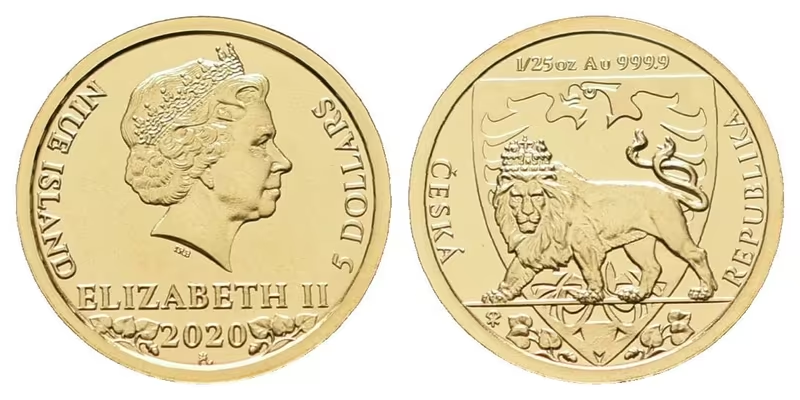
5 Dollars 2020 - Český lev, investiční mince
Česká republika (1993 - ) 5 Dollars 2020 (Asamat Baltaev) - Investiční mince Český lev Au 0,9999, 13 mm (1,24 g), 1/25 Oz Mince "Český lev" České mincovny se razí v zahraniční licenci již od roku 2017. Její cena závisí na spotové ceně zlata a je…