CNB
The CNB (Czech National Bank) is the central bank of the Czech Republic founded on 1 January 1993, which exercises oversight over the financial market, administers foreign exchange reserves and has the exclusive right to issue banknotes and coins of the Czech koruna. From a numismatic perspective, the CNB represents a key institution determining issuance…
The founding of the CNB was directly linked to the dissolution of Czechoslovakia. Preparations began in the summer of 1992 under the leadership of the economist Josef Tošovský, who assembled a team of experts to create a new central bank. The fundamental legislative framework became Act No. 6/1993 Coll. on the Czech National Bank, which defined its independence from political power — a revolutionary concept in the post-communist space.
Personnel continuity was ensured by taking over part of the staff of the State Bank of Czechoslovakia and its Prague branch. The CNB also inherited the historic building on Na Příkopě, built 1936–1942 according to the design of František Roith as the seat of the National Bank for Bohemia and Moravia. It thus symbolically continued the First Republic tradition of central banking interrupted by the communist regime.
The first Governor Josef Tošovský (1993–2000) had to address critical challenges — monetary separation, the banking crisis of 1996–1997 and the transformational recession. His greatest success was maintaining the stability of the koruna during a turbulent period when 15 banks went bankrupt. The introduction of inflation targeting in 1998 laid the foundations of modern monetary policy, which became a model for further transformational economies.
History
The era of Governor Zdeněk Tůma (2000–2010) brought preparations for entry into the eurozone, which were ultimately not carried out. The CNB successfully managed the global financial crisis of 2008 without the need for state aid for banks. Unique was the decision not to participate in EU rescue programmes, which strengthened the reputation of the Czech economy on international markets.
A controversial period came under Miroslav Singer (2010–2016), who pushed through foreign exchange interventions in 2013–2017. The unilateral exchange rate commitment keeping the koruna above 27 CZK/EUR was the largest intervention in the CNB's history — over 75 billion euros were purchased. Critics labelled the policy "monetary socialism"; supporters emphasised the prevention of deflation.
The current Governor Aleš Michl (from 2022) represents a conservative approach focused on rapid interest rate increases against inflation. His controversial management of gold reserves — the purchase of 19 tonnes of gold in 2023 — provoked debate about the role of precious metals in modern central banking.
Numismatic activity and issuance policy
The CNB has, by law, an issuance monopoly on the issuance of legal tender. Annually it approves a plan for commemorative coins, including 4–6 silver issues and 2–3 gold ones. Themes are chosen by the Commission for the Assessment of Designs for Czech Money, composed of historians, artists and numismatists. Artistic designs are created in anonymous competitions evaluated by an independent jury.
The portfolio of commemorative strikes includes four categories: standard silver (200 and 500 CZK), gold (5,000 and 10,000 CZK), bimetallic special and collector sets. Mintages range from 5,400 pieces for the gold ones to 50,000 for popular silver issues. The proof quality with polished surface and matt relief ranks among the European top.
A significant project is the Czech National Treasures series mapping UNESCO monuments since 2021. Innovative are technologies such as holographic elements, colour printing or embedded microchips. The CNB, as the first central bank, is testing NFT certificates of physical coins linking traditional numismatics with blockchain technology.
In our auction and shop
- Code: MCZ088-PROOFbzc
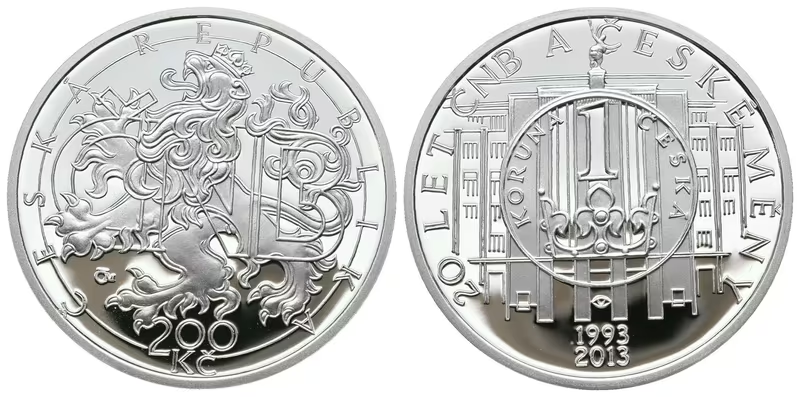
200 Kč 2013 - 20 let ČNB a české měny, PROOF - bez certifikátu
Česká republika (1993 - ) 200 Koruna 2013 - 20. výročí České národní banky a české měny, autor Vladimír Oppl, Aurea C188, etue, bez certifikátu, PROOF Ag 0,925, 31 mm (13 g), raženo 7 273 ks (běžná kvalita), 18 697 ks (proof)
Skladem 1 ks - Code: MCZS2013-PP-DREVO.1
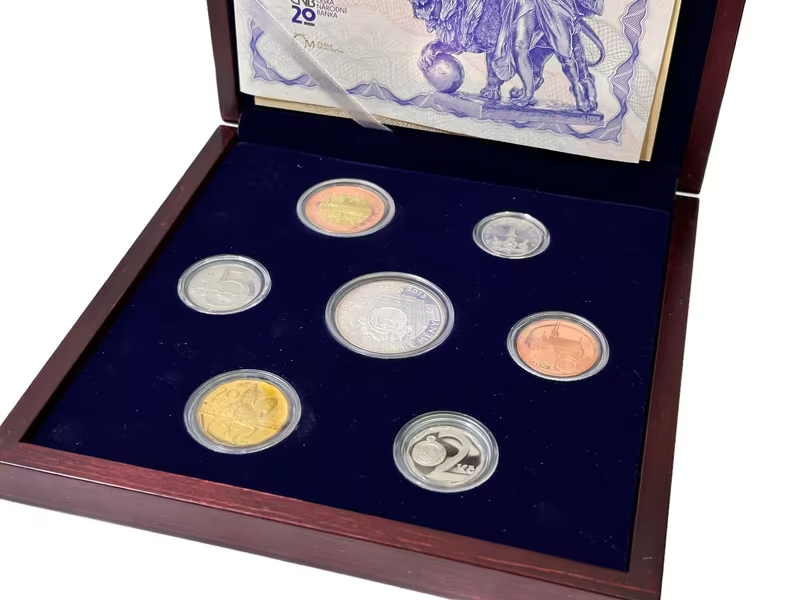
Ročníková sada mincí 2013 - 20 let ČNB, PROOF, dřevo
Česká republika, 1993 - Ročníková sada mincí 2013 - K 20. výročí ČNB a České měny. AR Medaile - 20 let ČNB a české měny. Ag 0,999, 34 mm (16 g), v ydáno 1000 sad, původní dřevěná etue mirně poškozená, certifikát a karta, PROOF kvalita
Skladem 1 ks - Code: MCZS2013
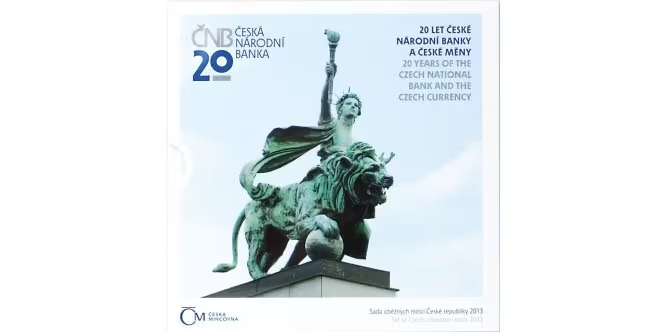
Ročníková sada mincí 2013- 20 let ČNB a české měny
Česká republika, 1993 - Ročníková sada mincí 2013 - 20 let České národní banky a české měny
Skladem 2 ks - Code: MCZ088-PROOF
200 Kč 2013 - 20 let ČNB a české měny, PROOF
Česká republika (1993 - ) 200 Koruna 2013 - 20. výročí České národní banky a české měny, autor Vladimír Oppl, Aurea C188, etue, certifikát, PROOF Ag 0,925, 31 mm (13 g), raženo 7 273 ks (běžná kvalita), 18 697 ks (proof)
Skladem (>5 ks)