Goldies (zlaťáky)
"Zlaťáky" (goldies) is a colloquial Czech designation for gold coins of various types and periods. In everyday speech people mean by it a "gold coin" in general - regardless of the exact denomination, country of origin or numismatic classification - from medieval ducats to modern investment coins.
Goldies do not designate one particular coin, but rather a popular way of speaking about gold circulation coinage and later also about collector or investment gold strikes. The term has naturally taken root in the setting in which gold long represented "hard" and intelligible value. While the names of individual coins have changed throughout history (ducat, gulden, koruna and a host of others), the very notion of a "gold coin" has remained always the same: it is something valuable, durable and easily exchangeable.
In the Middle Ages gold coins in the Czech lands and in wider Central Europe were associated above all with higher payments, trade and storing of property. A typical example are ducats, which, owing to their high fineness and relatively stable parameters, became an internationally recognised standard. In vernacular speech such coins were often not perceived according to the precise titulature of the sovereign or mint, but according to the material – a "goldie" was simply a gold piece that "has value".
In the modern period the range of gold coins further expanded. In various states there appeared gold denominations tied to monetary reforms and standards, and in the Habsburg setting, gold coins in the crown system later asserted themselves, for example. For ordinary speech, however, this often changed nothing: whether it was a ducat, a gulden or a gold koruna, people summed them up under one intelligible term. This is typical also for Czech and Slovak, where popular names often derive from the material or appearance, not from the official name.
History
In the 20th century the role of gold coins changed. Gold gradually disappeared from ordinary circulation and gold coins became rather a trading article, a means of hoarding and a collector's item. Nevertheless the colloquial term "zlaťáky" has been preserved – precisely because it is practical and intelligible even without knowledge of the denominations. Today a "zlaťák" may equally mean a historical ducat, an Austro-Hungarian gold strike, but also a modern bullion investment coin, if it is of gold and a person perceives it as a bearer of value.
Goldies can encompass a wide range of strikes. Among historical coins it is often a question of ducats and their multiples, or of other gold denominations of the early modern period. Among Habsburg and later strikes, this expression commonly refers also to gold coins of the crown system. In modern times investment coins are also colloquially designated in this way, which have a standardised weight and fineness and are traded mainly according to gold content.
If you want to be clear, with a "zlaťák" it is always good to find out three basic things: whether it is really a coin (has an issuer and a denomination), what its fineness and weight are, and whether it is an ordinary circulation strike, a commemorative coin or an investment bullion. Precisely these differences have the greatest influence on the price and on collector appeal. With some gold coins the collector value can be substantially higher than the value of the gold itself; at other times the price holds, on the contrary, close to the metal value.
What all "goldies" can mean and how to tell them apart
In practice it is also worth being cautious with gilded or "gold-looking" objects. The popular designation "zlaťák" tempts one to apply it to them, but numismatically and from an investment point of view they are not the same. With genuine gold coins the basic guide is usually a clearly stated denomination, fineness (for example in thousandths) and trustworthy provenance. When these basic facts come together, "zlaťák" is not only a fine popular term but also quite a precise description of something that in history has held extraordinary weight: gold in the form of a coin.
In our auction and shop
- Code: SCOOK90-X2011
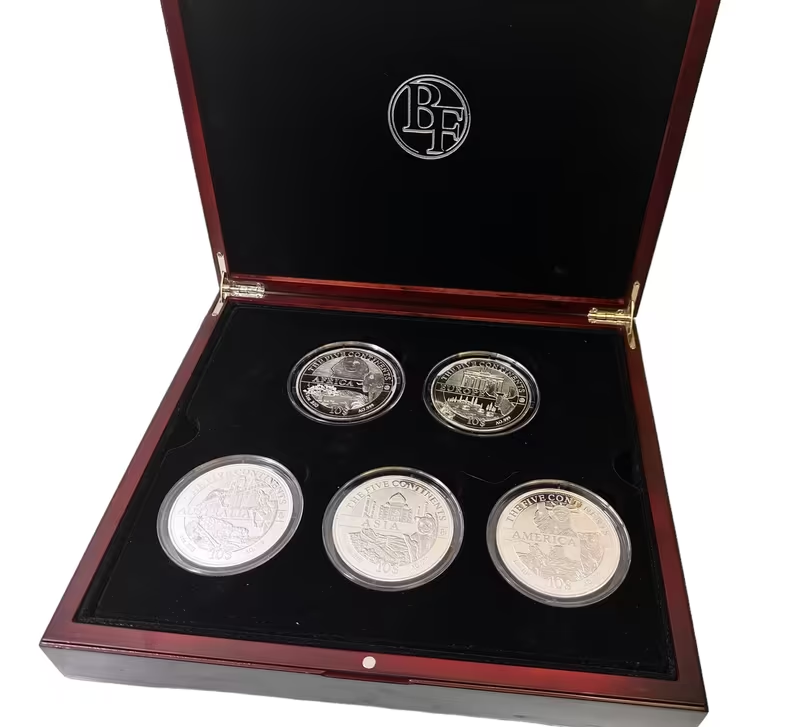
Cook Islands, Big Five - sada stříbrných mincí Pět Kontinentů
Cookovy Ostrovy (Cook Islands) 10 Dollars 2011 - Big Five - Pět kontinentů světa, největší unce světa Ag 0,999, 65 mm (31,1 g), 1 Oz, Proof, dřevěná etue, certifikáty, celkem 5 ks Afrika Afrika je třetí největší kontinent po Asii a Americe s celkovou…