12 Kreuzer
The 12 kreuzer, or twelve-kreuzer piece, is a silver coin which appeared in the Czech lands particularly in the turbulent years 1619–1623 and later briefly again at the end of the 18th century. It arose as a middle denomination of the kreuzer system and its striking was connected with the monetary interventions of the time.
The 12 kreuzer was introduced by the Bohemian estates in the period of the Estates Uprising as part of an effort to adjust the coinage system and to ensure a sufficiency of usable silver circulating coinage. The key moment was the coinage instruction of 15 June 1619, which introduced this denomination with a prescribed weight of 4.66 g. The pictorial decoration was practically identical to that of the 24 kreuzer, which was no coincidence: in the midst of rapid changes in circulation it was advantageous to maintain a unified 'visual language' of the denomination series and to distinguish the value rather by size and legible elements than by an entirely new motif.
Striking began in several mints at once. In Bohemia the 12 kreuzer was struck in Prague in 1619 (mintmaster B. Hübmer), in Kutná Hora likewise in 1619 (mintmaster Š. Hölzl) and in Jáchymov in 1619–1620 (mintmaster C. Lengefelder). This very network of mints shows that this was not a marginal experiment but a denomination intended for real circulation, which was to supplement the monetary system at a time when both the economy and politics were coming under enormous pressure.
An interesting difference was found in the Moravian strikings. In Moravia the heraldic logic changed for the same denomination: on the obverse, instead of the Czech lion, the Moravian eagle appeared, and on the reverse there was usually a pyramid entwined with grapevine, a motif known also from the 24 kreuzer. This too is a practical detail for collectors: the same value but a different coat of arms of the land allows quick distinction of the origin of the coin. Moravian twelve-kreuzer pieces were struck in Brno (1619–1620; mintmaster H. Petz) and in Olomouc (1619–1620; mintmaster K. Cantor, later B. Zwirner).
Shortly afterwards the denomination also appears in another political stage. Under Frederick of the Palatinate (1619–1620) the 12 kreuzer was struck in Prague and in Kutná Hora in 1620 and on the obverse the portrait of the ruler appears. The visual transformation – the transition to a portrait coin – captures well a time when strikings became also an instrument of legitimacy: the coin was not only a means of exchange but also 'portable propaganda' and a symbol of rule.
History
The further development is already connected with the sharp deterioration of monetary conditions. Under Ferdinand II the striking of some denominations was granted to the de Witte consortium, known from the period of the so-called long coin. The twelve-kreuzer piece of 1621 also belongs here, which is described as a poor-quality striking with a markedly lower weight of around 2.09 g. For circulation this meant a fundamental problem: when the quality deteriorates quickly and the real value changes, distrust grows and people begin to refuse coins, to hoard better-quality pieces or to demand conversions and surcharges.
In 1623 the 'good coin' was introduced and with it the striking of twelve-kreuzer pieces was discontinued. From the point of view of numismatics this is a typical example of how monetary order reacts to a crisis: some denominations, particularly those associated with problematic issues, are preferably withdrawn and the system is simplified so that it is once again legible and trustworthy.
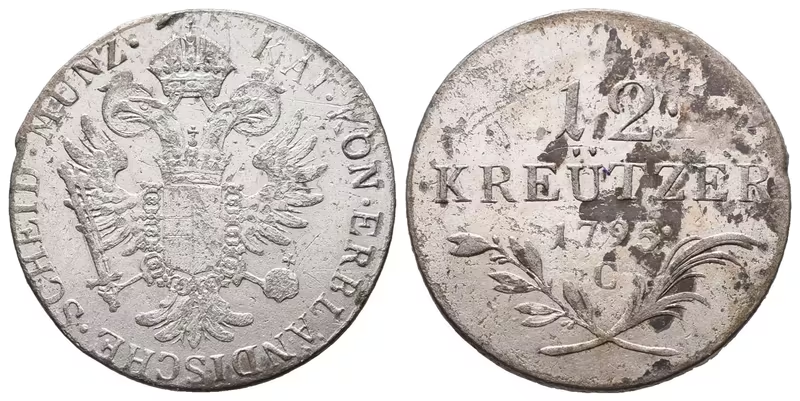
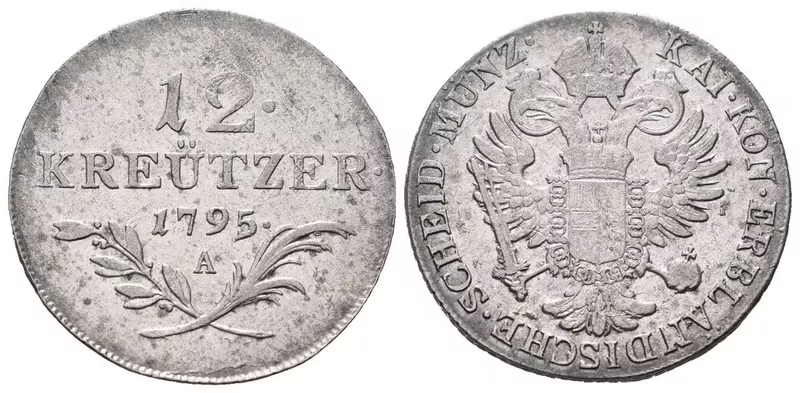
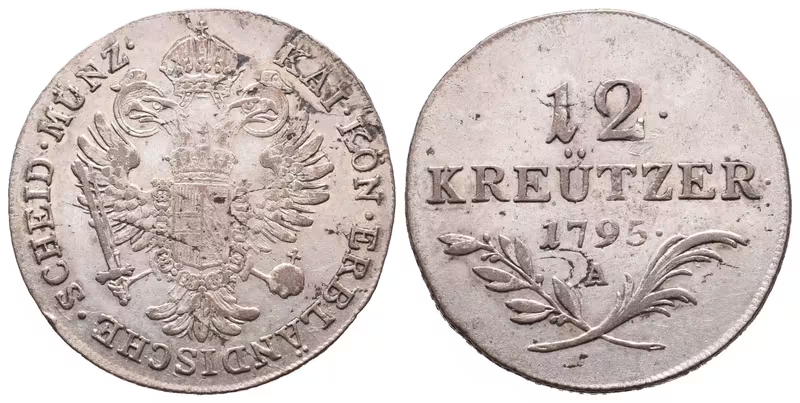
Much later the 12 kreuzer once more appeared in the Czech lands. It was renewed by an instruction of 20 April 1795 under Francis II in Prague, this time with a weight of 4.64 g and with the year 1795 (mintmaster I. Kendler). It was, however, a short episode: the same ruler by a decree of 15 August 1801 ended the striking of the silver twelve-kreuzer piece and it was not renewed in the Czech lands. This shows well that some denominations had a 'double life' in history – once as a product of a crisis period, another time as an attempt to supplement circulation in a different system – but did not maintain themselves in the long term.
The 12 kreuzer is a denomination for which the context of the striking is exceptionally important for collectors. The first issues of 1619 had a prescribed weight of 4.66 g and a pictorial content very close to that of the 24 kreuzer. In practice this means that when determining one should follow particularly the heraldry (Czech lion versus Moravian eagle), the composition of the reverse and small differences in the legends and marks, which may distinguish the individual mints (Prague, Kutná Hora, Jáchymov, Brno, Olomouc). It is precisely the variety of mints that makes the twelve-kreuzer piece a rewarding subject for a 'mint' collection, where the same denomination is arranged by origin.
Form, parameters and collector significance
A major theme is the quality of striking and silver. With the standard estate issues a relatively more honest parameter is to be expected, while strikings connected with the crisis years of the early 1620s may be problematic. The twelve-kreuzer piece of 1621 authorised within the de Witte consortium environment, described as poor-quality and at the same time substantially lighter (around 2.09 g), is particularly distinct. For the collector this is not just a 'deviation' but a clear trace of the monetary crisis: the difference in weight and in the trustworthiness of the coin is itself a historical message.
Another collector-attractive group are the strikings with the ruler's portrait of 1620 under Frederick of the Palatinate. Portrait types tend to be sought after because they are visually distinctive and often link well with a specific political episode. In their assessment a great role is played by state of preservation: the portrait and the fine details of the hair, the garment and the legends are quickly lost on circulating silver coins, and therefore fine pieces appear markedly 'collector-grade'.
The modern renewal of 1795, by contrast, is a short but clearly delimited chapter. For collectors it is clear because it ties to a single Prague issue with a given year and weight of 4.64 g. The discontinuation of striking in 1801 at the same time makes it a denomination which did not 'dissolve' into an endless series of years but remained a closed whole. The twelve-kreuzer piece thus offers an interesting contrast: on the one hand a varied set of mints and variants in the years 1619–1621, on the other a brief 'late' episode of the end of the 18th century. It is precisely this duality which gives the denomination collector depth beyond the value expressed by the number alone.
In our auction and shop
- Code: M92065-1795C
František II., 12 Krejcar 1795 C
František II. (1792 - 1835) 12 Krejcar 1795 C, Praha, Ves.65, patina, rysky
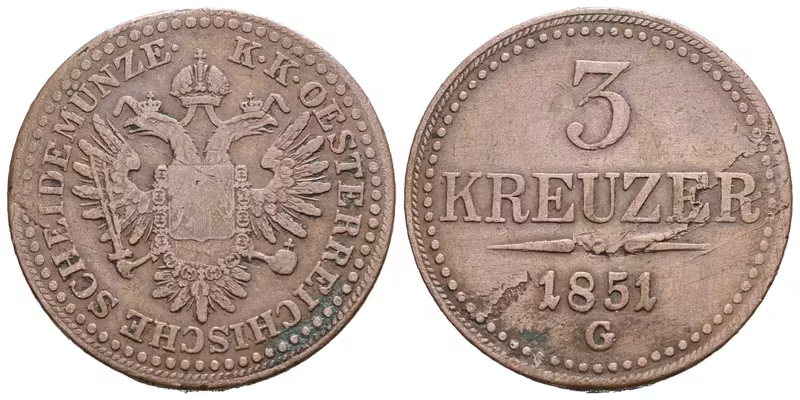
Skladem 1 ks - Code: MA012-1851G.2
3 Krejcar 1851 G
František Josef I. (1848 - 1916) 3 Krejcar 1851 G - Velká Baňa, Ves. 12, patina, vady střížku
Skladem 1 ks - Code: M92BAO1795A
- Code: M92065-1795A
František II., 12 Krejcar 1795 A
František II. (1792 - 1835) 12 Krejcar 1795 A, Ves.65, pěkná zachovalost, patina, zbytky lesku, vady stříže