Aquileia mint
The Aquileia mint was an imperial mint of the late Roman Empire operating in the city of Aquileia in northern Italy. Its strikes belong among the typical currency of the 4th–5th centuries and are important both for the study of Roman state administration and for collectors, because they can be identified more precisely by mint marks.
The Aquileia mint arose in the environment of late antiquity, when the Roman state sought to manage its economy and defence more flexibly. Northern Italy was a strategic area: it lay near the Alpine passes and communications to the Danube area, and military corps and administrative apparatus therefore often operated here. Where troops and state administration concentrate, the need for reliable currency for pay, supply and tax collection grows as well. The establishment or strengthening of mint operations in Aquileia thus made practical sense.
In the late Roman period the network of mints expanded and transformed according to where money needed to be struck and distributed quickly. The mint was not just a "coin workshop" but an instrument of the state: it made it possible to convert revenues into monetary form, finance military expenditure and at the same time spread the official image of imperial power. Aquileia, as an important city of the north with good connections to both commercial and military routes, was well suited to this role.
The operation of the mint must also be understood in the context of transformations of the Roman monetary system. In the 4th century several denominations were in use in circulation and the state sought to maintain a system that would cover both large payments and the everyday market. Mints therefore worked in various metals and with various types. In practice, the currency struck in Aquileia was mainly intended for wide circulation, and thus for actual "life" in the provinces — not just for representation in the centre.
History
The importance of Aquileia and its minting changed over time according to the political situation. Late antiquity brought periods of crises, troop movements and pressures on the borders, so the mint may have been exceptionally busy in some years, and on the contrary restricted in others. The end of the ancient flowering of the city is linked with the war upheavals of the 5th century, which struck northern Italy. Even so, the strikes from Aquileia remain one of the most tangible pieces of evidence of how state power tried to maintain a functioning economy even at a time when the Roman world was transforming.
The Aquileia mint is attractive for collectors mainly because late Roman coins usually bear a mint mark in the exergue on the reverse (the lower part of the reverse). This mark precisely is what makes it possible to distinguish Aquileia from other mints which could strike the same types for the same emperor. Besides the mark itself, letters designating workshops often appear, because mints worked in several operations and the state needed control over both production and quality.
Typical are bronze and copper strikes intended for circulation, often with an imperial portrait on the obverse and with motifs that were to strengthen the authority of the state — victory, security, prosperity or military strength. With these coins the legibility of the legends and especially of the exergue is essential: precisely there is the information that decides the correct identification of origin. Given hand-striking, offset of the blow is common, so it may happen that the mint mark is only partly visible; well-centred pieces are therefore usually valued more.
Strikes, marks and identification of coins
For bronze coins from Aquileia the state of the surface is also important. A natural patina can be aesthetically very attractive and at the same time protects the relief, while harsh cleaning often damages fine details and worsens identifiability. If you collect late Roman coins systematically, Aquileia strikes can be well classified into series by emperor, reverse types and workshop variants. It is precisely the combination of the historical significance of the city and the "legibility" of mint marks that makes the Aquileia mint a popular collecting subject.
In our auction and shop
- Code: SITAAQI-A1402
Itálie - Aquilea, Denár b.l.
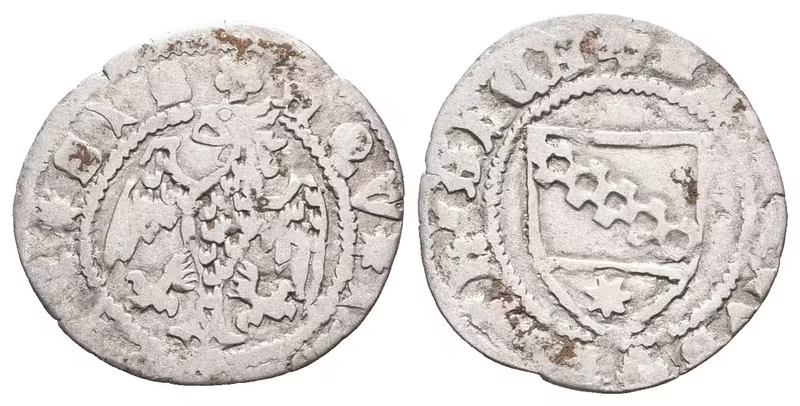
Itálie - Aquilejský patriarchát, Antonio II. Panciera, 1402 - 1412 Denár b.l., Rodový znak ve štítu, opis / Orel hledící vlevo, opis. Bernard.67 (0,58 g), patina, excentrický
Skladem 1 ks - Code: SITAAQI-A1402.1
Itálie - Aquilea, Denár b.l.
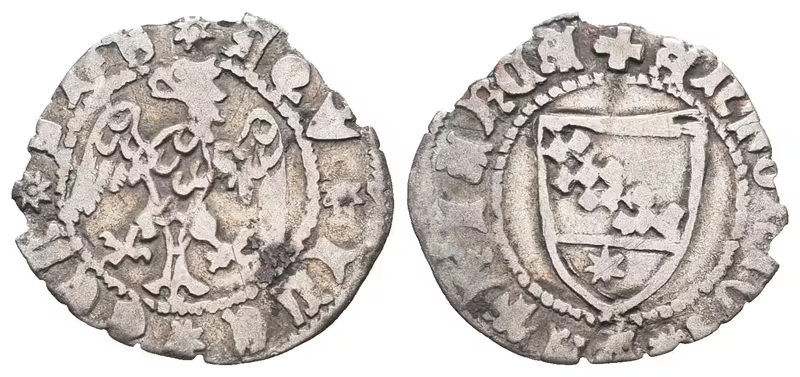
Itálie - Aquilejský patriarchát, Antonio II. Panciera, 1402 - 1412 Denár b.l., Rodový znak ve štítu, opis / Orel hledící vlevo, opis. Bernard.67 (0,51 g), patina, lehce olámaný
Skladem 1 ks - Code: SITAAQI-A1412
Itálie - Aquilea, Denár b.l.
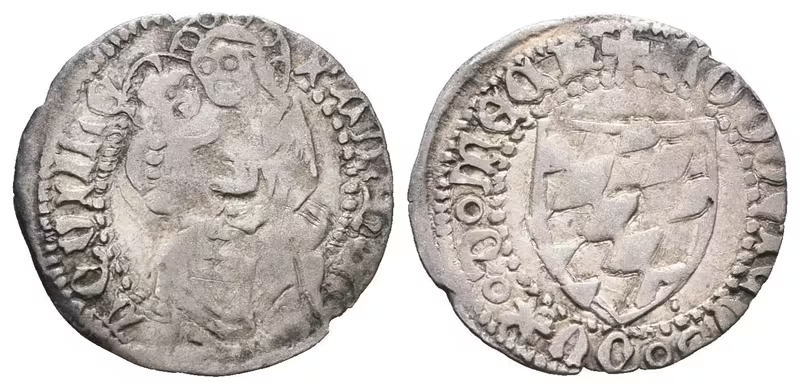
Itálie - Aquilejský patriarchát, Ludwig von Teck, 1412 - 1420 Denár b.l., Madonna s jezulátkem na trůně, opis / Znak vévodů z Teck, opis. Bernard.69 (0,56 g), patina, nedoražený
Skladem 1 ks