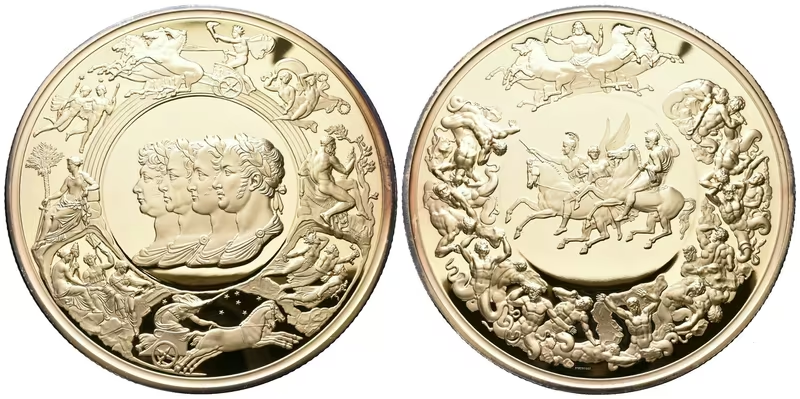
Battle of Waterloo
The Battle of Waterloo was a decisive battle on 18 June 1815 in present-day Belgium, in which coalition armies led by Arthur Wellesley, Duke of Wellington, and the Prussian army of Gebhard Leberecht von Blücher defeated the army of Napoleon Bonaparte. It ended his "hundred days" and fundamentally changed European power relations.
After Napoleon's first abdication in 1814 and his departure for the island of Elba, the European powers sought to restore the stability disrupted by the long wars. The Congress of Vienna deliberated a new arrangement of the continent, but Napoleon returned to France in March 1815 and quickly regained power. This period, known as the "hundred days", provoked an immediate response from the coalition, which decided to end Napoleon's return by military means.
Napoleon's aim was to defeat the coalition armies before they could fully unite. In the space of present-day Belgium two key forces stood opposed: the British-Dutch-Hanoverian army under the command of the Duke of Wellington, and the Prussian army led by Blücher. Napoleon attempted to separate the two armies and destroy them in sequence, and so he opened a campaign into the Netherlands and first fought the engagements at Ligny and Quatre Bras.
The decisive clash came near the village of Waterloo, where Wellington chose a defensive position on a gentle ridge and relied on several key points, in particular farmsteads and walled enclosures that could be defended even against heavy cavalry. The fighting lasted the whole afternoon and was exceptionally tough: French infantry attacked in several waves, the cavalry made repeated charges, and the decisive role was played by the defenders' ability to maintain cohesion under pressure.
History
The turning point came when Prussian units appeared on the battlefield in greater numbers. Napoleon had to divert part of his forces against them, and once the coalition pressure combined, the French army began to lose the initiative. In the evening followed a decisive attack which led to the disintegration of the French units and to a retreat that quickly turned into a panic-stricken collapse. The defeat meant the end of Napoleon's final power episode.
After Waterloo Napoleon abdicated again and soon found himself in British captivity. The subsequent removal to St Helena, where he died in 1821, closed one of the most striking chapters of European history. Politically the battle confirmed the restoration of the coalition system and strengthened the post-war arrangement, which was to secure for Europe a balance of power. In the memory of the continent, Waterloo became a symbol of the definitive "turning point", the moment when the fate of an epoch was sealed in a single day.
Waterloo is recalled to this day as a place where strategy, perseverance and the timing of reinforcements met. In practice a rich tradition of commemorative objects has formed around the battle, which is of interest also to collectors. A special place is held by the British Waterloo Medal, awarded to participants in the campaign (issued shortly after the wars), which is regarded as the first widely awarded campaign medal of the British army. Alongside decorations, commemorative medals and tokens also arose, often with portraits of the main commanders, allegorical motifs or with depictions of the battlefield.
Memory of the battle and collector connections
Numismatically, the motif of Waterloo is also projected into later commemorative issues: anniversary medals, themed series and collector strikes have arisen in various countries repeatedly, especially on round anniversaries. For collectors it is important to distinguish contemporary objects (early 19th century) from modern commemorations. With contemporary medals and decorations, authenticity, condition, any edge with inscription or name, and above all documented origin play a fundamental role. With modern strikes, on the contrary, material, mintage, designer and quality of execution are evaluated.
If you wish to have "Waterloo in your collection", you may choose several paths: decorations and medals associated with participation in the campaign, contemporary commemorative medals or modern issued strikes. Each category has a different price range and different risks (for example later imitations or restrikes), so it pays to rely on expert description and transparent provenance.
In our auction and shop
- Code: RX-VEL2015
Velká británie - Bitva u Waterloo
Velká Británie AE Medaile 1815 - 2015 (B. Pistrucci) - Medaile na památku bitvy u Waterloo Bronz zlacený ryzím zlatem 88,9 mm (cca 400 g), číslováno na hraně, brožura s certifikátem a popisem bitvy, vojevůdci, historie vzniku medaile, etue, papírový…
Skladem 1 ks