Byzantine mint
The Byzantine mint refers to the state mint production of the Byzantine Empire, whose main centre was Constantinople and which was supplemented by provincial mints as the need arose. It is renowned especially for its stable gold currency and its distinctive Christian symbolism on coins.
The Byzantine mint built on late Roman minting and for centuries belonged among the most important pillars of state power. The Eastern Roman (Byzantine) Empire needed reliable currency for the collection of taxes, the payment of the army and international trade. A key role here was played by gold: as early as the 4th century, Constantine I the Great introduced the gold solidus, the weight of which remained extraordinarily stable for a long time and made the Byzantine gold coin a trusted unit for the entire Mediterranean world.
Alongside gold, copper currency was essential for everyday life. A fundamental change was brought by the reform of Anastasius I, who in 498 reorganised the bronze coinage into an intelligible system and introduced large denominations marked with value-letters. The best known is the follis with a large "M" as the mark for 40 nummi. This step facilitated small-scale payment and gave Byzantine bronzes their typical appearance, by which they are easily recognisable even today.
The main mint was Constantinople, where coins were struck in all the main metals, but at various periods the empire also operated provincial mints. Their number and location changed according to the military situation, the availability of metal and administrative needs. In the 6th century a wider circle of active mints is attested, while in subsequent centuries part of the provincial workshops ceased to exist as a result of invasions and the loss of territory. The minting network thus sensitively reflected the condition of the state: when the empire expanded or stabilised a region, new operations arose; when it retreated, the mint network was reduced.
History
In the long term, Byzantine coinage was marked by an effort to maintain confidence in gold, but in some periods problems with fineness and exchange ratios appeared. A significant turning point was the monetary reform of Alexius I Comnenus in 1092, when the gold hyperpyron coin was introduced and the entire system was rebuilt in order to regain stability. From this time onwards, the characteristic cup-shaped (concave) coins, which are typical of the middle and late Byzantium, also became more prominent within Byzantine currency.
No less important was symbolism. While late Roman coins followed imperial iconography of the ancient type, Byzantine strikes increasingly emphasised Christian motifs. Crosses, religious inscriptions, and later also depictions of Christ and the saints appear on the coins. The mint was therefore not merely a "money factory" but also a medium of state ideology: every piece of currency carried the image of legitimate power and religious order.
The Byzantine mint worked with a strict notion of standard: for gold, weight and fineness were important, for bronze, legibility of the denomination. On many bronze coins, the large letters on the reverse help quickly to recognise the value (for example, "M"). Marks of the mint and of the workshop (officina) are also common and make it possible to determine the place of striking and sometimes also the specific production "unit" within the mint. This is precisely why Byzantine bronzes are so rewarding for the study of mint organisation.
Production, marks and characteristic features of Byzantine coins
For the identification of a type, one observes the emperor's portrait and titulature, the reverse motif, the value mark and possibly the mintmark. With the gold solidi and their successors, it also matters whether the coin belongs to a period of stable fineness or to a time when the system was changing and a greater number of denominations and alloys appeared. Given the long duration of the empire (330–1453), Byzantine coinage is very varied: from "classically" looking early strikes to late concave coins with markedly stylised iconography.
Byzantine coins are also a significant source for the history of art and religion. Christian motifs on currency show how state representation changed and how the visual language of power was transformed. It therefore makes sense to perceive the Byzantine mint not only technically but also culturally: every denomination is a small document of how the empire wished to project itself to its subjects and to foreign partners.
In our auction and shop
- Code: XB1300-10
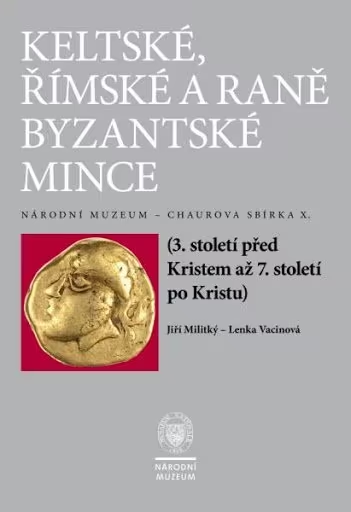
Chaurova sbírka - Keltské, římské a raně byzantské mince
Jiří Militký, Lenka Vacínová Keltské, římské a raně byzantské mince (3. století před Kristem až 7. století. po Kristu ) Praha 2012, 208 stran, vázané Další svazek obsáhlé a ambiciózní ediční řady zasvěcené odborné prezentaci jedinečné numismatické…