Charles IV of Spain
Charles IV of Spain was a Spanish king of the House of Bourbon who reigned in the years 1788–1808. His era is associated with the upheavals of the Napoleonic Wars and with a significant coin output, since Spanish silver and gold carried exceptional weight in the world trade of that time.
Charles IV of Spain ascended the throne at the end of the 18th century, when Europe was rapidly changing under the influence of revolutionary and Napoleonic events. Spain was still a power with an extensive colonial backdrop, but at the same time it faced internal weaknesses: tensions in administration, dependence on foreign policy and a complex economic situation. In this period, the question of who really ran the state grew in significance — alongside the king, strong ministers and court groups also acted, influencing the country's direction.
The key theme of Charles's reign was the response to revolutionary France and later to Napoleon's expansion. Spanish policy at various stages leaned towards alliances which, however, did not lead to long-term stability. The wars burdened the finances and increased pressure on the supply of metal, provisioning and the administration of the empire. It is precisely in such periods that the importance of currency is well demonstrated: the state needs functioning currency for taxes, payments and trade, while at the same time trying to maintain confidence in metallic money.
History
In 1808 a fundamental turning point occurred. In a dynastic crisis and under the pressure of Napoleon's policy, Charles IV abdicated, and events ended in occupation and the long conflict known as the Peninsular War. Spanish society became polarised and the question of legitimacy came to the fore: who was the legitimate ruler and who represented the state. These disputes also had practical consequences for monetary circulation, because in times of crisis regional differences arise, emergency issues appear and varying degrees of control over the mints develop.
For economic history, Charles's era is also interesting because the Spanish colonies were the source of huge quantities of silver, which flowed into Europe and into Asia. Spanish coins were therefore not merely a "national" tender but part of a global circulation. This explains why strikes bearing the portrait of Charles IV are found in hoards far from Europe and why they are important also for the wider history of world trade.
Charles IV's coins and what affects their price
Charles IV of Spain appears on coins above all in portrait form, typical of modern monarchies in which the head of the ruler is the main bearer of legitimacy. With Spanish strikes it is practical to track the denomination, mint and year, since both Spain and its overseas territories had several production centres. For the collector, the state of preservation is also key: the sharpness of the hair and features, the legibility of the legend and the quality of the edge in denominations where edge decoration was used as protection against clipping.
With silver and gold coins, the price is usually composed of two elements: the value of the metal and the collectors' premium, which is determined by rarity, demand and condition. With more common types, the state of preservation may be decisive, while with rarer year-marks or mints, even small details in the legend and marks may matter. Spanish coins of this era are also attractive to investors and collectors, since they combine historical significance with the tangible value of the precious metal.
In our auction and shop
- Code: SSPAN90-B1800MZ
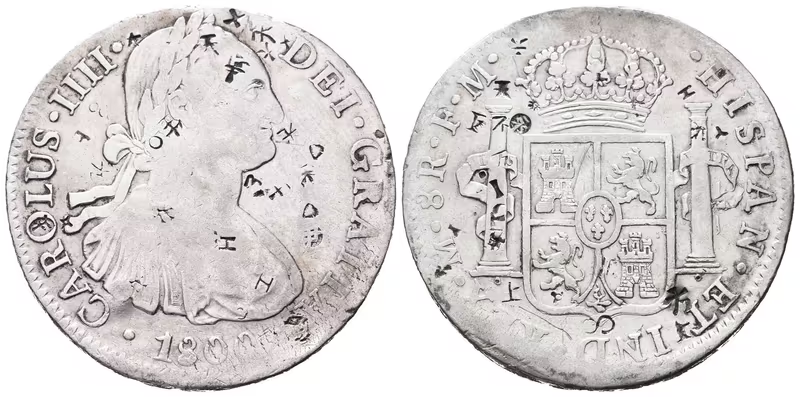
Španělsko, 8 Real 1800 FM
Španělsko, Carlos IV., 1788 - 1808 8 Reales 1800 FM, Mexico, KM.109, patina, škr. a hranky, Asijské kontramarky v ploše (Chopmarks), zajímavé! Španělské 8 Realy byly vyhledávaný a oblíbenými platidly v oblasti nového světa. Bylo to především pro stálost…
Skladem 1 ks - Code: SSPAN90-D1798S
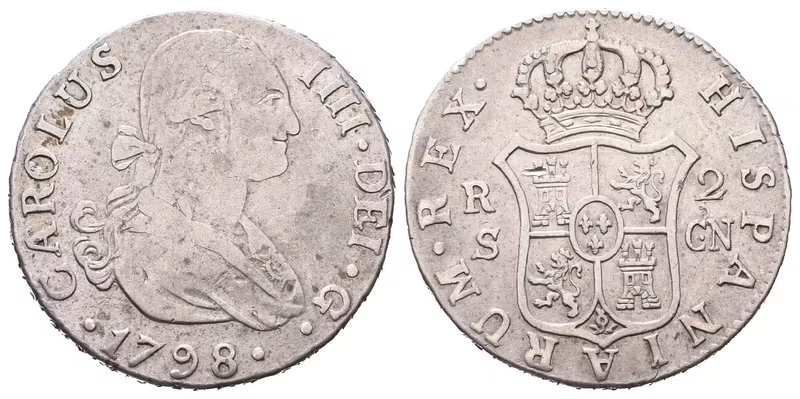
Španělsko, 2 Real 1798 S-CN
Španělsko, Carlos IV., 1788 - 1808 2 Reales 1798 S-CN, Sevilla- de Roxas a N. Lamas , KM.430, pěkná zachovalost a patina, drobné rysky, oběh
Skladem 1 ks - Code: SSPAN90-D1807M
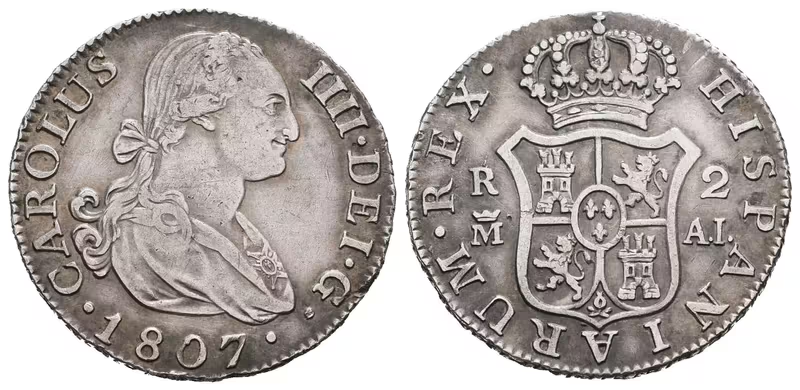
Španělsko, 2 Real 1807 M-AI
Španělsko, Carlos IV., 1788 - 1808 2 Reales 1807 M-A.I., Madrid-Goycoechea Urquiza, pěkná zachovalost a patina, drobné rysky
Skladem 1 ks - Code: SSPAN90-B1792MZ
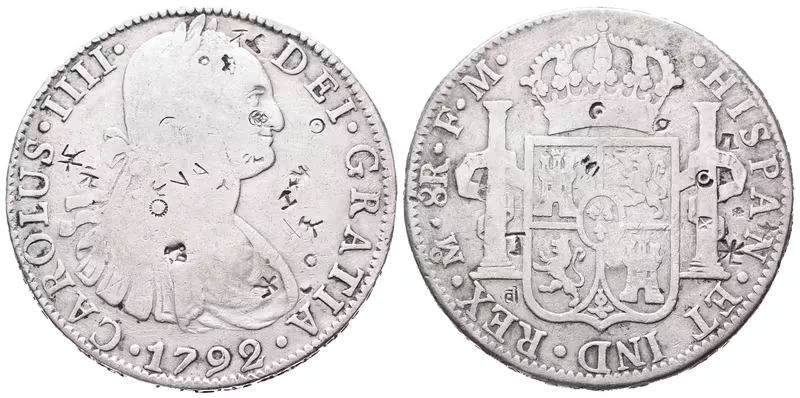
Španělsko, 8 Real 1792 FM
Španělsko, Carlos IV., 1788 - 1808 8 Reales 1792 FM, Mexico, KM.109, pěkná zachovalost, patina, škr. a hranky, Asijské kontramarky v ploše (Chopmarks), zajímavé! Španělské 8 Realy byly vyhledávaný a oblíbenými platidly v oblasti nového světa. Bylo to…