Kingdom of Denmark
The Kingdom of Denmark is a Northern European kingdom that has existed since the 10th century to the present day; at the height of its power it ruled an extensive territory comprising present-day Denmark, Norway, Sweden, Iceland, Greenland and parts of the German lands. The Kingdom of Denmark is significant in numismatics thanks to its long-standing coina…
The Kingdom of Denmark arose during the 10th century with the unification of the Jutish and Danish tribes under the rule of the House of Gorm. The first historically recorded king was Gorm the Old, whose son Harald Bluetooth (958–986) completed the unification of the Danish territories and accepted Christianity. Harald's runestone at Jelling is regarded as Denmark's "baptismal certificate", on which the king proclaims his conversion and the unification of the Danish and Norwegian people.
The golden age of Danish power was the 11th century during the reign of Cnut the Great (1018–1035), who created a northern empire encompassing Denmark, England, Norway and parts of Sweden. Cnut's empire was the largest northern state formation of the early Middle Ages and controlled the important trade routes of the Baltic and the North Sea. After Cnut's death the empire fell apart, but Denmark retained its position as a significant Northern European power.
In the 12th and 13th centuries Denmark enjoyed a period of internal consolidation during the reign of the Valdemars. Especially Valdemar I the Great (1157–1182) and Valdemar II the Victorious (1202–1241) extended Danish dominion to the Baltic lands and northern Germany. This period is referred to as the "Danish eastward expansion", when the Danes founded towns and spread Christianity in the Baltic region.
The Kalmar Union (1397–1523) represented the peak of Danish power in Scandinavia. The Danish Queen Margaret I united under Danish leadership all three Northern European kingdoms — Denmark, Norway and Sweden. The union lasted more than a century, though it was often disrupted by Swedish attempts at independence. It came to a definitive end in 1523 with the accession of Gustav Vasa to the Swedish throne.
History
The 16th and 17th centuries were characterised by rivalry with Sweden for supremacy in the Baltic. Denmark waged a series of wars against the growing Swedish power, but gradually lost territories. The Swedes conquered the important Danish provinces of Skåne, Halland and Blekinge, while Denmark retained Norway and its German holdings in Holstein.
The 18th and 19th centuries brought the gradual modernisation of Denmark. The country went through agricultural reforms, the introduction of absolutism and later constitutional monarchy. To a significant degree it engaged in colonial trade through the Danish West India Company. The Napoleonic Wars, however, meant the loss of Norway in favour of Sweden in 1814.
Modern Denmark emerged after the constitutional changes of 1849, when absolute monarchy was abolished and parliamentary democracy introduced. The country was transformed from a predominantly agricultural state into an industrialised Nordic social democracy. Today Denmark is a prosperous European country with a constitutional monarchy and a developed social system.
Danish coinage has a tradition of more than a thousand years, reaching back to the early 11th century. The first Danish coins were struck by King Sweyn Forkbeard around 995–1000 on Anglo-Saxon models, which he brought from his English campaigns. These early coins were silver pennings with Christian symbols and royal names, which replaced the older barter system.
Danish coinage
In the 12th and 13th centuries Denmark became the centre of Nordic bracteate coinage. Bracteates were thin silver coins struck from only one side, distinguished by rich iconography including royal portraits, heraldic symbols, religious motifs and mythological creatures. Danish bracteates belonged among the most beautiful medieval coins of all and influenced the coinage of the whole Northern European region.
The Renaissance period brought the introduction of large silver coins — thalers and their multiples. The Danish kings struck representative coins with their own portraits and state symbols, which served not only as currency but also as a means of royal propaganda. Especially under Christian IV (1588–1648) Danish coinage achieved a high artistic level with precisely executed portraits and allegorical motifs.
Modern Danish coinage built on these historical traditions. The Danish krone, introduced in 1873 as part of the Scandinavian Monetary Union, is still in use today. Contemporary Danish coins preserve traditional motifs including royal portraits and national symbols, combining historical continuity with modern striking technology.
In our auction and shop
- Code: RX-Z-012
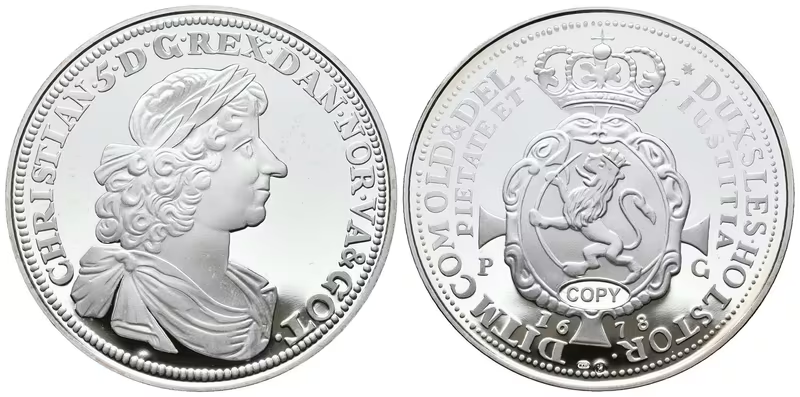
Dánsko, Speciedaler 1678 - Portrét panovníka / Korunovaný dánský lev, replika
Dánské království - Kristián V. (1670-1699) Speciedaler 1678 - Portrét panovníka / Korunovaný dánský lev Ag (.999), 40 mm (20 g), v kapsli. Stav mince odpovídá fotografii.
Skladem 1 ks - Code: RX-Z-013
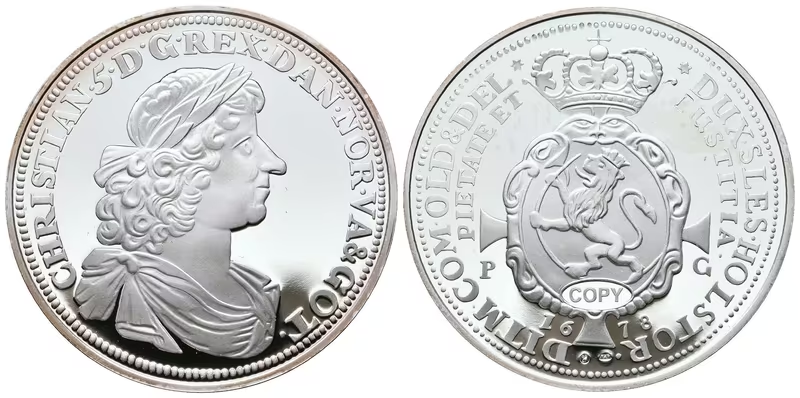
Dánsko, Speciedaler 1673 - Portrét Christiana V., dánský státní znak, replika
Dánské království - Kristián V. (1670-1699) Speciedaler 1673 - Portrét Christiana V., dánský státní znak Ag (.999), 40 mm (20 g), v kapsli. Stav mince odpovídá fotografii.
Skladem 1 ks - Code: RX-Z-022
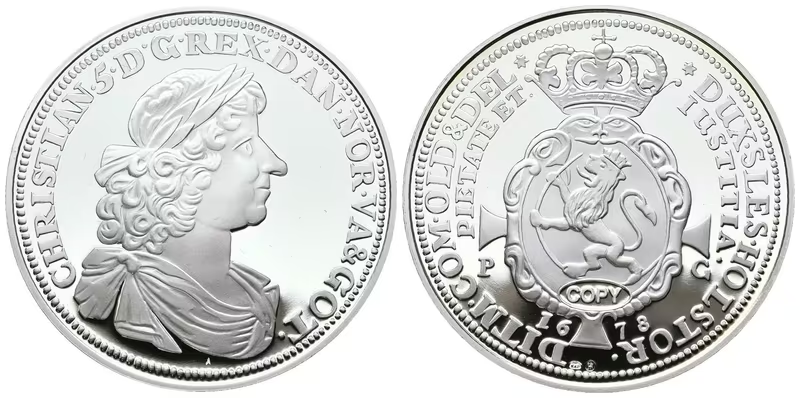
Dánsko, 1 Speciedaler 1678 - Portrét Kristiána V. / Korunovaný dánský erb se lvem, replika
Dánské království - Kristián V. (1670-1699) 1 Speciedaler 1678 - Portrét Kristiána V. / Korunovaný dánský erb se lvem Ag (.999), 40 mm (20 g), v kapsli. Stav mince odpovídá fotografii.
Skladem 1 ks - Code: RX-Z-019
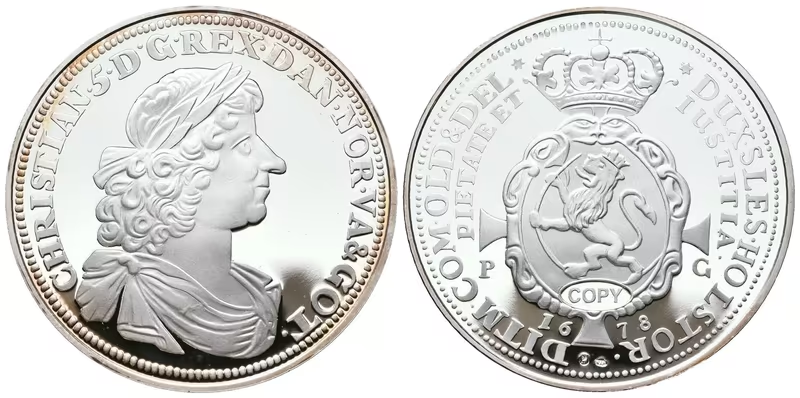
Dánsko, Speciedaler 1678 - Portrét Kristiána V., korunovaný erb s lvem - Holstein, Ditmarschen, Oldenburg, Delmenhorst, replika
Dánské království - Kristián V. (1670-1699) Speciedaler 1678 - Portrét Kristiána V., korunovaný erb s lvem - Holstein, Ditmarschen, Oldenburg, Delmenhorst Ag (.999), 40 mm (20 g), v kapsli. Stav mince odpovídá fotografii.
Skladem 1 ks