VAT and gold
VAT and gold refers to the rules on when value-added tax applies on the sale of gold and when gold is exempt. In Czech practice, the most common issue is the distinction between investment bars and coins on one side and jewellery or collector strikes on the other.
The taxation of gold has long been one of those topics in which the tension between "consumer goods" and "financial assets" is clearly visible. Gold serves a dual purpose: as a raw material for industry and jewellery-making, but also as a means of storing value. If the same taxation as on ordinary goods is automatically applied to investment forms of gold, holding gold becomes more expensive compared with other financial instruments, which tend to be wholly or partly excluded from indirect taxes. This proved to be a problem in the European environment, because individual states applied different rules - in some places investment gold was taxed, elsewhere it was exempt, which created unequal competition and an incentive to shift trade across borders.
The European Union therefore introduced at the end of the 1990s a special regime for investment gold which unified the basic approach: the supply of investment gold, its acquisition from another member state and its import are to be exempt from VAT. Part of the regime is also a fairly strict definition, so that the exemption applies to truly investment forms - that is, to standardised high-fineness bars and gold coins whose price is usually kept close to the value of the metal content, not for example to jewellery or decorative products. The rules also recognise that in the case of coins legal certainty is important for practice: therefore lists of coins meeting the given criteria are published every year, on which traders can rely when assessing a particular strike.
Czech law builds on this European framework in the VAT Act through a special regime that defines what is considered investment gold and under what conditions it is exempt. Investment gold is typically standard bars in the form of bricks or plates with a fineness of at least 995/1000 and bearing a standard marking (manufacturer, fineness, weight, often also a unique number). For coins several features are considered together: a fineness of at least 900/1000, minting after the year 1800, the status of legal tender in the country of origin and a usual selling price not exceeding the market value of the contained gold by more than 80%. This combination is intended to distinguish investment coins from purely collector pieces, whose price is determined chiefly by rarity, historical value and collector demand.
History
The taxation of gold, however, is not just about "zero tax" for investors. The regime also addresses how deduction should work and how to limit abuse of the rules. The legal regulation therefore contains the possibility of an option for taxation in selected supplies between taxable persons and follow-up mechanisms to prevent tax evasion in chains of traders. In practice this means that investment gold is typically invoiced in ordinary sale as an exempt supply, but the system also makes provision for the situations of producers, refineries or wholesalers, where the link to input supplies and the control of the flow of material are important.
The most important thing is to determine correctly whether the item is investment gold or another product made of gold. If a gold bar or gold coin meets the statutory definition of investment gold, its supply in the country, acquisition from the EU and import are generally exempt from tax. For the buyer this appears simply: VAT is not "added" to the price. At the same time, it is good to know that this is not an ordinary "0% rate" but an exemption that has its own rules - especially on the side of traders and producers, where the link to input tax deduction and the possible option for taxation in supplies between taxable persons is addressed.
As soon as gold does not meet the investment definition, however, it is assessed as standard goods. This typically includes gold jewellery, technically worked products, medals and also many gold coins that are sold with a high collector premium or do not meet the condition of minting after 1800 or legal-tender status. In these cases the standard rate of VAT usually applies (unless the law provides for an exception). For collector items, in some situations the special regime for traders in second-hand goods and collectors' items may also be relevant, but it always depends on the precise type of object and compliance with statutory conditions.
How VAT on gold is assessed in practice
In numismatics it is practical to think in terms of three typical "borders": (1) investment gold coins, where the price is driven mainly by the metal and the fulfilment of conditions of exemption, (2) modern commemorative and gift strikes, which may be made of precious metal but are not investment gold, and (3) historical gold coins, where collector value is decisive - these often fall outside the investment definition simply because they were struck before 1800. When buying and selling it therefore makes sense to track not only the material and weight but also the legal status (coin vs. medal), the fineness, the year of issue and the usual premium above the value of the contained gold.
In our auction and shop
- Code: ZEN-2021OREL
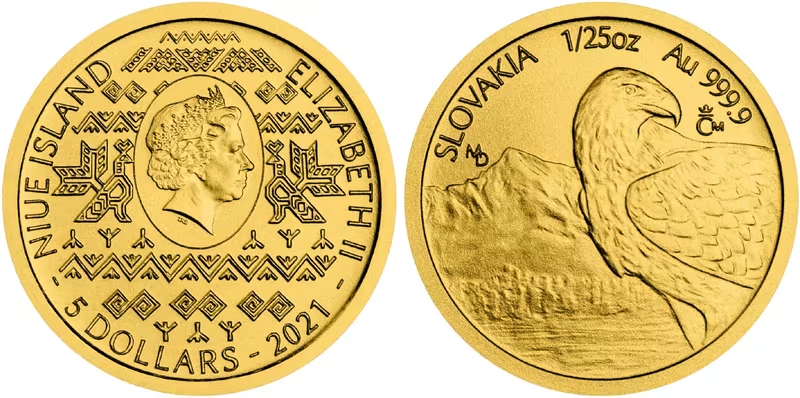
5 Dollars 2021 - Orel, investiční mince
Slovenská republika (1993 - ) 5 Dollars 2021 (Asamat Baltaev) - Investiční mince Orel Au 0,9999, 13 mm (1,24 g), 1/25 Oz Světové investiční mince bývají věnovány silným národním symbolům a ani „Orol“, který je první ražbou svého druhu určenou pro…
- Code: ZD-2020LEV1
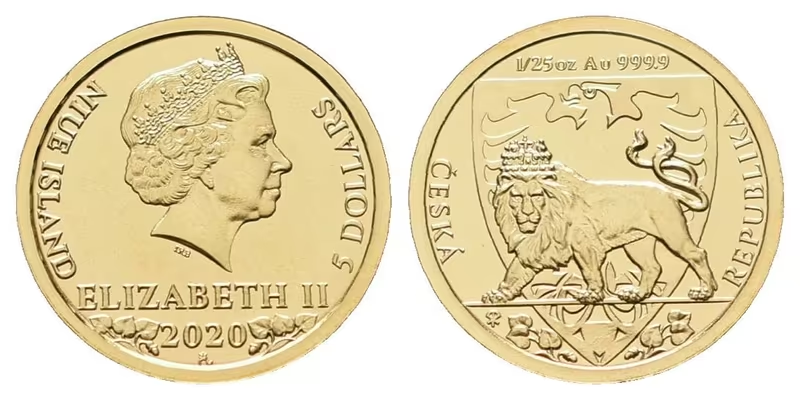
5 Dollars 2020 - Český lev, investiční mince
Česká republika (1993 - ) 5 Dollars 2020 (Asamat Baltaev) - Investiční mince Český lev Au 0,9999, 13 mm (1,24 g), 1/25 Oz Mince "Český lev" České mincovny se razí v zahraniční licenci již od roku 2017. Její cena závisí na spotové ceně zlata a je…