Dresden Mint
The Dresden Mint was the principal mint of the Electorate, and later Kingdom, of Saxony from the Middle Ages until 1872. The centre of striking of Saxon thalers and groschen, it represented one of the most productive mints of the Holy Roman Empire.
The Dresden Mint has its roots in the 12th century, when the margraves of Meissen obtained the minting right. The first documented strike comes from 1180 under Otto the Rich. As the residential city of the Saxon Electors from 1485, Dresden became a centre of coinage. The Ernestine and Albertine lines of the Wettins struck their own coins. Maurice of Saxony unified coinage in 1547. The Saxon thaler became one of the most trusted currencies of the Holy Roman Empire.
The Thirty Years' War brought the period of Kipper coins and debasement. Johann Georg I restored the quality of striking and introduced new denominations. Augustus II the Strong, as king of Poland, struck joint Saxon-Polish coins. The Dresden Mint supplied the union with silver thalers from Ore Mountain silver. During the Seven Years' War an occupation mint struck Prussian Ephraimites. Frederick Augustus I modernised the technology by introducing steam engines.
History of the Dresden Mint
The Napoleonic Wars saw Saxony as a French ally; the mint struck coins of the Confederation of the Rhine. After the Congress of Vienna in 1815, Saxony lost half its territory to Prussia. The Convention currency unified German coinage. The German Ernst Albert founded in 1838 a technical school at the mint. After the unification of Germany in 1871, Dresden's production was transferred to a new mint at Muldenhütten. The historic mint ceased operation in 1872.
The Dresden Mint was a pioneer of technical innovations. The Taschenwerk - a pocket roller press invented in 1550 - made accurate striking possible. The Baroque thalers of Augustus the Strong are among the peaks of medallic art. Vikariatsmünzen struck during interregna were masterpieces. Annual production reached 5 million thalers in the 18th century. The mintmarks of various periods allow precise identification.
Technology and production
The organisation followed guild tradition with the mint master, the warden and the Pregers (strikers). Ore Mountain silver from Freiberg, Annaberg and Schneeberg secured the raw material. Quality control was strict, and Saxon coins enjoyed a reputation for the highest quality. Exports of Saxon thalers reached from Russia to the Netherlands. The technical school trained generations of mint masters for the whole of Germany. The collection of dies in the Münzkabinett documents the artistic development.
In our auction and shop
- Code: ZD-2018PHA
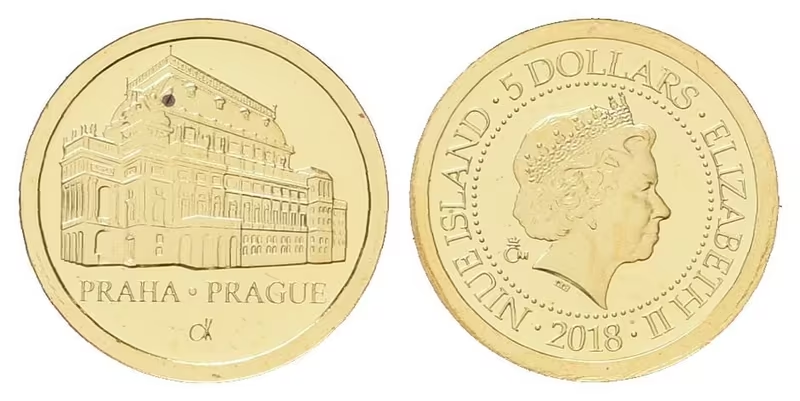
Zlatá mince Praha - dobová pohlednice
Niue 5 Dollars 2018 (David Kružliak) - Praha - Národní divadlo v dobové pohlednici Au 0,9999, 11 mm (0,5 g), náklad 2000 ks, PROOF Motivem páté zlaté mince České mincovny o hmotnosti jedné poloviny gramu , která je zasazena do repliky dobové litografické…