Muldenhütten
Muldenhütten is a historic mining and smelting settlement near Freiberg in Saxony, known for its long tradition of processing ore from local mines. The site lies on the Freiberger Mulde river and became famous as a major smelting complex which in the modern period also took on mintage activity.
Muldenhütten arose and grew in direct connection with the Freiberg district, one of the most important mining areas in Central Europe. While Freiberg itself was renowned chiefly for the extraction of silver ores, Muldenhütten represented "the other half of the story": a place where the mined material was concentrated, prepared and metallurgically processed. Smelting operations were typically established near water, which served as both an energy source and a practical part of the technical infrastructure, and the location on the Freiberger Mulde was indeed one of the area's principal advantages.
Smelting activity in the region is documented as early as the Middle Ages and the complex is among the oldest sites of non-ferrous metallurgy in the German territory. In its early phases this concerned chiefly the processing of silver-bearing ores, from which metal was obtained for monetary circulation and for the country's economy. In the centuries that followed, the works developed alongside mining: as the technologies, quality and availability of ores, and the needs of the state changed, so too did the smelting procedures and the organisation of production. Characteristically, Muldenhütten was not "a single workshop" but rather a system of smelters which over time were rebuilt, merged and supplemented with new operations.
History
An important milestone in modern history was the merger of the older smelting sections into a single more unified operation in the 19th century, when industrial modernisation was taking hold across Europe. It was then that the appearance of the buildings and the technological equipment at the Muldenhütten complex changed significantly, and the smelter became a complex capable of long-term and organised operation. This was linked to a more intensive connection with state administration and with the needs of the broader economic system, since smelters in such regions were not merely "local manufactures" but part of a strategic chain running from the mine through processing to state finances.
A specific chapter is the mintage activity: in later times Muldenhütten was also linked with the operation of a state mint, which strengthens its significance for numismatics as well. Such a linkage made sense - the site had a long tradition of working with metals, a technical infrastructure, and established supplier and oversight structures. In the 20th century the complex continued to change with the needs of industry; after the decline of classical mining, similar smelters often shifted more towards the processing of secondary raw materials and more modern metallurgy. Even so, Muldenhütten retained marked historical value as a living testimony to how, over the centuries, mining, smelting and the state economy were intertwined in mining regions.
Smelting complex and its significance for numismatics
Muldenhütten is interesting because it allows coins to be understood "from the metal up". In numismatics we often focus on the finished piece - denomination, mint, legend and iconography - but behind it there is always the raw material and its processing. The smelter was the place where ore was turned into metal usable for further manufacture, whether it was silver, copper or other components important for the monetary system. In practice this means that the history of mintage is not only the history of mints, but also the history of smelters which were able to deliver material of the required quality.
A further dimension is the actual presence of mintage operations in more recent times. When a locality is associated with a mint, it gains in significance not only technically but also symbolically: it is a place where state authority and metal control were transformed into actual currency. For collectors Muldenhütten is also interesting as an "address" on the map of Central European mintage, since it shows that the production of money relied on a broader industrial infrastructure and on long-maintained metalworking know-how.
In our auction and shop
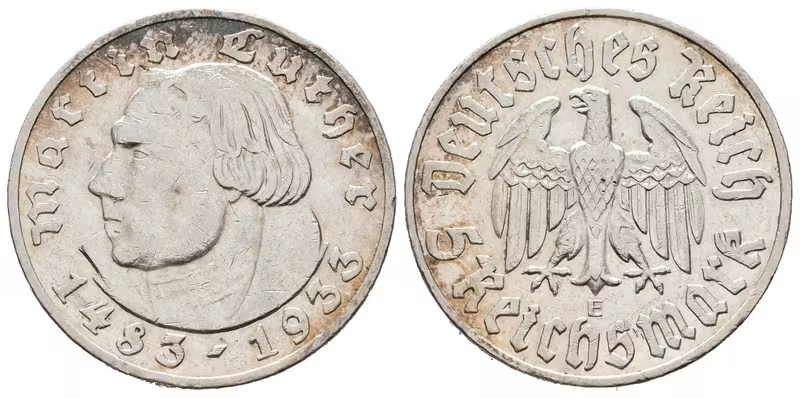
- Code: NF-G1933ERecommended
III. říše, 5 Marka 1933 E
III. říše (1933 - 1945) 5 Marka 1933 E, mincovna Muldenhütten, Německo Ag 0,900 , 29 mm (13,88 g), raženo 100 000 ks
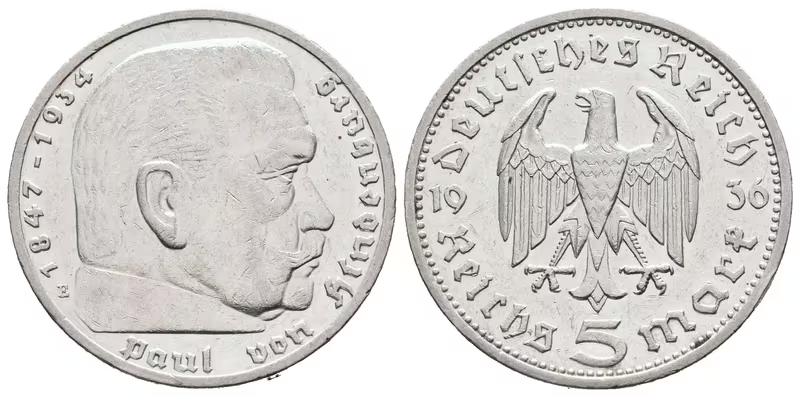
Skladem 1 ks - Code: NF-G1936E.6
III. říše, 5 Marka 1936 E
III. říše (1933 - 1945) 5 Marka 1936 E, mincovna Muldenhütten , pěkná zachovalost, ilustrační fotografie Ag 0,900 , 29 mm (13,88 g), raženo 3 320 000 ks
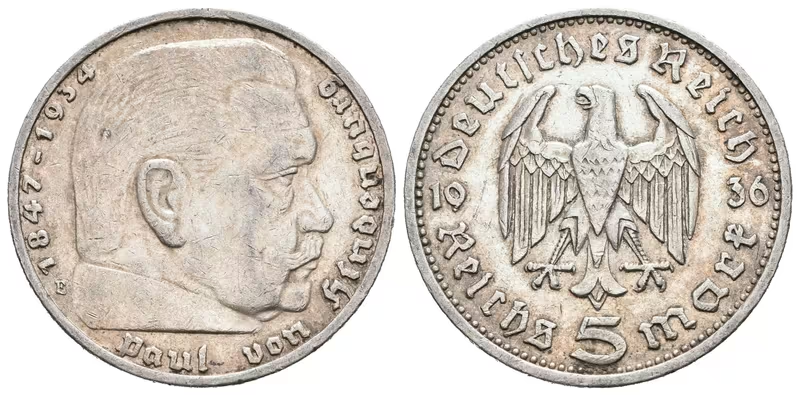
Skladem 1 ks - Code: NF-G1936E.5
III. říše, 5 Marka 1936 E
III. říše (1933 - 1945) 5 Marka 1936 E, mincovna Muldenhütten , ilustrační fotografie Ag 0,900 , 29 mm (13,88 g), raženo 3 320 000 ks
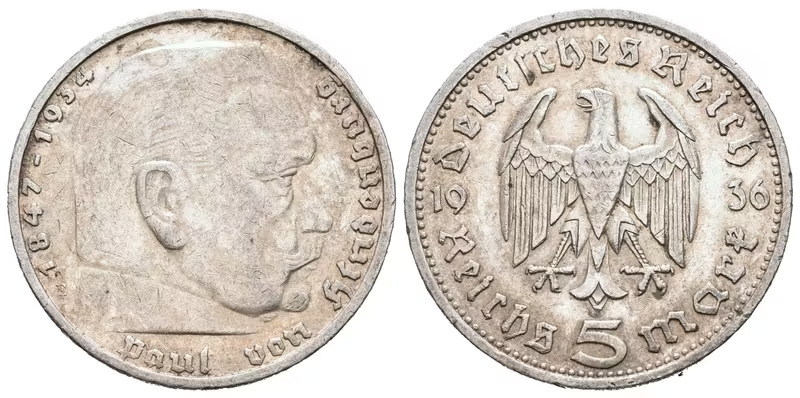
Skladem 1 ks - Code: NF-G1936E.4
III. říše, 5 Marka 1936 E
III. říše (1933 - 1945) 5 Marka 1936 E, mincovna Muldenhütten , ilustrační fotografie Ag 0,900 , 29 mm (13,88 g), raženo 3 320 000 ks
Skladem 1 ks