Ferdinand Charles of Tyrol
Ferdinand Charles of Tyrol (1628–1662) was a Habsburg archduke and ruler of Tyrol and the so-called Further Austria. He became renowned for his splendid court at Innsbruck, his cultural ambitions and also for the country's strained finances, which significantly marked his reign.
Ferdinand Charles of Tyrol came from the Habsburg dynasty and his career unfolded against the standing of Tyrol as an important country on the Alpine passes. For the Habsburgs Tyrol had not only strategic value but also economic significance: control over the routes across the Alps supported trade and customs revenue, the region had a tradition of mining and metalworking, and on Tyrolean territory strong administrative centres functioned, headed by Innsbruck. After the death of his father, Ferdinand Charles took over rule in the middle of the 17th century, at a time when Central Europe still felt the consequences of the Thirty Years' War and when states were seeking a balance between representation, administration and exhausting military expenditure.
The Tyrolean branch of the Habsburg administration traditionally placed importance on court representation, which was to confirm the prestige of the dynasty and of the country. Ferdinand Charles pushed this model to an even more lavish form: Innsbruck became a place of court festivities, cultural projects and the effort to make the Alpine residence a distinctive centre of art. Such ambitions, however, had their price. In the 17th century, with smaller and middle-sized states it was a frequent problem that revenues from taxes and royal prerogatives did not suffice for a costly court and at the same time for the obligations arising from wider Habsburg policy. In Tyrol this manifested itself chiefly in tension between court expenditure and the need for stable administration of the country.
A significant role in the ruler's image was also played by his wife, Anna de' Medici, since the marriage with the House of Medici was perceived as a prestigious connection with a traditionally wealthy and culturally advanced milieu. In such unions it was not just family policy but also representation: the court took over artistic models, strengthened ceremonial and built up a circle of people connected with culture and court service. In Tyrol this strengthened the perception of Innsbruck as a place where Habsburg statehood blended with Italian court elegance.
History
At the same time, however, Ferdinand Charles faced what is typical of his reign: a deteriorating financial situation. In practice this meant pressure on the land estates, complications in financing the administration and also the search for extraordinary solutions to cope with debts. Tyrol was not an isolated state but part of the Habsburg composite monarchy, and so the financial difficulties were also projected into relations with the wider dynasty. After Ferdinand's death the rule was taken over by his kinsman and successor, and the country was gradually reincorporated more firmly into the Habsburg administrative framework. In memory Ferdinand Charles is remembered as a sovereign with a distinctive cultural imprint, but also as a ruler whose court policy left a tangible economic strain on the country.
Ferdinand Charles of Tyrol is also of interest from the numismatic point of view, because Tyrol belonged to the countries with a long tradition of coinage. In the region both silver and gold coins were struck, and the denominations in circulation corresponded to the Central European monetary customs of the time. Tyrolean coins were naturally influenced by the fact that this was Habsburg territory, but they also had their own land features: emphasis on the titulature, the land's coats of arms and a recognisable iconography that helped in an environment where coins of many states and principalities mingled.
In 17th-century sovereign issues, the key motif tends to be the ruler's portrait or at least his name and title, complemented by heraldry. In the Tyrolean setting, emblems linked with the land and the Habsburg dynasty often appear, which makes the coins not only a means of payment but also a bearer of a political message: who is in charge, who stands behind the metal and who has the right to collect levies and direct economic life. Particularly with rulers who placed emphasis on court representation, the coin becomes part of a broader image of power — alongside festivities, buildings and ceremonial, it is an "everyday" object that disseminates authority among the people.
Reign, Court and Tyrolean Issues
The financial side of rule, moreover, naturally meets coinage. When a country is burdened with debt and the administration is seeking additional revenue, the importance of regular circulation, tax collection and trust in the currency grows. Even though the coin alone does not solve the problem, it belongs to the instruments that help to maintain the functioning of the market and the state. The Tyrolean issues of Ferdinand Charles's time therefore stand on the border of two worlds: a culturally self-confident court and an economy that must bear its costs. For collectors they are attractive in that they represent Habsburg power in the Alpine region and at the same time bear the typical aesthetic of the Baroque age.
In our auction and shop
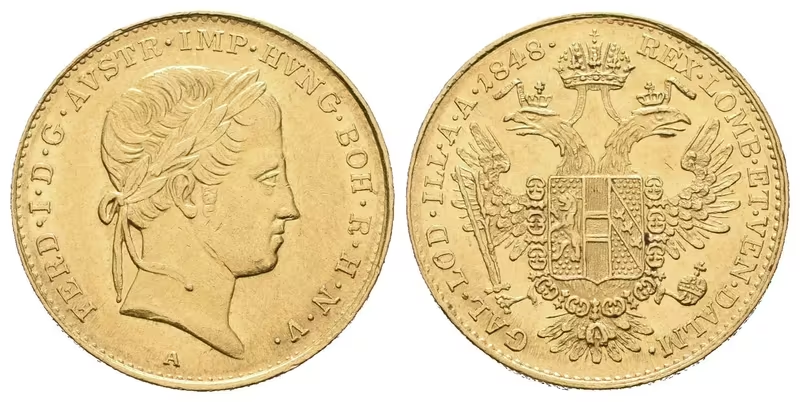
- Code: Z94C-1848A
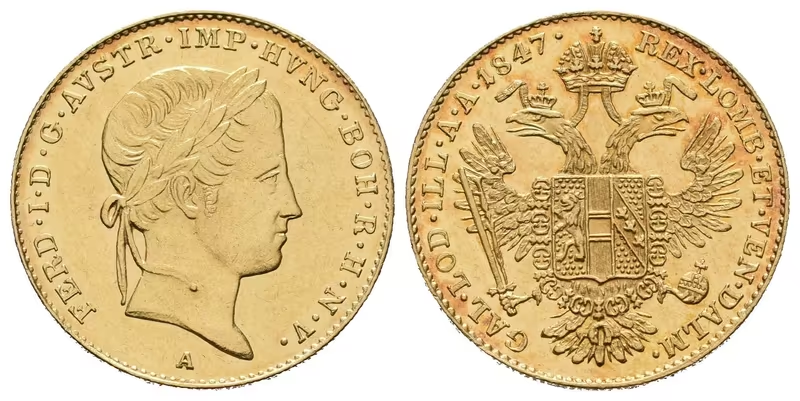
- Code: Z94C-1847A
Ferdinand V., Dukát 1847 A, Vídeň
Ferdinand V. (1835 - 1848) Dukát 1847 A, Vídeň, Ves. 3, nádherná zachovalost s ražebním leskem
Skladem 1 ks - Code: M94006-1838A
Ferdinand V., Tolar, 1838 A, Vídeň
Ferdinand V. (1835 - 1848) Tolar 1838 A, Vídeň, Ves. 6
Skladem 1 ks - Code: M94006-1838A.1