Frederick Augustus I (III) of Saxony
Frederick Augustus I (III) was the last Saxon Elector as Frederick Augustus III and the first Saxon King (1806-1827), and at the same time Duke of Warsaw (1807-1815). He entered history especially with his Napoleonic policy and the loss of a large part of Saxony after 1815.
Frederick Augustus I (III) (23 December 1750 - 5 May 1827) was born in Dresden into the Albertine line of the House of Wettin. He came to the throne very young: after the death of his father Frederick Christian he took over Saxony in 1763 as Elector Frederick Augustus III, with the first years connected to regency administration. The country was at the time emerging from the severe shock of the Seven Years' War, which had significantly damaged Saxony economically and demographically. It was precisely the experience of post-war recovery that shaped his reputation as a ruler who prefers stability, well-ordered finances, and gradual reforms to ostentatious court politics.
In domestic administration he relied on a bureaucratic apparatus and sought to strengthen the predictability of administration and of state revenues. Compared with some neighbours, his period is perceived as relatively moderate: instead of major conquests he focused on consolidation, support of education and the economy, and on maintaining trust in institutions. In the cultural sphere he continued the Dresden tradition of art and representation, although his own style was more restrained than the Baroque era of preceding Saxon rulers. Dresden remained a symbol of Saxon statehood and a "showcase" of the court, where traditional collections, architecture, and urban commerce met.
A prominent part of his life is associated with the Polish question. After the reforms in the Polish-Lithuanian Commonwealth, in the second half of the 18th century he was considered a suitable heir to the Polish throne, because the Wettins had a historical link with the Polish crown. In practice, however, the balance of power in central and eastern Europe decided: the partitioning of Poland between neighbouring powers made his accession to the Polish role impossible and meant for Saxony the loss of hope for a broader dynastic return to the east.
History
The Napoleonic Wars fundamentally changed Saxony's position. Frederick Augustus initially sought to manoeuvre between the great powers, but after the Prussian defeat of 1806 Saxony came into the sphere of influence of Napoleon I Bonaparte. In December 1806 the elector was elevated to king and assumed the title of King of Saxony as Frederick Augustus I. A year later, after the creation of the Duchy of Warsaw, he became its ruler, which in the eyes of the Poles was a promise of restored statehood but at the same time a commitment to France. By this Saxony gained greater prestige, but at the same time entered a politically risky bond whose price became fully apparent after the turn of Napoleonic power.
In 1812 Napoleonic policy was broken by the Russian campaign and the subsequent defeats. After the Battle of Leipzig in October 1813 the Saxon position collapsed and the king found himself a captive. At the Congress of Vienna in 1815 the fate of Saxony was negotiated harshly; the result was a painful loss of a large part of the territory in favour of Prussia. Frederick Augustus did indeed return to the throne, but he ruled only over a "reduced" kingdom, which had to seek both economic and political balance anew. The rest of his life he devoted to the stabilisation of the state and to maintaining its distinct character in the new German arrangement. He died in 1827 in Dresden, and in Saxon memory remained as a ruler whose personal moderation contrasted with the drama of the times.
For numismatics Frederick Augustus I (III) is important in that his long reign extends into several monetary phases: from the late electoral period through the Napoleonic changes to post-war consolidation. Saxon coinage in the 18th century relied on silver standards intended to ensure the comparability of currency in the wider German space. In practice this meant the striking of thaler denominations and their fractions according to specifications that corresponded to the contemporary agreements on weight and fineness (including the "convention" tradition, where the precisely defined content of pure silver was observed). Alongside silver, small monetary values were also struck for everyday circulation, where alloys were more frequently used and where pronounced wear is today common.
Coinage and strikings under Frederick Augustus
A typical mark of his coins is the ruler's titulature and Saxon heraldry. On higher silver strikings you will often encounter the portrait of the ruler; on some of the smaller denominations, instead, a crowned monogram with a simple expression of value. In the transition from electoral to royal period it is precisely the way in which the ruler is named in the legend that is key for collectors: the change of titles after 1806 is reflected very clearly on the coins and helps in quick orientation in dating. Of no lesser importance are the small mint marks and initials of responsible persons, which can distinguish individual issues and variants within the same year.
In the attribution of coins of Frederick Augustus a combination of several features is decisive: year, titulature (Elector versus King), denomination, style of portrait or monogram, and small marks. With thaler pieces the quality of strike and the completeness of the legend are also fundamental, because silver coins were often used intensively and the marginal parts are susceptible to wear. In summary his strikings represent a clear "cross-section" of the transformation of Saxony from imperial electorate through Napoleonic kingdom to a state which after 1815 had to redefine its role and economic strength.
In our auction and shop
- Code: NASAS55-H1698
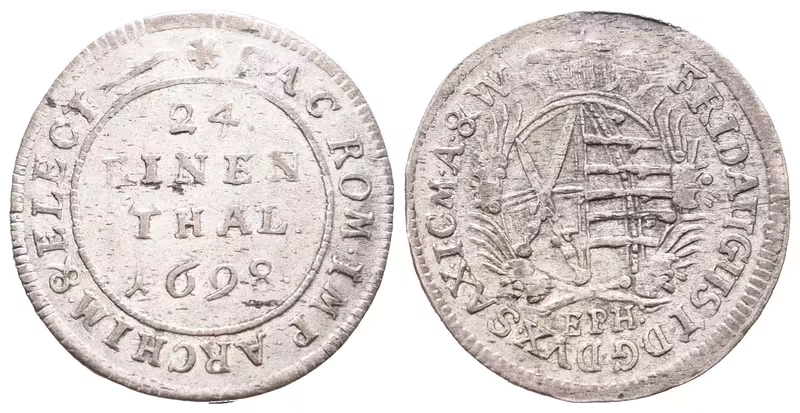
Sasko, 1/24 Tolar 1698 EPH
Sasko, Friedrich August (1694 - 1733) 1/24 Taler (Groš) 1694 EPH, Leipzig, KM.645, pěkná zachovalost, prohnutý ražbou
Skladem 1 ks