Frederick II of Anhalt
Frederick II of Anhalt (1856-1918) was Duke of Anhalt from the House of Ascania, who ruled in the years 1904-1918. His reign falls in the closing period of the German Empire and the time of the First World War, when independent dynastic politics gradually disappeared from the small German states.
Frederick II of Anhalt, full name Leopold Frederick Edward Charles Alexander, was born in Dessau and grew up in the environment of a small but historically significant German duchy. Anhalt belonged among the states which long preserved their own court, administration, and dynastic representation within the German space, but at the same time were ever more dependent on broader political and economic conditions. Frederick became heir only after the death of his elder brother Leopold (1886), and only then did he prepare to take over rule at a time when Germany was rapidly modernising, strengthening its army, and transforming public life from monarchical ceremony to a mass society.
He ascended the ducal throne in January 1904 after the death of his father Frederick I of Anhalt. For a small duchy it was important to hold its own in competition with larger German lands not only economically, but also culturally and socially. Frederick II built up a reputation as a ruler with an interest in the arts, especially music, and supported the court cultural institutions, including the theatre. Such support was not mere personal taste: the court in smaller states often functioned as a centre of learning and representation that maintained the prestige of the country and gave it a "voice" within the German federal mosaic.
History
In 1889 he married Marie of Baden. The marriage remained childless, which had a fundamental dynastic impact: in the event of his death there threatened a problem with direct succession and a strengthening of the role of secondary branches of the dynasty. In the First World War, which Germany entered in 1914, the smaller states also participated in the war mobilisation primarily in administrative and symbolic ways. In December 1914 Frederick II established the decoration of the Friedrich-Kreuz (Frederick Cross) for services in the war, thereby following the contemporary practice in which territorial rulers supported morale and recognised military and civilian services with their own order or cross.
The duke's reign closed even before the end of the war: he died in the spring of 1918. As he had no offspring, he was succeeded by his brother Edward of Anhalt. The duchy itself, however, was already on the threshold of disappearance: in 1918 the monarchies in Germany collapsed and the German lands were transformed into republican states. Frederick II is thus remembered as the last Anhalt ruler whose reign took place within the fully monarchical framework of the German Empire.
The duke on coins and in the order tradition
Frederick II of Anhalt appears in numismatics especially on coins from the time of the German Empire, when the individual federal states issued circulating silver and gold coins of a unified monetary system, but with their own rulers and territorial motifs. For Anhalt the silver mark denominations with the duke's portrait, complemented by imperial symbolism on the reverse, are especially typical. On some strikings you will encounter the mintmark of the Berlin mint (A), because the production of coins for smaller countries was often concentrated in the great minting facilities.
Alongside the coins, the previously mentioned Friedrich-Kreuz of 1914 is also of interest to collectors. It is not a means of payment but a decoration, which today belongs to the field of phaleristics and documents how even small German states used their own decorations to recognise services in time of war. In combination with coins, Frederick II represents a typical ruler of the late monarchical era: his image appears both on the currency of everyday life and in the order tradition, which was intended to strengthen loyalty and the public prestige of the country.
In our auction and shop
- Code: NASA-1181
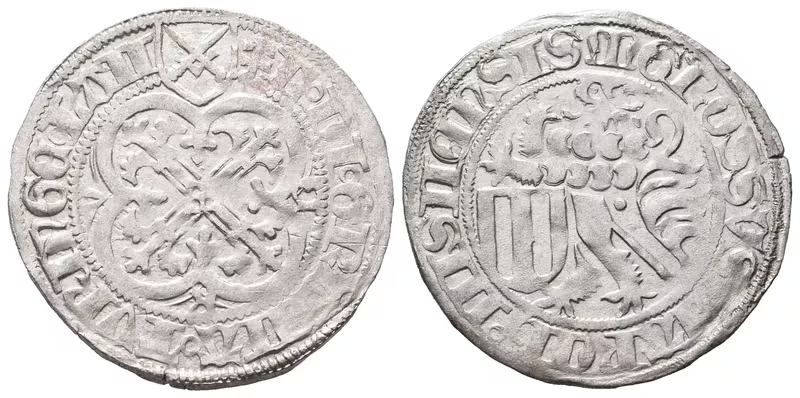
Sasko - Míšeň, Mečový groš, Colditz
Sasko - Míšeň, Friedrich II. a Margaretha (1456 - 1464) Schwertgroschen b.l. (1457 - 1464), Colditz, Krug.1181/77-78, stav 1/1, pěkná zachovalost, pěkně vyražený, drobné rysky
Skladem 1 ks - Code: NBBAD-BY1910
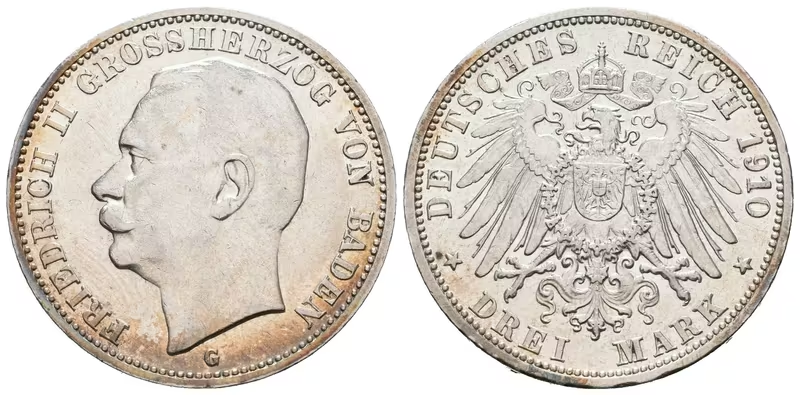
Baden, 3 Marka 1910 G
Baden, Friedrich II. (1907 - 1918) 3 Marka 1910 G, J. 39, KM.280, velmi pěkná zachovalost, patina, zbytky lesku, lesk na Rv., rysky a drobné hranky
Skladem 1 ks - Code: NBBAD-BY1912.3
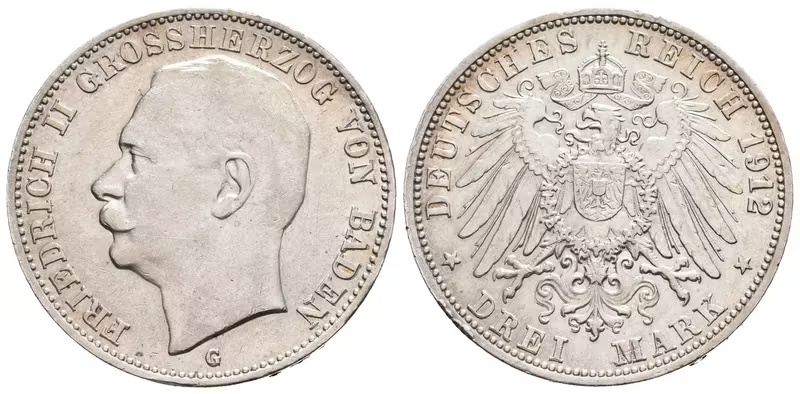
Baden, 3 Marka 1912 G
Baden, Friedrich II. (1907 - 1918) 3 Marka 1912 G, J. 39, KM.280, krásná zachovalost, jemná patina, zbytky lesku na Rv., drobné rysky a hranka
Skladem 1 ks - Code: NBBAD-BY1914.1
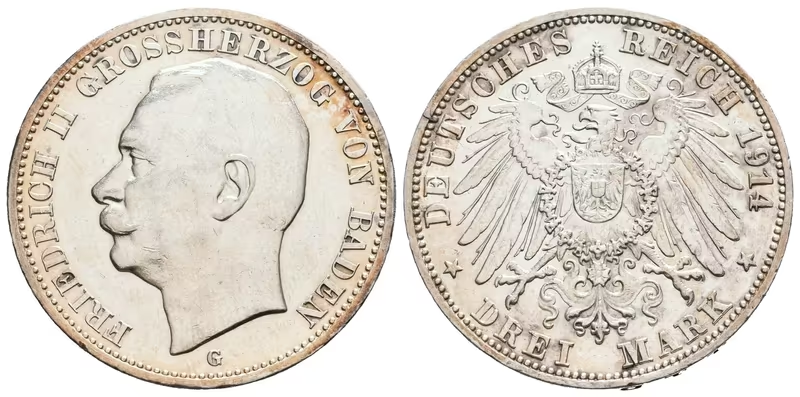
Baden, 3 Marka 1914 G
Baden, Friedrich II. (1907 - 1918) 3 Marka 1914 G, J. 39, KM.280, velmi pěkná zachovalost, jemná patina, lesk na Rv., rysky
Skladem 1 ks