Frederick III of Prussia
Frederick III of Prussia (1831-1888) was the German Emperor and King of Prussia from the House of Hohenzollern, who ruled for only 99 days in 1888. As crown prince he advocated a moderately liberal direction and was renowned also as a commander in the Franco-Prussian War, but his reign was ended by severe illness.
Frederick III of Prussia was born on 18 October 1831 in Potsdam as the only son of the future Emperor William I and Augusta of Saxe-Weimar-Eisenach. From childhood he was prepared for the role of heir, but at the same time he grew up in an environment where traditional Prussian military values clashed with the growing constitutional and liberal demands of the 19th century. In 1858 he married Victoria, Princess Royal (the eldest daughter of the British Queen Victoria), by which the Prussian court was more closely connected with British dynastic politics. The marriage is described as intellectually ambitious and politically significant, but at the same time aroused distrust in conservative circles, which feared a "foreign" influence on Prussian affairs.
From 1861 he was Crown Prince of Prussia, and after the establishment of the German Empire in 1871 also German Crown Prince. Politically he often came into tension with the conservative line, embodied in practice by Chancellor Otto von Bismarck. Frederick was perceived as a ruler with a greater willingness to respect parliamentary life and public opinion, which in a more authoritatively led state acted as a potential change of direction. His real possibility of influencing the affairs of the empire was, however, for decades limited: his father William I ruled for a long time and Bismarck's position was exceptionally strong.
A prominent chapter of his life is represented by his military career. During the Franco-Prussian War of 1870-1871 he commanded the 3rd Army and participated in key operations which opened the way to the unification of Germany under Prussian leadership. From the standpoint of public reputation this experience gave him "Prussian" legitimacy, because in the monarchy of the 19th century the image of the ruler was often connected with military success. Even so, with Frederick it was long emphasised that he was also interested in the civilian face of the state: education, science, cultural institutions, and a more modern conception of governance.
History
The year 1888 entered history as the "Year of the Three Emperors". After the death of William I, Frederick ascended the throne on 9 March 1888 as German Emperor and King of Prussia. At that time, however, he was already suffering from cancer of the larynx, which prevented him from ordinary communication and gradually wore him down physically. He reigned a mere 99 days and died on 15 June 1888 in Potsdam. He was succeeded by his son William II, whose politics already led in a different, considerably more confrontational direction. The brevity of Frederick's reign therefore often raises the question of "wasted possibility" - whether the German Empire could have looked different under a longer reign of a ruler with a more liberal instinct.
Frederick III ascended the throne with the reputation of a ruler from whom milder domestic conditions and a certain loosening of state style were expected. His state of health, however, restricted real steps, and most of his reign took place under a hospital regime and crisis functioning of the court. Even so, his name has been firmly linked with an exceptionally symbolic moment of German history: the transition from the long era of William I to the new epoch of William II, all in a single year.
From a numismatic point of view, Frederick III is prominently present on the strikings of the imperial mark currency precisely because the year 1888 brought specific issues for Prussia. In circulation appear silver coins of 2 and 5 marks with his portrait and the year 1888, which attract collector attention by the very brevity of his reign. Alongside these there are also gold coins of 20 marks with his likeness, also dated 1888. These strikings fit into the system of the German Empire, where the federal lands used a unified currency but on the coins often bore their own rulers and territorial identity.
The short reign and coins of 1888
Typically, on the obverse of Prussian issues the portrait of the ruler with the titulature is used; on the reverse, the imperial eagle and the inscription DEUTSCHES REICH with the value. For attribution practice it is important to observe not only the denomination and the year but also the mintmark (for example the Berlin "A"), because strikings differ according to mint and some variants may be substantially rarer. Frederick's coins thus represent not only the "face of the year 1888" but also a clear example of how a political event (the sudden change of rulers) leaves a direct trace on the currency.
In our auction and shop
- Code: RX-Z-020
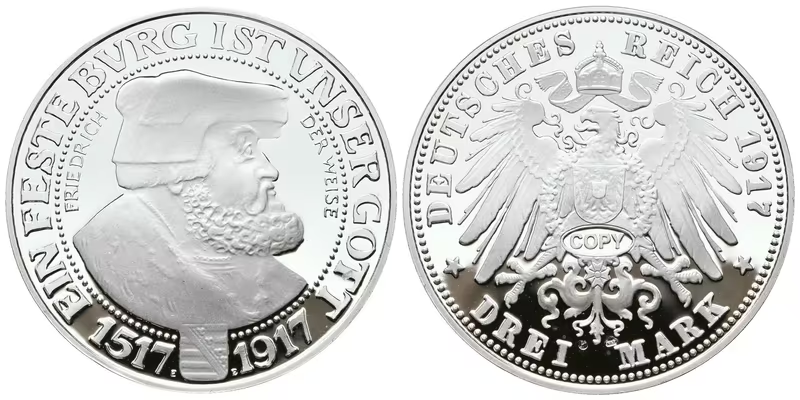
Německo, 3 Mark 1917 - 400. výročí reformace, Friedrich III. Moudrý, replika
Německé císařství / Sasko (replika) 3 Mark 1917 - 400. výročí reformace, Friedrich III. Moudrý, KM# 1272 Ag (.900), 40 mm (20 g), v kapsli. Stav mince odpovídá fotografii.
Skladem 1 ks - Code: NAHOGO-1626
Holstein - Gottorp, 1/8 Tolaru 1626
Schleswig-Holstein-Gottorp , Friedrich III., 1616 - 1659 1/8 Thaler 1626, KM.75, Lange 336 var., pěkná zachovalost, patina, zvlněný_R!
Skladem 1 ks - Code: NBPRU-BX1888
Prusko, 5 Marka 1888
Prusko (Preussen), Friedrich III. (1888) 5 Mark 1888 A, Berlín, KM.512, J.99, krásná zachovalost, lesk, jemná patina, rysky a nep. hranky
Skladem 1 ks - Code: NAPRU91-G1690
Prusko, 1/12 Tolar 1690 LCS
Braniborsko-Prusko, Friedrich III. (1688 - 1701) 1/12 Thaler 1690 (2 Groše) LCS, Berlín, v. Schrötter 530, var. s letopočtem na Rv., oxidace
Skladem 1 ks