Frederick William II of Saxe-Altenburg
Frederick William II of Saxe-Altenburg was an Ernestine duke of the House of Wettin who ruled the Duchy of Saxe-Altenburg from 1639 to 1669. He was born posthumously in Weimar, and his reign falls within the closing stage of the Thirty Years' War and the period of post-war recovery of the country.
Frederick William II of Saxe-Altenburg was born on 12 February 1603 in Weimar as the youngest son of Frederick William I of Saxe-Weimar and Anna Maria of Palatinate-Neuburg. He came into the world several months after his father's death, and so in the sources he also appears as "posthumus" — born posthumously. In the early modern period the House of Wettin was divided into several branches, and the Duchy of Saxe-Altenburg belonged to the so-called Ernestine domains in Thuringia. In practice this meant frequent divisions of inheritance, joint rule by siblings, and repeated adjustments of borders and competencies, which was typical of the small German states.
In his first years of life, Frederick William II could not take part in government, and so the country was administered under a regency. The stability and protection of the underage dukes was looked after by the Saxon electoral authorities, especially Christian II of Saxony and John George I of Saxony. Only after reaching adulthood did the younger members of the dynasty gradually become involved in the governance of the country. In Saxe-Altenburg, rule was for a long time associated with the collective responsibility of the brothers, which appeared unified from outside but internally often required compromises regarding finances, courtly representation, and foreign policy.
History
A marked turning point came in the 1630s, when, as a result of the deaths of older siblings, power was concentrated into the hands of a narrower circle. Frederick William II at first acted as co-ruler alongside his elder brother John Philip, but real governance long depended above all on the latter's authority. Only after John Philip's death in 1639 did Frederick William II take personal rule and become head of the duchy. His reign took place at a time when central Germany was recovering from the long war: administration, the economy, and the fiscal base were being restored, while at the same time the need for representation grew, which was to confirm the prestige of the dynasty once more.
In his personal life, Frederick William II entered his first marriage in 1638 with Sophie Elisabeth of Brandenburg, which remained childless. After her death, in 1652 he married Magdalene Sibylle of Saxony, widow of the Danish crown prince and daughter of John George I. From the second marriage came three children: a son Christian (who died in childhood), a daughter Johanna Magdalena, and the heir Frederick William III of Saxe-Altenburg. In the 1660s the duke also focused on expanding and consolidating his position: in 1660 he acquired the towns of Themar and Meiningen, and in the following years he developed courtly seats. He is credited with establishing the hunting residence at Hummelshain (1664) and with building a dignified dower residence for his wife in Altenburg, known as the Magdalenenstift (1665). He died on 22 April 1669 in Altenburg and was succeeded on the throne by his only surviving son, Frederick William III.
His reign, court, and imprint on minting
As a minor imperial ruler, Frederick William II had to balance courtly representation with the economic possibilities of the country. The practical side of governance rested on the running of the court, the administration of offices, the collection of taxes, and the recovery of the economy from war damage. At the same time, great emphasis was placed in such domains on dynastic continuity: marriage policy was meant to secure allies, prestige, and above all a legitimate heir. The second marriage to Magdalene Sibylle, who came from an electoral house, strengthened precisely this dimension — both symbolically and politically.
Minting was also connected with the representation of the ruler. In the 17th century, various denominations were struck in the Duchy of Saxe-Altenburg, and the names or titles of co-ruling dukes, or their joint coats of arms, appear on some of the issues. With Frederick William II are associated above all the thaler issues and ducats from the time when several members of the dynasty took part in the administration of the country. Such coins are significant today as a source: they recall the division of power in the Ernestine lines as well as how the dukes presented themselves to the public through heraldry, titulature, and iconography. In the numismatic context, his name is therefore most often encountered precisely on coins of the Thuringian and Saxon duchies of the 17th century.
In our auction and shop
- Code: NAPRU97-B1861
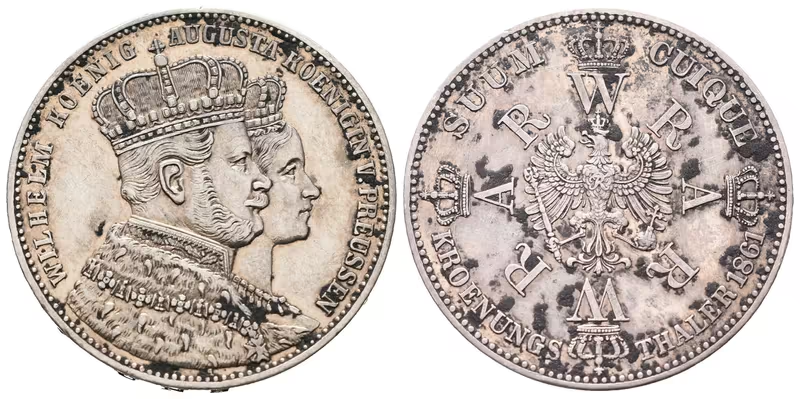
Prusko, Tolar 1861 - Korunovační
Pruské království, Friedrich Wilhelm IV. (1840 - 1861) Tolar 1861 A - Ke korunovaci Viléma a Augusty Sasko-Výmarské, KM.488, Dav.778, tmavá patina, rysky, oběh