Frederick William I of Prussia
Frederick William I was the King of Prussia reigning from 1713 to 1740, known as the Soldier-King. His reign laid the foundations of Prussian military power and turned Brandenburg-Prussia into a disciplined absolutist state.
Frederick William I was born on 14 August 1688 in Berlin as the son of the first Prussian king Frederick I and his second wife Sophia Charlotte of Hanover. From his youth he showed a passion for military matters and contempt for the luxury of his father's court. Upon ascending the throne in 1713, he immediately launched extensive austerity reforms. He dismissed most courtiers, abolished costly court festivities, and sold the royal jewels. He invested the saved funds in the army.
His greatest work was the reform of the Prussian army, which he expanded from 40,000 to 80,000 men, representing four per cent of the population. He introduced uniform dress, strict training, and iron discipline. He created a system of cantons for conscription and founded cadet schools for the training of officers. His pride was the regiment of giant grenadiers in Potsdam, to which he gathered exceptionally tall men from across Europe. The army became the best-trained and best-organised force in Europe, although the king paradoxically never used it in a great war.
History
In internal politics, Frederick William I introduced strict mercantilism and a centralised administration. He founded the General Directory for the management of finance and administration. He supported the development of manufactories, especially textile ones, and accepted Protestant refugees who brought craft expertise. He introduced compulsory school attendance and had thousands of village schools built. His economic policy doubled state revenues and created a budget surplus.
Personally he led a Spartan life, rising at four o'clock in the morning and devoting the whole day to state affairs. He was known for his quick temper and coarseness, often beating his courtiers with a cane. The conflict with his son, the future Frederick II the Great, culminated in the prince's attempted escape and the execution of his friend Hans Hermann von Katte. Frederick William I died on 31 May 1740 in Potsdam, leaving his son a strong state with a full treasury and the best army in Europe.
Minting under Frederick William I
Prussian minting under Frederick William I underwent important reform and standardisation. The king introduced strict control of the mints and unified the monetary system according to the Leipzig mint ordinance. The main denominations were silver thalers, their fractions, and gold Friedrichs d'or worth 5 thalers. The coins bore on the obverse the ruler's portrait with a Latin legend, and on the reverse the Prussian eagle with the Hohenzollern arms on its breast.
A characteristic feature of the coins of this period was the high quality of striking and precise observance of weight and fineness. Frederick William I personally oversaw the mints in Berlin and Königsberg. The gold Friedrichs d'or became a recognised international currency and were imitated in other German states. The king also had commemorative thalers struck on important occasions, such as the wedding of the heir to the throne or the anniversary of the Reformation.
In our auction and shop
- Code: NAPRU97-B1861
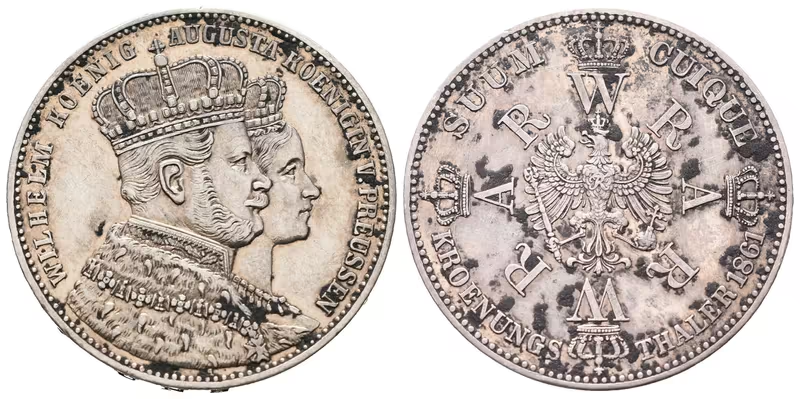
Prusko, Tolar 1861 - Korunovační
Pruské království, Friedrich Wilhelm IV. (1840 - 1861) Tolar 1861 A - Ke korunovaci Viléma a Augusty Sasko-Výmarské, KM.488, Dav.778, tmavá patina, rysky, oběh