The House of Hanover
The House of Hanover was a British royal dynasty which reigned from 1714 to 1901 and brought Britain to the position of a world power. It came from the German house of Welf and acceded to the British throne under the Act of Settlement.
The House of Hanover acceded to the British throne in 1714, when Queen Anne Stuart died without a direct heir. Under the Act of Settlement of 1701 the British sovereign had to be a Protestant, which excluded the Catholic Stuarts. The throne was inherited by George I, Elector of Hanover, the great-grandson of James I Stuart. George I could not speak English and was more interested in Hanover than in Britain; he left government to his ministers, by which the system of parliamentary monarchy arose.
Under George II the development of constitutional monarchy continued, along with the rise of the first Prime Minister, Robert Walpole. George III, who reigned for 60 years from 1760, attempted to restore royal power but lost the American War of Independence. His reign was marked by bouts of madness caused by porphyria. During his illness his son, the future George IV, governed as regent. Britain under Hanoverian rule defeated Napoleonic France and became the most powerful country in the world.
History
William IV reigned briefly from 1830 to 1837 and carried out the parliamentary reform widening the franchise. After his death his niece Victoria acceded, whose 64-year reign represented the high point of British power. In the Victorian era Britain ruled a quarter of the world and became the workshop of the world. Victoria married Prince Albert of Saxe-Coburg and Gotha, but their children remained formally members of the House of Hanover until Victoria's death in 1901.
The personal union with Hanover ended in 1837, since under Salic law a woman could not inherit the Hanoverian throne. Hanover was inherited by Victoria's uncle Ernest Augustus. The House of Hanover in Britain formally ended with the death of Queen Victoria, when her son Edward VII of the House of Saxe-Coburg and Gotha acceded. The Hanoverian era left Britain as the greatest world empire with a developed parliamentary democracy.
Coinage of the House of Hanover
The House of Hanover revolutionised British and world coinage. The gold guinea, struck until 1816 with the portraits of the Hanoverian sovereigns, was the main trading coin. In 1816 Britain was the first to introduce the gold standard with the new sovereign weighing 7.98 grammes of pure gold. The silver crown, shilling and penny formed an elaborate system. Victorian coins with the queen's portrait at various stages of her life are iconic.
The Royal Mint in the Tower of London and later in its new seat on Tower Hill used the most modern technologies, including Matthew Boulton's steam press. The quality of British coins of the Hanoverian era was legendary, ensured by the strict oversight of Isaac Newton as Master of the Mint. British coins became a model for colonial and dominion issues. The gold sovereign became an international reserve currency and the basis of the world financial system until the First World War.
In our auction and shop
- Code: NABRACAH-C1827
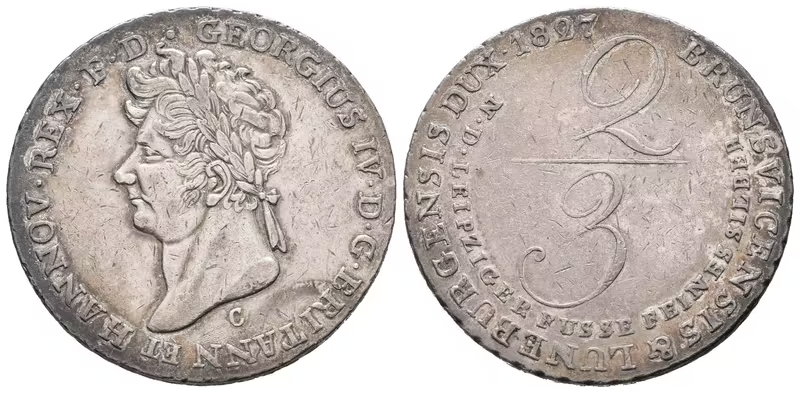
Brunšvicko-Hannoversko, 2/3 Tolaru 1827 C
Braunschweig-Calenberg-Hannover, Georg IV. (1820 - 1830) 2/3 Taler 1827 C , Clausthal, KM.140, AKS.39, tmavá patina, škr. a drobné hranky