Investing in gold
Investing in gold is a way of storing value in a precious metal that has for centuries been seen as "money of last resort" and an insurance against uncertainty. Most often investment goes into physical bars and coins, possibly indirectly through exchange-traded products, with the key being costs, liquidity and the credibility of the origin.
Gold belongs among the oldest stores of value. In many cultures it functioned as material for jewellery and prestige items, but gradually it also established itself in a monetary role - especially because it is rare, durable, easily divisible and relatively easily recognisable. Already in antiquity gold coins appear, and in subsequent centuries gold became a symbol of wealth and state power. In the Middle Ages and the early modern period gold coins were used mainly for larger trade and as a reserve means of payment, while ordinary circulation often rested on silver and small denominations.
In modern times the importance of gold has repeatedly changed depending on how the monetary system functioned. In the period of the gold standard the currency was linked to gold and gold played the role of "anchor" of trust. Later, with the development of central banking and the transition to money backed by trust in the state, gold withdrew from everyday circulation but did not lose its importance as a reserve asset. Central banks keep gold as part of their reserves and in times of crisis and inflation private investors often turn to it as well. It is precisely this historical memory - that gold survives regimes and monetary changes - that explains its attractiveness even today.
In the 20th century investing in gold became more accessible to the wider public. Besides bars and coins, products arose that allow indirect exposure to the price of gold. At the same time the perception of gold changed: instead of "money" it became above all a tool of diversification and an insurance against extreme scenarios. In periods of rapid change - high inflation, geopolitical tension or financial crises - gold tends to be sought after, because its value is not directly dependent on the results of one firm or on the solvency of a particular state. On the other hand, in calmer times gold may lag behind more lucrative assets, because in itself it generates neither interest nor dividend.
History
In the Czech context investment gold is most often associated with the purchase of bars and struck investment coins. Popularity is also raised by the fact that investment gold is typically exempt from VAT within European rules, which distinguishes physical gold for example from many other commodities. For an investor, gold is thus not just a "bet on the price" but also a practical choice for how to take part of one's wealth out of purely financial instruments and have it in tangible form.
The basic decision is whether to choose physical investment gold or paper exposure. Physical gold means bars or investment coins. The advantage is direct ownership of the metal, the disadvantage costs of safe storage, insurance and a higher spread between the buy and the sell price (margin). Indirect forms (for example exchange-traded products linked to the price of gold) are more liquid and often cheaper to hold, but the investor does not own the metal in hand and also bears the "institutional" risks of the system in which the product operates.
With bars the typical standard is high fineness 999.9/1000, and the most common investment sizes are 1 g, 2.5 g, 5 g, 10 g, 20 g, 1 oz (31.1 g), 50 g, 100 g and above. Smaller weights are more accessible but tend to have a higher premium per gram. Larger bars tend to be more advantageous per unit of metal but harder to "split" with a partial sale. The certification and brand of the refinery are also important - the investor should prefer commonly recognised producers and an unbroken seal, because this simplifies future sale.
Forms of investment, parameters and practical selection
Investment coins (typically of 1 oz weight, possibly 1/2 oz, 1/4 oz, 1/10 oz) alongside their gold content have the advantage of easy recognisability and high liquidity. They are often struck at fineness 999.9/1000, sometimes from traditional "coin gold" (for example 916.7/1000), but the decisive thing is always the net weight of gold stated on the particular coin. Many investment coins carry a nominal value (only formal), a state emblem and are traded worldwide, which usually helps with buy-back. Unlike collector coins, on investment types one usually pays a low collector premium and the main role is played by the price of the metal and the current market premium.
When buying it is practical to follow: the difference between buy and buy-back, the credibility of the seller, documents of origin, condition and packaging, and also a plan for storage (home safe vs. bank safe deposit). From the viewpoint of strategy, gold is often used as a supplement to a portfolio - not as the only investment. A gradual purchase over time may make sense in order to reduce the risk of poor timing. Gold is above all an insurance: it may stabilise wealth in a period of uncertainty, but in itself it is not a guarantee of quick returns.
In our auction and shop
- Code: ZEN-2021OREL
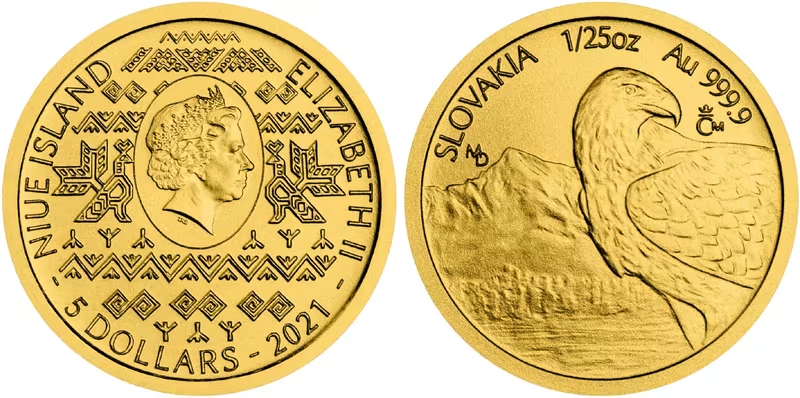
5 Dollars 2021 - Orel, investiční mince
Slovenská republika (1993 - ) 5 Dollars 2021 (Asamat Baltaev) - Investiční mince Orel Au 0,9999, 13 mm (1,24 g), 1/25 Oz Světové investiční mince bývají věnovány silným národním symbolům a ani „Orol“, který je první ražbou svého druhu určenou pro…