Kaláda (Long Coin Debasement)
Kaláda is a historical Czech term for the declaration of state bankruptcy linked with currency debasement, most often recalled in connection with the crisis in the Czech lands at the end of 1623. In practice it meant a sharp fall in the value of the circulating coins and state intervention in the monetary circulation.
The kaláda was most firmly inscribed into Czech historical consciousness by the events of 1621–1623, when the financial straits of the Habsburg government were combined with the harsh post-war policy following the defeat of the Estates' Uprising. After the Battle of White Mountain, Ferdinand II needed to obtain quickly the resources for waging the Thirty Years' War, for maintaining mercenary armies and at the same time for consolidating power in the Czech lands. Ordinary revenues did not suffice, and the debts of the ruler and his administration were accumulating from previous years. It was precisely in this situation that there came to the fore a plan to "extract" immediate finance from monetary circulation.
The key instrument became the leasing of the mints to a private grouping — the so-called Mint Consortium. At its head stood the Dutch banker Jan de Witte, and among the well-known participants appear also Charles I of Liechtenstein, Albrecht of Wallenstein, Jacob Bassevi and other influential personalities of the court and administration. The consortium gained the right to strike new coins and at the same time to enforce that precisely these newly struck pieces should prevail in circulation. The basic principle was simple but devastating for the population: the new coins contained significantly less silver than the earlier high-quality strikes, yet were to circulate at the same or a higher face value.
Kaláda
In practice, a rapid and targeted debasement thus occurred. The older, higher-quality coins were withdrawn and served as raw material for the striking of new, "lighter" and less fine pieces, into which ordinary metals were admixed. The difference between the value of the metal and the face value created profit for the lessees of the mints and at the same time brought ready money into the state treasury — particularly in the form of rent and the rapid financing of military expenditure. This policy, however, inevitably undermined confidence in the currency: prices rose, merchants demanded better means of payment, people sought to preserve value in high-quality silver, and circulation began to be deformed.
The crisis culminated at the end of 1623, when a fundamental intervention was made in the circulation: the value of the coins then in use was officially reduced, and their replacement by "more stable" currency was ordered. In contemporary and later accounts the kaláda is therefore described as a state bankruptcy linked with a sharp fall in the purchasing power of money. Dramatic was not only the speed but also the scope of the debasement, which affected everyday life. While the state and a narrow circle of people connected with the coinage business were able to benefit from the process, the population bore the costs in the form of rising prices, uncertainty and the loss of confidence in money.
History
The kaláda at the same time became a symbol of the fact that currency is not just a technical question of mints but a sensitive "nerve" centre of the economy. As soon as confidence in the value of the circulating currency collapses, it shows itself immediately in prices, contracts, debts and in people's ability to plan. For this reason the events of 1623 are recalled in the Czech setting to this day — not only as a numismatic episode but as a warning example of how extraordinary financial policy can in a short time disrupt the economic conditions of an entire country. At the origin of the word, a connection with the meaning "fall" is sometimes given, although there is no need to over-emphasise a definite interpretation — more essential is that the term became domesticated in Czech as a designation for a sharp monetary collapse and state bankruptcy.
The kaláda is exceptional for numismatics in that it can be "read" directly in the money. A typical sign is the rapid alternation of issues, conspicuous differences in the quality of the metal and sometimes even in the overall impression of the strike. In the period of debasement, several types of coins appear in circulation, whose face value ceases to correspond to what people feel as the real value. High-quality silver disappears into hoards, while poorer coins circulate more often, because no one wishes to hold them for long.
How the Kaláda Manifests Itself in Coins and in Circulation
The practical impact on everyday life is well imaginable: wages and prices diverge, debts are repaid in "poorer" currency, and whoever has the option seeks to receive payment in the metal in which he trusts. The state then usually attempts to close the situation by a stabilising step — to set new rates, to withdraw the problematic coins and to return to circulation a more reliable strike. For collectors and researchers it is important that in such periods we often encounter a great quantity of variants and coins which are historically powerful but which at the same time require precise identification by year, mint and type.
The kaláda is therefore not "one coin" but a dramatic chapter of monetary history: it shows the relationship between state finances, power and confidence in money. If the kaláda is spoken of for a particular period in the Czech lands, it is usually a reminder that money can be used as an instrument of policy — and that the costs of such an intervention tend to be very high for society.
In our auction and shop
- Code: XB1300-0402
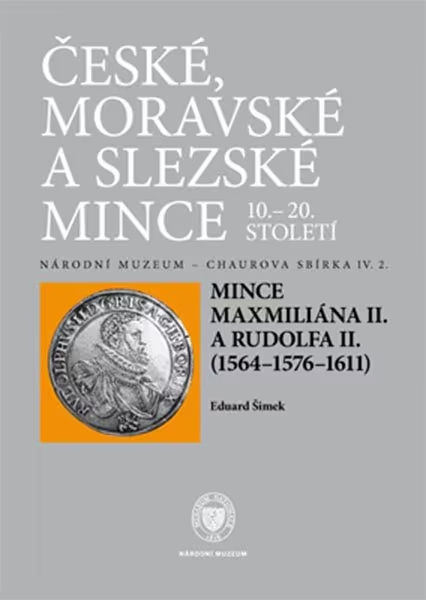
Chaurova sbírka - Mince Maximiliána II. a Rudolfa II. (1564 - 1576 - 1611)
Eduard Šimek České, moravské a slezské mince 10. - 20. století - Mince Maximiliána II. a Rudolfa II. (1564 - 1576 - 1611) , Praha 2011, 432 stran, vázané Předkládaná publikace – druhý sešit čtvrtého svazku edice České, moravské a slezské mince 10.–20.…