Charles Albert of Bavaria
Charles Albert of Bavaria was Elector of Bavaria and, in the years 1742 to 1745, Holy Roman Emperor under the name Charles VII. As the only non-Habsburg emperor in more than three centuries, he tried to dispute the succession of Maria Theresa and to assert his own claims to the Habsburg inheritance.
Charles Albert of Bavaria was born on 6 August 1697 in Brussels, the son of the Bavarian Elector Maximilian II Emanuel and the Polish princess Theresa Kunegunda Sobieski, daughter of the famous King John III Sobieski. His childhood was marked by the War of the Spanish Succession, during which his father, as an ally of France, was deprived of the electorate and the family was forced into exile. Only the Peace of Rastatt of 1714 enabled the Wittelsbachs to return to Bavaria.
After his father's death in 1726 Charles Albert assumed the government of Bavaria. As elector he sought to strengthen the standing of his country among the German states and cultivated ambitions reaching beyond the boundaries of a medium-sized territory. In 1722 he married Maria Amalia of Habsburg, daughter of Emperor Joseph I, which later provided him with a pretext for claims to the Habsburg inheritance. The marriage was happy and produced seven children.
The opportunity to realise his dynastic ambitions came with the death of Emperor Charles VI in October 1740. Although Charles VI had spent a considerable part of his reign securing international recognition of the Pragmatic Sanction, which was to guarantee the succession to his daughter Maria Theresa, Charles Albert refused to recognise this arrangement. He cited older inheritance agreements and the claim of his wife as daughter of Joseph I, the elder brother of Charles VI.
The War of the Austrian Succession broke out when the Prussian king Frederick II the Great invaded Silesia in December 1740. Charles Albert joined an anti-Habsburg coalition including France, Prussia, Saxony and Spain. With the support of French troops he invaded Bohemia and in December 1741 had himself crowned King of Bohemia in Prague. Acceptance of the Bohemian crown was intended to legitimise his candidacy for the imperial throne.
History
On 24 January 1742 Charles Albert was elected Holy Roman Emperor at Frankfurt am Main as Charles VII. He thus became the first non-Habsburg emperor since 1438, when the dynasty had obtained this dignity. His coronation took place on 12 February 1742 with all the splendour of the traditional ceremonial. By an irony of fate, on the very day of the election Austrian troops occupied Munich, the capital city of the new emperor.
The empire of Charles VII was from the outset marked by military weakness and financial dependence on France. Bavaria remained occupied by Austrian forces, and the emperor could not return to his own country. He lived in exile in Frankfurt, from where he tried in vain to influence the course of the war. Maria Theresa meanwhile consolidated her power, gained the support of Hungary and Britain and went over to the counter-attack.
The health of Charles VII rapidly deteriorated under the weight of worries, military failures and financial difficulties. He suffered from gout and other illnesses. He died on 20 January 1745 in Munich, to which he had managed to return shortly before, after a temporary Austrian withdrawal. His son and successor Maximilian III Joseph concluded peace with Maria Theresa and renounced claims to the Habsburg inheritance in exchange for recognition of Bavarian integrity.
The reign of Charles VII left an interesting trace in coinage. As Holy Roman Emperor he struck coins with imperial insignia and titulature; at the same time Bavarian electoral coinage continued. Coins from this short period are relatively rare given the limited length of his reign and the financial difficulties that limited mintage.
Numismatic significance
On the imperial coins of Charles VII his portrait appears with the imperial crown and the titulature Carolus VII D.G. Rom. Imp. Semp. Aug. (Charles VII by the grace of God Holy Roman Emperor, ever august). The reverses bear the imperial eagle or the denomination with the year. Bavarian strikings of the same period depict the electoral insignia and the Wittelsbach arms.
A particular numismatic curiosity is formed by coins struck during Charles's short reign in Bohemia. As King of Bohemia, Charles struck Bohemian ducats and thalers in the Prague mint with his portrait and the Bohemian lion. These strikings are very rare and represent a unique episode within an otherwise unbroken Habsburg Bohemian coinage.
In our auction and shop
- Code: SFRA-D1990
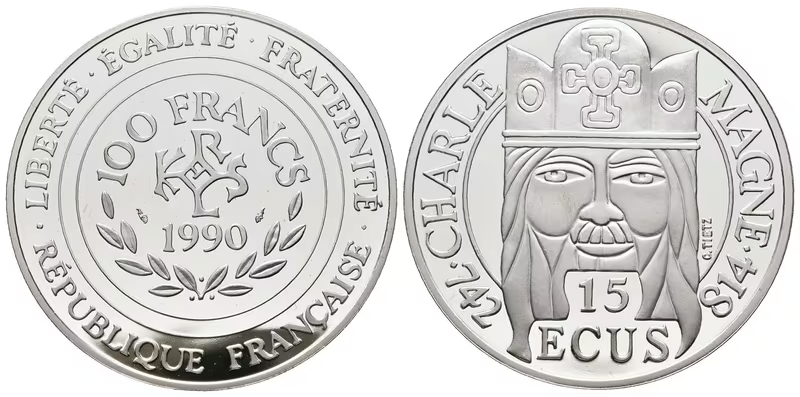
Francie, 100 Francs / 15 Ecus 1990 - Karel Veliký (Charlemagne, 742-814)
Francouzská republika (1958-dosud) 100 Francs / 15 Ecus 1990 - Karel Veliký (Charlemagne, 742-814), KM# 983 Ag (.900), 37 mm (22,2 g), v kapsli. Stav mince odpovídá fotografii.
Skladem 1 ks - Code: M78B-BZ1719
Karel VI., 1/2 Krejcar 1719
Karel VI. (1711 - 1740) 1/2 Krejcar 1719, Kutná Hora-Weyer, oxidace, lehce olámaný_R!
Skladem 1 ks - Code: RASPANEK-1958A
Špánek Karel - Výročí korunovace Jiřího z Poděbrad
Špánek Karel (1883 - 1983) AR Medaile 1958 - 500. výročí korunovace Jiřího z Poděbrad a Kunštátu českým králem Ag 0,900, 29 mm (12,13 g), puncováno luxusní zachovalost, jemná patina, lesk
Skladem 1 ks - Code: RASPANEK-1958A.1
Špánek Karel - Výročí korunovace Jiřího z Poděbrad
Špánek Karel (1883 - 1983) AR Medaile 1958 - 500. výročí korunovace Jiřího z Poděbrad a Kunštátu českým králem Ag 0,900, 29 mm (12,17 g), puncováno luxusní zachovalost, jemná patina, ražební lesk
Skladem 1 ks