Maximilian III Joseph
Maximilian III Joseph of Bavaria (1727–1777) was Elector of Bavaria reigning from 1745 to 1777, the last sovereign of the direct Wittelsbach line, who became famous as an enlightened absolutist modernising Bavaria during the second half of the 18th century and whose childless death triggered the War of the Bavarian Succession. Maximilian III Joseph is sig…
Maximilian was born on 28 March 1727 in Munich as the son of the Bavarian Elector Charles Albert (the later Emperor Charles VII) and Maria Amalia of Austria. He grew up during the War of the Austrian Succession, when his father acquired the imperial crown but Bavaria was occupied by Austrian troops. These experiences taught him caution in foreign policy and a focus on the internal development of the country.
His accession to the throne in 1745 after his father's death meant that the eighteen-year-old Maximilian inherited a war-ravaged Bavaria with an empty treasury and a demoralised population. The young Elector had to abandon his father's imperial ambitions and concentrate on the renewal and modernisation of the country along the lines of enlightened absolutism.
The peace with Austria concluded in 1745 ended Bavaria's participation in the war of succession and enabled Maximilian to begin the reconstruction of the country. The Elector renounced claims to the Austrian inheritance in exchange for recognition of Bavarian independence and Austrian support for the renewal of the economy. This pragmatic policy saved Bavaria from further war devastation.
Enlightened reforms characterised the whole of Maximilian's reign. The Elector introduced religious tolerance, modernised the legal system, supported education and improved the position of peasants. He founded the Bavarian Academy of Sciences in 1759 and supported the development of manufactories and trade according to mercantilist principles.
Economic reforms transformed feudal Bavaria into a modern state. Maximilian supported agricultural innovations, the introduction of new crops and soil improvement. He had a road network built linking the main Bavarian cities and supported the development of crafts and manufactories, especially the textile industry.
History
Cultural patronage made Munich an important cultural centre. The Elector supported Baroque and Rococo art, had the Munich Residenz rebuilt and founded a court theatre and opera. Under his patronage worked significant architects, painters and musicians who enriched Bavarian culture.
A policy of neutrality enabled Bavaria to avoid further war conflicts. During the Seven Years' War (1756–1763) Maximilian maintained neutrality between Austria and Prussia, which made it possible to continue internal reforms and economic development. This wise policy contrasted with the adventures of his father.
Religious policy combined Catholic orthodoxy with enlightened tolerance. Maximilian remained a faithful Catholic, but limited Jesuit influence on education and administration and enabled greater freedoms for Protestants and Jews. These reforms modernised Bavarian society while preserving the Catholic identity.
Maximilian's childlessness raised concerns about the future of the dynasty. The Elector never married and had no legitimate children, which meant that the direct Wittelsbach line would die out with him. This situation created tension over the succession among distant relatives from various Wittelsbach branches.
The death of Maximilian on 30 December 1777 in Munich ended the direct Wittelsbach line and triggered the War of the Bavarian Succession (1778–1779) between Austria and Prussia. The throne was inherited by Charles Theodore of the Palatinate, but Emperor Joseph II laid claim to parts of Bavaria. Maximilian's legacy lies in the modernisation of Bavaria and the creation of foundations for its 19th-century prosperity.
Maximilian III Joseph in numismatics
Maximilian III Joseph's coins document his 32-year reign and reflect the transition from Baroque pomp to enlightened elegance. The portraits show the Elector from a young man to a mature sovereign with emphasis on dignity and wisdom. The design gradually adopts neoclassical elements typical of the Enlightenment period.
Characteristic motifs are allegories of prosperity and wisdom — cornucopias, Minerva, books and symbols of the sciences and arts reflecting Maximilian's support for the Enlightenment. The Bavarian coat of arms with crown and Wittelsbach lion dominates most issues, often supplemented by the imperial eagle emphasising electoral status.
Commemorative coins for the founding of the Academy of Sciences (1759) and other cultural projects document Maximilian's role as patron of education and culture. These rarer issues often contain allegories of the sciences, arts or references to specific institutions founded during his reign.
The quality of Bavarian coins during Maximilian's reign is high thanks to the country's economic prosperity and the Elector's support of the artistic crafts. Thalers and ducats from this period represent the peak of Bavarian Rococo coinage with precise portraits and rich symbolic ornamentation reflecting the cultural flourishing of Munich.
In our auction and shop
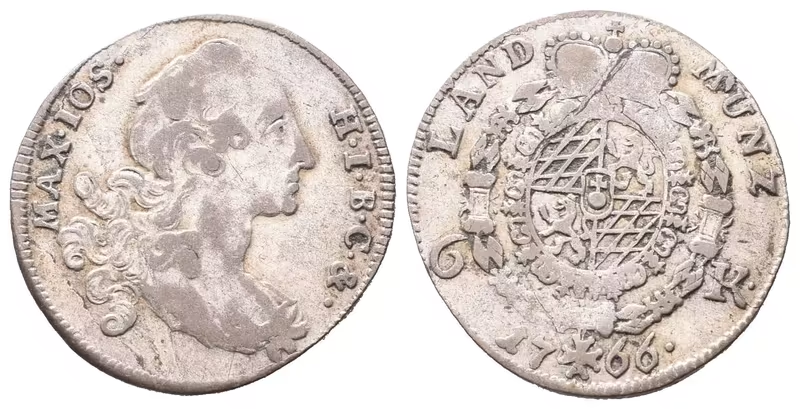
- Code: NABAV-G1766
Bavorsko, 6 Krejcar 1766
Bavorsko (Bayern), Maximilian III. Josef (1745 - 1777) 6 Kreuzer 1766, Mnichov, KM.542, patina, rysky
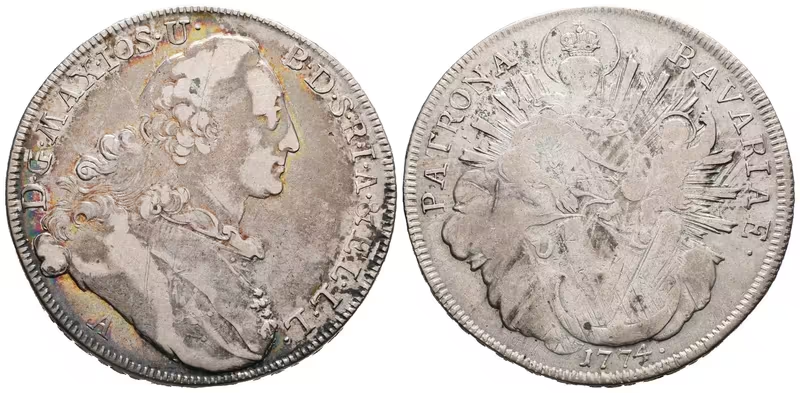
Skladem 1 ks - Code: NABAV-G1774A
Bavorsko, Tolar 1774 A, Amberg
Bavorsko (Bayern), Maximilian III. Josef (1745 - 1777) Tolar 1774 A, Amberg - madona, KM.234.2, pěkná zachovalost, patina, just.
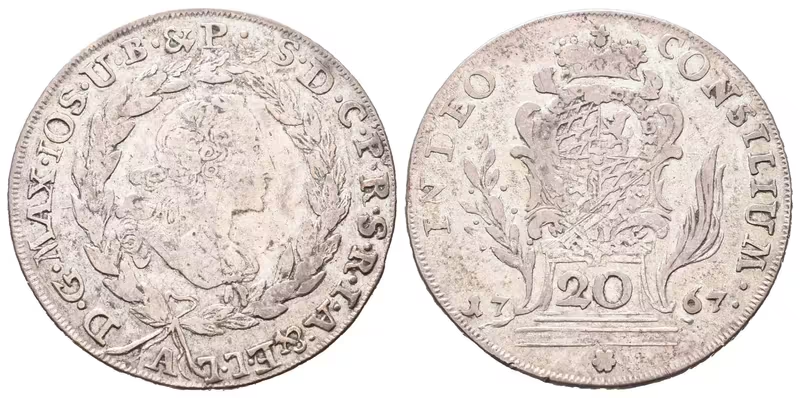
Skladem 1 ks - Code: NABAV-E1767
Bavorsko, 20 Krejcar 1767
Bavorsko (Bayern), Maximilian III. Josef (1745 - 1777) 20 Kreuzer 1767, Mnichov, KM.528, patina, rysky, just.
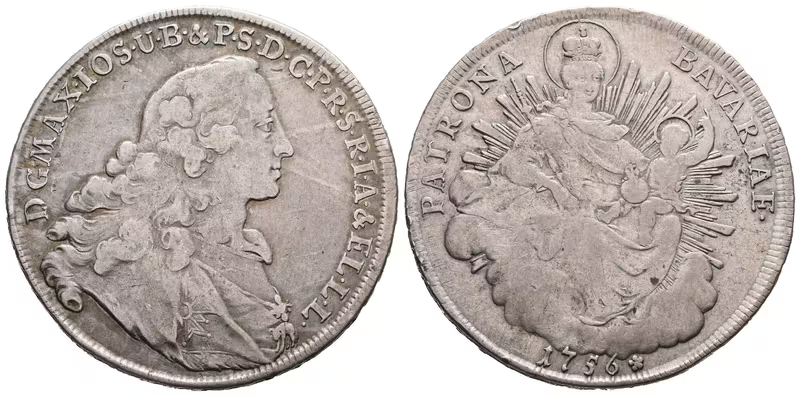
- Code: NABAV-G1756
Bavorsko, Tolar 1756
Bavorsko (Bayern), Maximilian III. Josef (1745 - 1777) Tolar 1756, Mnichov, KM.234.2, velmi pěkná zachovalost, patina, lesk, drobné hranky a rysky