Polished field
A polished field is a mirror-smooth surface in the background of a coin, typical especially of proof-quality strikes, where it contrasts with the matt relief. It arises from a special treatment of the dies and the blanks and is very sensitive to scratches, fingerprints and inexpert cleaning, so it has a marked effect on the resulting preservation grade.
The polished field is linked to the development of qualitative grades of mintage, which began to assert themselves more strongly in the modern period and especially in the 19th and 20th centuries. Whereas ordinary circulating coins were produced primarily with an emphasis on speed and durability, representative issues were also to play the role of a "shop window" of the mint: to show the technical standard of production, the quality of the engraving and the aesthetic of the design. It was precisely for such purposes that methods were developed leading to an exceptionally smooth, lustrous background and to a sharp, contrasting relief.
In earlier issues a very smooth surface could appear even by accident, for instance thanks to more careful working of the blanks or to fresh dies, but only with the development of mechanical mintage could this effect be produced deliberately and repeatably. Mints began to use specially prepared dies, the surfaces of which were polished to a high lustre so that the field of the coin would act as a mirror. At the same time the blanks were also treated; they were cleaned, sometimes polished, and often struck under higher pressure or with multiple blows so that the detail was fully "pushed" into the metal.
In this way the quality known as proof arose, intended for collectors, presentation sets, diplomatic gifts or ceremonial occasions. The polished field became one of the most visible features of such issues: even a layman often recognises at first sight that this is a coin "different" from a circulating one, because the background is deeply lustrous and the design stands out by contrast. Further terminology and intermediate grades gradually developed, since some coins have only a partially mirror-like effect, or have it pronounced only in certain parts of the field, for example on very early strikes from fresh dies.
History
In modern numismatics the term polished field is used not only for proof issues, but also for coins that were produced with greater care without being full-fledged proofs. Mints sometimes produce so-called top circulation quality, commemorative coins or collectors' editions, where a higher lustre of the fields is also worked with. The difference is that in proof the mirror effect is usually the goal and the standard, whereas in other qualities it may be more a "side" result of more careful production.
A polished field looks like a pure mirror: when the coin is tilted it reflects its surroundings and the light in continuous planes, without the typical "circular" mint lustre we know from ordinary coins. That is why it is sometimes called a mirror field. On proof issues it usually contrasts with the matt relief, which can be created by the deliberate roughening of certain parts of the die so that the design stands out plastically and optically "darker".
In practice the polished field is very delicate. Even a slight contact with a harder material can leave hairline scratches, which on a mirror surface are far more visible than on an ordinary coin. Proof coins are therefore commonly kept in capsules or in original cases, and it is not recommended to touch the surfaces with the fingers. A frequent problem is also traces of inexpert cleaning: polishing may indeed "light up" the surface, but at the same time creates typical micro-scratches that worsen the appearance and, for collectors' coins, can significantly reduce the value.
How a polished field looks and how it is assessed
When grading, attention is paid above all to the cleanliness of the surfaces and the extent of disturbing marks. With proof coins, greater emphasis is usually placed on a perfect surface than with circulating coins, because the purpose was not circulation but representation. At the same time there are issues that have a mirror effect only partially or only at a certain angle of light; with these it is important to distinguish whether it is intentional quality or merely the result of fresh dies and a careful strike. For collectors, the polished field is one of the most beautiful elements of modern coin production, but at the same time the most sensitive place, which decides the overall impression.
In our auction and shop
- Code: ZC501.A
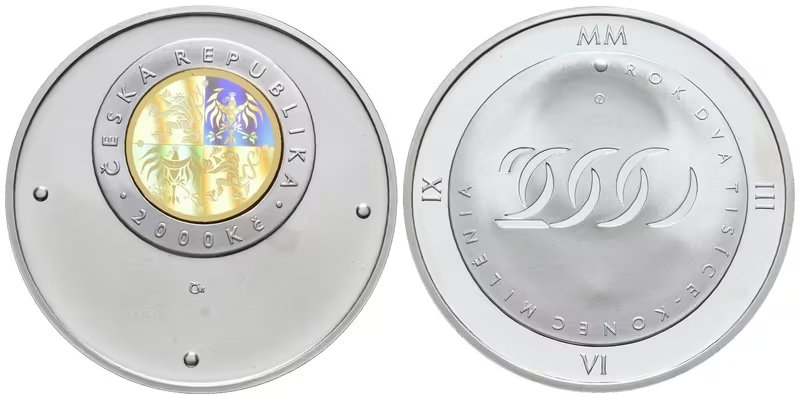
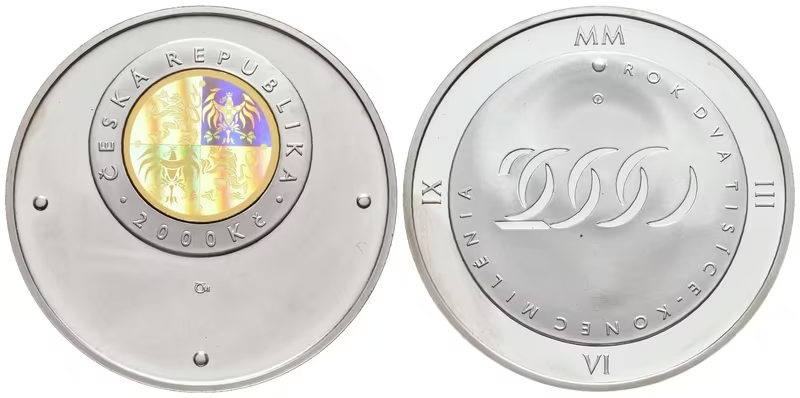
2000 Kč 2000 - Rok dva tisíce - konec milénia
Česká republika (1993 - ) Mimořádné a bimetalové ražby zlatých mincí 2000 Kč - Rok 2000 - konec milénia, autor Otakar Dušek, Aurea C501, etue, bez certifikátu, matové averzní pole, nep. oxidační tečka a skvrnka u hrany na reverzu Ag 0,999 (31,1 g), Au…
Skladem 1 ks - Code: ZC501.1
2000 Kč 2000 - Rok dva tisíce - konec milénia
Česká republika (1993 - ) Mimořádné a bimetalové ražby zlatých mincí 2000 Kč - Rok 2000 - konec milénia, autor Otakar Dušek, Aurea C501, etue, bez certifikátu, skvrnka u hrany na reverzu na 8 hod., jinak bezvadná Ag 0,999 (31,1 g), Au 0,9999 (3,111 g),…
Skladem 1 ks - Code: ZC501-PROOF.1
2000 Kč 2000 - Rok dva tisíce - konec milénia, PROOF - matové averzní pole
Česká republika (1993 - ) Mimořádné a bimetalové ražby zlatých mincí 2000 Kč 2000 - Rok 2000 - konec milénia, autor Otakar Dušek, Aurea C501, etue, certifikát, matové averzní pole, patina a drobná oxidace, ilustrační foto Ag 0,999 (31,1 g), Au 0,9999…
- Code: ZSPOB-2009
Pobřeží slonoviny, 1500 Francs 2009 - HMS Victory
Pobřeží slonoviny (Cote D´Ivoire) 1500 Franků 2009 - Plachetnice SMS Victory Au 0,999, 13,92 mm (1,00 g), PROOF, certifikát Z cyklu Nejmenší zlaté mince světa
Skladem 1 ks