Loth
The loth is an older unit used both for weight and for expressing the fineness of silver, widespread especially from the groschen period. In the Czech setting the loth was counted as part of the Prague grivna and at the same time served the practical description of how "pure" the silver was in the alloy intended for the striking of coins.
The loth system arose from the need to have a simple and intelligible measure for working with silver at a time when monetary circulation rested on the striking of coins and when the quality of the metal decided the confidence in the currency. In coinage it is not enough to know merely the weight of the coin; just as important is how much of it consists of real silver and how much of admixtures. The loth made it possible to express this ratio practically and without complicated counting in thousandths, which are commonly used today.
In the Czech lands the loth was used as a unit of weight from the beginning of the groschen period. It related to the Prague grivna, which was the basic unit of weight for the calculation of mintage. The loth made up 1/16 of the Prague grivna, which in the numismatic context is given as around 253 g. From this it follows that one loth had approximately 15.8 g. This relationship is also important for understanding contemporary mint accounting: when planning a strike one worked with grivnas and their parts, so the loth was a natural unit "in the hand".
Still more significant, however, is the loth as a unit of fineness. In the loth system, fineness is expressed by the number of loths of pure silver in a whole of 16 parts. Sixteen-loth silver thus means pure silver (in modern notation 1000/1000). Eight-loth silver contains half silver and half admixtures, corresponding to 500/1000. Such an expression was very useful in practice: both the mintmaster and the assayer could quickly judge whether the alloy corresponded to the prescribed standard, and at the same time loths could easily be converted into dosing during smelting.
History
The loth system was applied in our lands markedly especially in the thaler period, when large silver coins were struck and the control of the quality of the metal was of exceptional importance. Large denominations placed higher demands on the stability of the standard: even small deviations in fineness meant great differences in the quantity of precious metal in large issues. Loths therefore became the common language of mint practice, which appears in the period regulations and descriptions of metal as well.
Loth fineness can be understood as a simple "fraction" out of sixteen. If the alloy has, for instance, 12 loths, it means that 12/16 is pure silver, that is 0.75 (in modern expression 750/1000). Similarly, 14-loth silver corresponds to 14/16, that is 875/1000. In practice, loths could thus be used directly for the mixing of metal: the mint set the required fineness and the smelters knew what proportion of pure silver and admixtures to prepare.
In numismatics the loth is a useful concept when describing older coins and mint regulations. When a source mentions "loth silver", it is not about the weight of the coin but about the quality of the alloy from which the strike was made. In catalogue descriptions the fineness is today usually converted to thousandths (for example 833/1000), but in historical strikes you may also encounter the original loth expression, since it corresponds to contemporary terminology and helps to grasp precisely how coinage thought about the quality of the metal.
The loth as a measure of fineness and how it is used
The loth as a unit therefore links two levels: that of weight (1/16 of a grivna) and that of fineness (the number of parts of pure silver out of 16). In both cases it is a practical tool of mint practice, which helped to standardise production and to maintain confidence in coins at a time when the quality of the metal was one of the main "laws" of money.
In our auction and shop
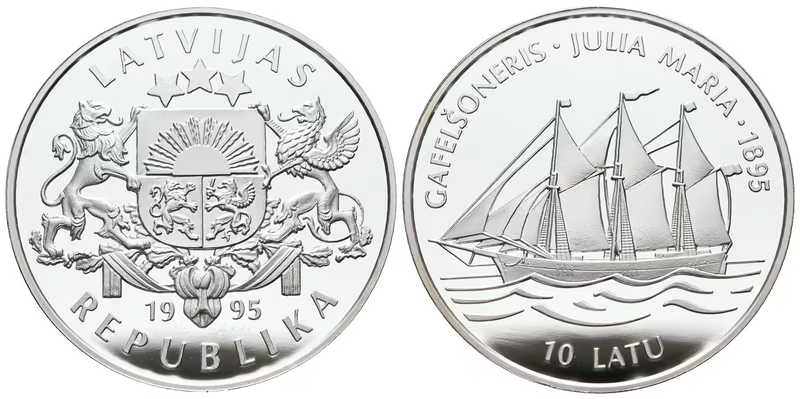
- Code: SLOTY-K1995
Lotyšsko, 10 Latu 1995 - Plachetnice Julia Maria
Lotyšská republika (1993-2013) 10 Latu 1995, 100. výročí plachetnice Julia Maria, KM# 25 Ag (.925), 38,61 mm (31,47 g), proof, v kapsli. Emise: 20 000 ks. Série "Historie mořeplavby - Lotyšské lodě". Mincovna: Valcambi, Balerna - Švýcarsko. Autor: Jānis…
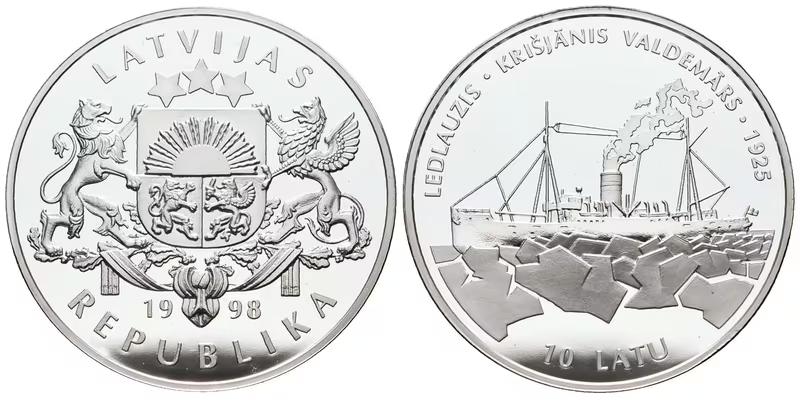
Skladem 1 ks - Code: SLOTY-K1998
Lotyšsko, 10 Latu 1998 - Ledoborec Krisjanis Valdemars
Lotyšská republika (1993-2013) 10 Latu 1998 - Ledoborec Krisjanis Valdemars, KM# 32 Ag (.925), 38,61 mm (31,47 g), proof, v kapsli. Emise: 10 000 ks. Série "Historie mořeplavby - Lotyšské lodě". Mincovna: Valcambi, Balerna - Švýcarsko. Autor: Arvīds…
Skladem 1 ks - Code: BLOTYS10010B
Lotyšsko - Libava, 10 Kopějka (1915), chybotisk
Lotyšsko / Latvia 10 Kopějka (1915), chybotisk N/UNC
Skladem 1 ks - Code: BLOTYS20500D
Lotyšsko - Libava, 5 Rubl 1915, chybotisk (posunutý podtisk)
Lotyšsko / Latvia 5 Rubl 1915, chybotisk (posunutý podtisk) N/UNC
Skladem 1 ks