Louis III of Hesse-Darmstadt
Louis III of Hesse-Darmstadt (1806–1877) was Grand Duke of Hesse and by Rhine, who reigned from 1848 to 1877. His era falls within the turbulent 19th century from the revolution of 1848 through the Austro-Prussian conflict to German unification, which fundamentally changed the position of the small German states.
Louis III of Hesse-Darmstadt was born in Darmstadt as the eldest son of Louis II of Hesse and Wilhelmina of Baden. He grew up in the environment of a small but politically sensitively placed state: Hesse lay between great-power influences, had important transport routes and at the same time constantly had to come to terms with the fact that its sovereignty depended on the balance of power in Germany. As heir he underwent military training and also studied at the University of Leipzig; aristocratic education also included travels around Europe which shaped court contacts and political horizons.
In 1833 he married Mathilde Caroline of Bavaria. The marriage remained childless, which later raised the importance of dynastic succession within the wider family line. The revolutionary wave of 1848 became a turning point. In Hesse the questions of the constitution, civil rights and modernisation of administration were then opened. Louis was called to the role of co-ruler in March 1848 and, after his father's early death, became Grand Duke. In the first months he was perceived as a sovereign from whom liberal circles expected changes: new figures came to the head of the government and some of the demands of the day were affirmed. At the same time, however, the grand duke himself understood government rather as a task grounded in tradition and order than as space for experimentation.
After the revolutionary tensions had subsided, more conservative tendencies strengthened in Hesse and the country took a long-term pro-Austrian orientation in German politics. This proved problematic in the Austro-Prussian conflict of 1866, when Hesse found itself on the losing side. Military and diplomatic pressure meant hard negotiations for the small state about what it would retain and what it would lose. Hesse had to accept the new conditions and enter into the North German state framework, by which its sovereignty was effectively narrowed and ties to Prussia became a reality — even though that had not been Louis's original political goal.
History
After 1871 the German space was fundamentally transformed by the creation of the German Empire. For the grand duke's government this meant that the traditional court diplomacy of small states no longer carried the same weight as before: the decisive word lay with Berlin. Louis III, moreover, withdrew from public life in his later years, and some of his duties were gradually taken over by his successor. He died in 1877, closing the chapter of a sovereign whose reign played out during the transition from the "old" Germany of principalities to a modern nation state.
Louis III of Hesse-Darmstadt is commemorated in numismatics above all by the circulation coins of the Grand Duchy of Hesse which bore his name, titles and the country's heraldry. In the mid-19th century, southern Germany commonly used a currency based on the gulden and kreuzer, so one encounters small kreuzer values as well as higher silver denominations. These strikes in particular are attractive for collectors, as the combination of the ruler's portrait and state emblems — which was meant to affirm the legitimacy of the issuer and confidence in the coin's parameters — comes out well on them.
The coins typically have a dual function: practical and representative. Small kreuzer pieces served everyday payment at markets, in towns and in the countryside, and wore down quickly in circulation. Higher silver values, by contrast, kept better and have more often survived in decent condition, so they allow one to follow the portrait style of the time as well as the quality of mintage. With Hesse coins of this period it is also important to perceive the wider German context: coins from a number of states circulated together, and merchants were sensitive to whether they matched in weight and fineness. For this reason even small states sought to maintain their strikes to a recognisable, trustworthy standard.
The ruler on coins and monetary context
After 1871 German unification accelerated the transition to a more uniform monetary environment, and older denominations gradually became "coins of one epoch". This is precisely what makes the strikes of Louis III attractive to collectors: they represent the last generation of coins of a small German state before the financial and political space began to be governed from the centre of the new empire. For a collection of German state strikes, coins bearing his portrait thus form a well-legible link between the revolutionary year of 1848 and the late 19th century.
In our auction and shop
- Code: GO-C10
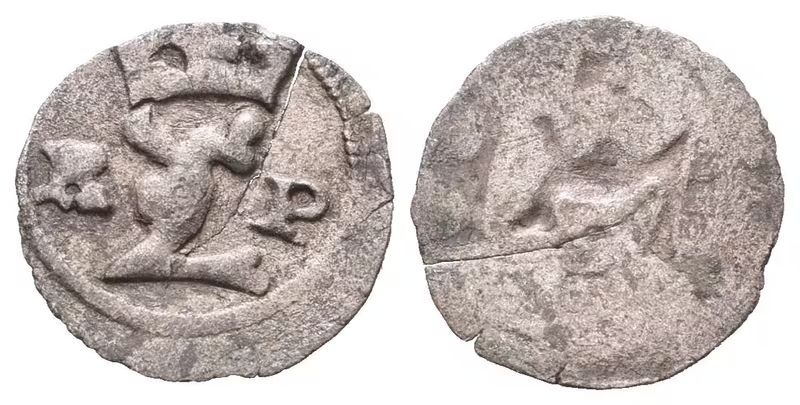
Ludvík I., Bílý peníz, Cast. III/10
Ludvík I. (1516 - 1526) Malý (černý) peníz, Castelin 10, Smolík 60 (0,30 g) napr. střížek