Mansfeld thalers
The Mansfeld thalers are silver thalers struck by the Counts of Mansfeld, famed for the motif of St George — St George on horseback piercing a dragon with his lance. They rank among the sought-after strikes of the early modern period, since they combine quality silver, striking iconography and a strong symbolism of protection.
The Mansfeld thalers grow out of an extremely specific environment of central Germany, where in the 16th century two key factors met: rich mining and the ambitions of the local nobility. The Mansfeld family controlled the territory around Eisleben and other towns which lived from the mining and processing of ores, especially silver and copper. It was precisely the availability of metal that enabled coinage to become not only a practical instrument of trade but also a means of representation. At a time when the thaler asserted itself as an internationally intelligible large silver coin, the issuer's own thaler mintage meant prestige, revenue and influence in regional circulation.
The motif of St George appeared elsewhere too in the European coinage tradition, but with the Mansfelds it became one of the most typical and best-known. The depiction of St George as a knight triumphing over the dragon was legible across countries and had a clear meaning: the triumph of good over evil, protection and bravery. In the environment of the early modern period, marked by religious conflicts, wars and the uncertainty of travel, such iconography acquired an even stronger charge. It is no coincidence that these thalers were later understood in popular belief as objects with a protective function — people wore them as amulets against misfortune, injury or dangerous journeys.
The mintage of Mansfeld thalers is closely tied to the mint at Eisleben, where the family relied on technical facilities and on a sufficient supply of metal. On the coins, alongside the St George scene, the titulature and the family heraldry appear, confirming the issuer and at the same time showing his standing in the imperial space. Typical for collectors is that the Mansfeld strikes exist in a series of variants — according to individual branches of the family, years and small differences in legends and execution. This is connected with the fact that the Mansfeld domains were not always administered as a single unit and family lines changed over time, which was naturally reflected in coinage production.
History
Alongside the basic "St George" scene, the later tradition also associates the motif of a ship in a storm with Christ and the apostles, which on St George thalers in some periods appeared as a supplementary image on the other side of the coin. Such a depiction reinforced the protective interpretation: the coin was to be not only a means of payment but also a reminder of faith and hope in time of danger. It is precisely this combination of striking scene and strong message that lies behind the fact that the Mansfeld St George thalers also inspired imitation at other mints — their motifs penetrated into further strikes, whether coins, medals or later commemorative pieces.
In time, the Mansfeld thalers became a collecting phenomenon. They are not just "one coin" but a whole circle of strikes on which one can follow the changes of style, inscriptions and technological execution. In this lies their value still today: they represent a tangible record of an era when the thaler was a European standard and when the regional power of families and princes was inscribed into circulation through large silver coins with a clear message.
Mansfeld thalers are prized above all for the iconography of St George on horseback with a lance and for the striking composition, which on the large surface of the thaler appears extraordinarily plastic. The thaler format was ideal for such scenes: it permitted detailed engraving, legible legends and rich heraldry. To the ordinary observer the dynamism of the scene is most impressive — the knight in motion, the dragon and often also accompanying elements that create the impression of a "story" in metal. It is precisely this artistic effect that is one of the reasons why these coins are collected even outside narrowly specialised collections of German territorial strikes.
Motif, parameters and collecting appeal
From the material point of view, these are silver coins corresponding to the thaler circle of the early modern period, that is, strikes intended for higher payments, trade and the storage of value. In circulation the thaler behaved differently from small coins: it was less often "turned over" in everyday small purchases, but it was used all the more in market and larger transactions. For this reason Mansfeld thalers may survive both in markedly circulated grades and in good preservation, if they were kept as a store of value, a memento or precisely as a protective object.
For collectors, variability is important. With Mansfeld thalers one follows the year, the legend, the form of the coat of arms and sometimes also fine differences in engraving which arose by the replacement of dies or by a differing practice at the mint. Interesting also are pieces that bear traces of being worn as a pendant or amulet — these interventions, while lowering the "numismatic" preservation, sometimes increase the historical witness, since they show how people actually perceived and used the coin. If the motif of the ship in a storm appears, it tends to be another element that collectors specifically seek out, because it broadens the iconographic story of the coin and strengthens its symbolic level.
The Mansfeld St George thalers thus stand at the border of several worlds: they are large silver trade coins, representative strikes of the family, and at the same time objects to which folk tradition ascribed a protective force. It is precisely this combination that makes the Mansfeld thalers one of the most attractive groups of thaler strikes of the early modern period.
In our auction and shop
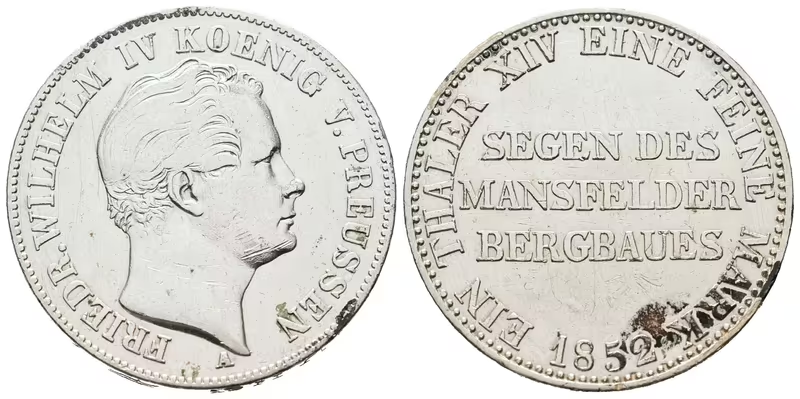
- Code: NAPRU96-B1852
Prusko, Tolar 1852 A - Výtěžkový
Pruské království, Friedrich Wilhelm IV. (1840 - 1861) Tolar 1852 A - Z výtěžků Mansfeldských dolů, Dav.770, KM.455, patina, rysky a hranky
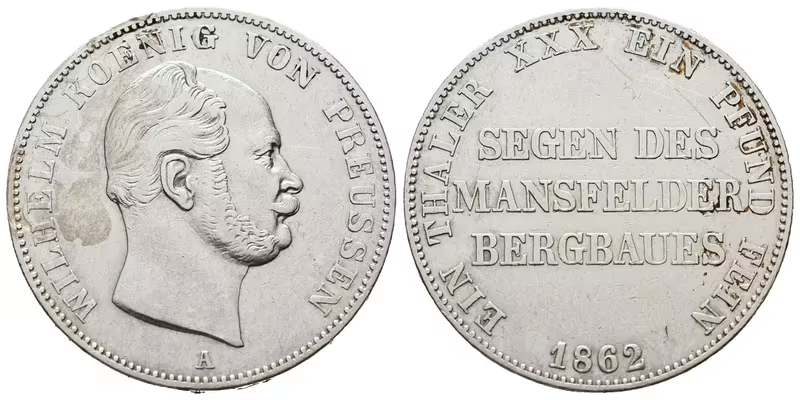
- Code: NAPRU97-B1862
Prusko, Tolar 1862 - Výtěžkový
Pruské království, Wilhelm I. (1861 - 1888) Tolar 1862 A - Z výtěžků Mansfeldských dolů , KM.490, Dav.781, patina, škr., zbytky laku