Maximilian III of Habsburg
Maximilian III of Habsburg (the Tyrolean) (1558–1618) was an Austrian archduke, ruler of Tyrol and Grand Master of the Teutonic Order. He became famous as an unsuccessful candidate for the Polish throne and as a representative of the Catholic Counter-Reformation in the Alpine Habsburg lands.
Maximilian III of Habsburg was born in 1558 in Wiener Neustadt as the son of Emperor Maximilian II and Maria of Spain. He grew up in the high Habsburg politics of the late 16th century, when Europe was polarising both religiously and politically. From his youth he was prepared for a court and military career; at the same time he profiled himself as a markedly Catholic aristocrat, which later determined his activities in the empire. His name entered European history especially through events around the Polish election of 1587. After the death of King Stephen Báthory, the throne of the Polish-Lithuanian Commonwealth fell vacant and Maximilian was among the chief candidates. Part of the estates elected the Swedish prince Sigismund III Vasa, while the pro-Habsburg minority supported Maximilian. The latter attempted to win the crown by force, but the campaign ended in failure and his "kingship" remained merely a disputed episodic claim.
After this experience, his career concentrated more on the Habsburg lands. Crucial for him was the taking over of Tyrol and the so-called Further Austria (in imperial terminology often "Further Austria"), which he gained from relatives in the mid-1590s. Innsbruck became his residential centre, and Maximilian here appeared as a sovereign-administrator: he strengthened the court apparatus, attended to discipline and relied on ecclesiastical institutions. It was in Tyrol that the policy of the Counter-Reformation manifested itself most distinctly with him — support for Catholic orders, emphasis on unity of faith and the effort to maintain firmer control over the religious life in lands that were religiously diverse and sensitive to influences from the German space.
History
From 1590 he also stood at the head of the Teutonic Order as its Grand Master. This provided him with prestige and his own institutional base, but also responsibility for the order's possessions and their administration. At a time when the originally "crusading" institution had become primarily a landed and noble order within the empire, this was a significant function that interwove with the politics of the Habsburg court. Maximilian moved between several centres of power: alongside Innsbruck and the Vienna court also in the environment where decisions were made about succession in the Habsburg dynasty and about the direction of imperial policy on the eve of the Thirty Years' War.
Maximilian III died in 1618. His era in Tyrol closes the late Renaissance period of Habsburg administration in the Alps, just before Central Europe sank into the great war conflict. In the memory of numismatics he remains also thanks to mintages from the Tyrolean mints, especially from Hall, where representative silver thalers and their fractions were struck. These coins combine his titulature and the symbolism of the order with the typical style of Habsburg Alpine mintages, and rank among the sought-after documents of his rule.
Tyrolean rule and coinage connections
Maximilian's power in Tyrol rested on the administration, defence and economic base of the Alpine space, where mining and work with metal played a long-term role. This was reflected also in coinage: Tyrolean mintages were to supply circulation with quality silver and at the same time to represent the sovereign. On the coins appear his name and titles, often supplemented by the order's symbolism, which recalls his position as Grand Master. For collectors it is important to follow not only the year issue and denomination but also the mint location (Hall) and the type of strike, since there are variants and fractions of thalers that differ in details of the legend and execution.
In our auction and shop
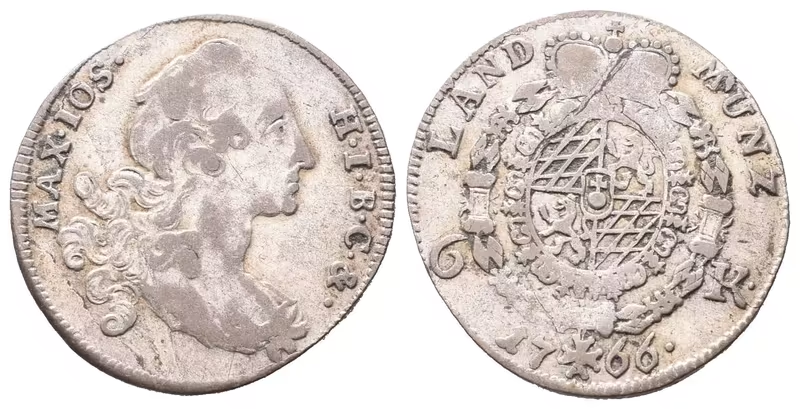
- Code: NABAV-G1766
Bavorsko, 6 Krejcar 1766
Bavorsko (Bayern), Maximilian III. Josef (1745 - 1777) 6 Kreuzer 1766, Mnichov, KM.542, patina, rysky
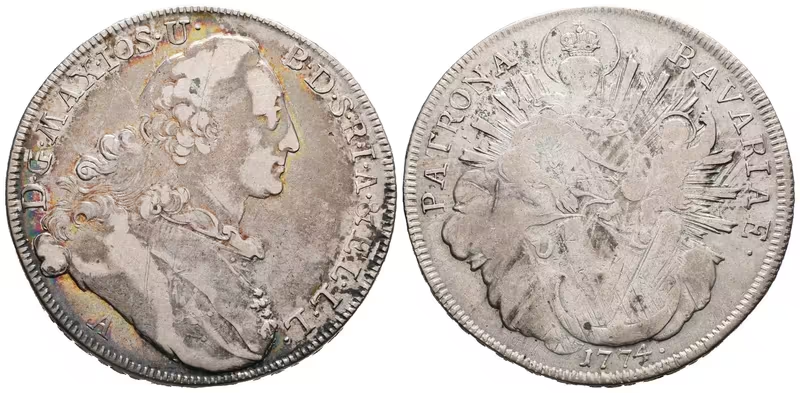
Skladem 1 ks - Code: NABAV-G1774A
Bavorsko, Tolar 1774 A, Amberg
Bavorsko (Bayern), Maximilian III. Josef (1745 - 1777) Tolar 1774 A, Amberg - madona, KM.234.2, pěkná zachovalost, patina, just.
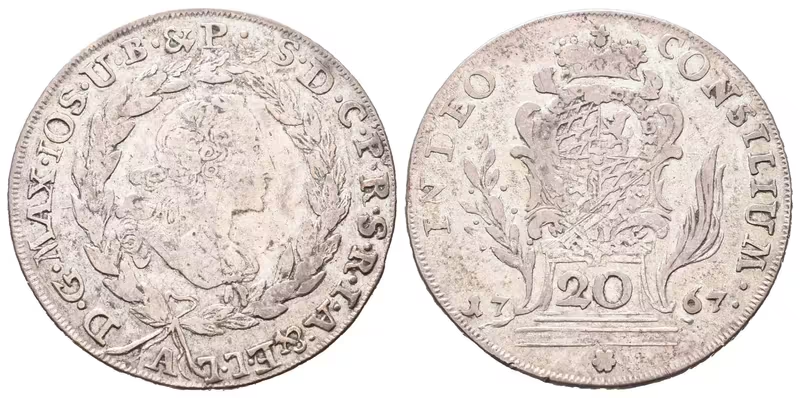
Skladem 1 ks - Code: NABAV-E1767
Bavorsko, 20 Krejcar 1767
Bavorsko (Bayern), Maximilian III. Josef (1745 - 1777) 20 Kreuzer 1767, Mnichov, KM.528, patina, rysky, just.
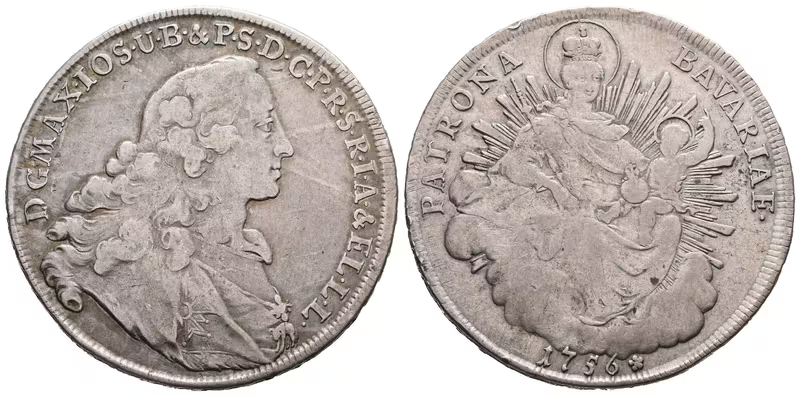
- Code: NABAV-G1756
Bavorsko, Tolar 1756
Bavorsko (Bayern), Maximilian III. Josef (1745 - 1777) Tolar 1756, Mnichov, KM.234.2, velmi pěkná zachovalost, patina, lesk, drobné hranky a rysky