Sigismund III Vasa
Sigismund III Vasa (1566-1632) was King of Poland and Grand Duke of Lithuania, who reigned at the turn of the 16th and 17th centuries and significantly influenced the politics and culture of the Polish-Lithuanian Commonwealth. For a brief period he was also King of Sweden and is known, among other things, for the rich coinage production of his era.
Sigismund III Vasa was born in 1566 as the son of the Swedish king John III and Catherine Jagiellon, daughter of the Polish king Sigismund I the Old. He thus linked the Swedish Vasa dynasty with the Jagiellonian dynastic legacy in Poland and Lithuania, which later had fundamental political significance. After the death of the Polish king Stephen Báthory, Sigismund was elected King of Poland (and Grand Duke of Lithuania) in 1587, that is, the sovereign of an elective monarchy in which he shared rule with the noble community and the estate institutions.
His reign took place at a time of strong religious and power tension in Europe. Sigismund III was raised as a Catholic and within his policy supported the Catholic side, which in the multinational and multi-confessional commonwealth provoked disputes. Important events also include the Union of Brest (1596), which brought part of the Orthodox structures in the area of today's Ukraine and Belarus into communion with Rome while preserving the eastern rite. Internally he also faced opposition from part of the nobility; a known manifestation of conflict was the estate opposition and the armed uprising at the beginning of the 17th century.
Sigismund's position was further complicated by the Swedish claim. In 1592 he became King of Sweden, but in Sweden he encountered the opposition of the Protestant elite and the power ambitions of his uncle Charles IX. The result was Sigismund's deposition and the de facto loss of the Swedish crown (1599), which turned into a long-term dynastic dispute and a series of Polish-Swedish conflicts. These wars had an impact not only on the international standing of the commonwealth but also on its economy and state financing.
History
Sigismund's era also includes an active eastward policy, especially interventions in affairs of the Muscovite state during the so-called Time of Troubles. The Polish-Lithuanian army at certain stages of the conflict reached as far as Moscow, and the commonwealth temporarily controlled some territories, among them the Smolensk region. The results of these campaigns were variable and burdened relations with the eastern neighbour in the long term. Alongside this, the commonwealth also clashed with the Ottoman Empire and the Crimean Khanate, so Sigismund's reign was for most of the time associated with high military expenditure and the need for stable revenues.
From a cultural point of view he is associated with the development of Baroque representation and with the transfer of the royal court to Warsaw (end of the 16th century), by which Warsaw gradually transformed into the main political centre. Sigismund III died in 1632; he was succeeded on the throne by his son Władysław IV Vasa. In historical memory he remains a sovereign whose long reign brought both ambitious dynastic plans and cultural flourishing, and the deepening of internal conflicts and protracted foreign wars.
Sigismund III Vasa is exceptionally important for numismatics thanks to the extensive and varied minting of coins within the Polish-Lithuanian Commonwealth. In circulation there appeared both small denominations for everyday payments and more valuable silver and gold coins for trade and representation. On the coins the sovereign's portrait and titulature were often applied, which had a clear political function: it emphasised the legitimacy of his rule and dynastic claims (including references to the Swedish title at a time when this corresponded to his ambitions).
Coins and sovereign representation
Typical motifs were royal insignia, heraldry (the arms of the Crown and Lithuania) and various renditions of state emblems. The appearance of the portrait and the style of the inscriptions changed over time, which allows dating and attribution to individual mints or periods. With part of the issues a propaganda dimension was also at work – coins were a mass-distributed carrier of the "official image" of the sovereign, which reached across regions of the commonwealth.
For collectors and researchers, Sigismund's era is also attractive because in it high production meets with variable strike quality and frequent die varieties. Influences included wars, the availability of metal, the need for finances and the organisation of the minting system. Even so, Sigismund III ranks among the most prominently represented sovereigns of the early modern period on Central European coins – and his strikes form a significant chapter in the history of coinage in Poland and Lithuania.
In our auction and shop
- Code: RX-Z-014
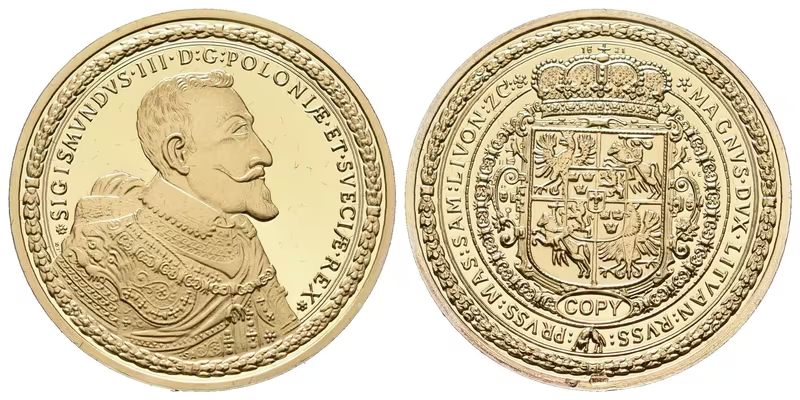
Polsko, Taler - Zikmund III. Vasa, polský a švédský král - portrét a královský erb, replika
Polské království (1587-1632) Taler - Zikmund III. Vasa, polský a švédský král - portrét a královský erb Ag (.925), 25 mm (10 g), BU, v kapsli. Stav mince odpovídá fotografii. Jedná se o druhotný prodej. (Možná oxidace, atd.. ! - VIZ FOTOGRAFIE !)
Skladem 1 ks - Code: SPOL89-F1592V
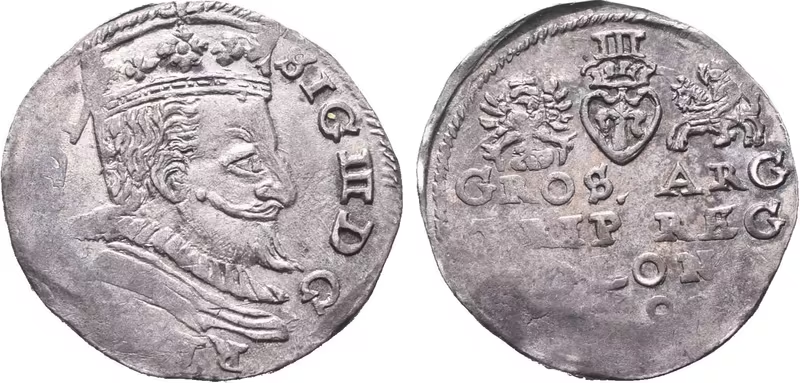
Polsko, III Groš 1592, Vilno
Polsko, Zikmund III. Vasa, 1587 - 1632 III Grosz 1592, Vilno, Kop.3520, Iger V.92.1. var.? , pěkná zachovalost, patina, lehce ned.
Skladem 1 ks - Code: SPOL89-F1597B
Polsko, III Groš 1597, Bydhošť
Polsko, Zikmund III. Vasa, 1587 - 1632 III Grosz 1597, Bydgoszcz, Kop.1071, Iger B.97.3.a var.? , velmi pěkná zachovalost, krásná patina, nepatrně nedoražený_R!
Skladem 1 ks - Code: SPOL89-F1598B
Polsko, III Groš 1598, Bydhošť
Polsko, Zikmund III. Vasa, 1587 - 1632 III Grosz 1598, Bydgoszcz, Kop.1125, pěkná zachovalost, krásná patina, nedoražený
Skladem 1 ks