Coin imitations
Coin imitations are mintages created on the model of popular and widespread coins, which arose for commercial or economic reasons. These coins as a rule retained the weight and fineness of the original, but differed in quality of execution and minor details.
The phenomenon of imitating coins appeared as early as antiquity, when local rulers and tribes copied the successful and widely accepted coins of large empires. The first attested imitations come from the 5th century BC, when Greek colonies in Asia Minor created their own variants of the popular Athenian tetradrachms with the owl. These mintages served to facilitate trade in regions where the original coins were known and trusted.
The Celtic tribes were among the most significant producers of imitations in European history. From the 3rd century BC they systematically copied the Macedonian tetradrachms of Philip II of Macedon and his son Alexander the Great. Silver coins with the portrait of the sovereign and a horseman on the reverse became the model for extensive production in the Danubian region. The quality of these Celtic mintages gradually declined and the original realistic depiction changed into abstract geometric patterns, which today allows archaeologists to trace the spread and development of Celtic mintage.
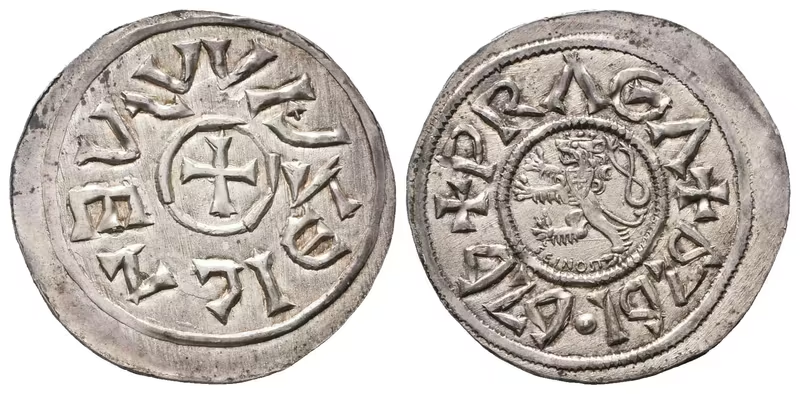
In medieval Europe imitations arose chiefly for economic reasons. When a particular type of coin became dominant in international trade, neighbouring sovereigns issued their own versions with a similar appearance. Czech denarii of the 10th to 12th centuries were imitated in Poland and Saxony, with these imitations, known as fabriks, often having lower weight and worse execution. The largest find of these imitations was made in 1886 near Polish Bystrzyca, where over a thousand pieces were discovered.
An important chapter is represented by the beischlags - imitations of Viennese pfennigs from the 15th century, which Czech mints struck. These small coins served ordinary trade and their production was tolerated because it facilitated local payment dealings. A similar system operated in the early modern period, when smaller German principalities issued coins imitating the successful thalers of larger states.
History
In the period of mercantilism in the 17th and 18th centuries the imitation of coins became part of economic policy. States deliberately produced coins similar to neighbouring denominations in order to facilitate the export of their own goods. Austrian Levantine thalers, for example, imitated the appearance of older Spanish eight-real pieces, because these were generally accepted in the Orient.
The modern era brought a new type of imitation - official replicas and copies of historical coins. These mintages arise legally for collector and commemorative purposes, but are marked with special signs so that they cannot be confused with the original. From the 20th century there also exist bullion coins imitating historical models, for example modern strikings of the St Wenceslas ducats or the Maria Theresa thalers.
Imitations can be divided by purpose of origin into several categories. Commercial imitations arose spontaneously in areas which a popular type of coin had penetrated. Local mints produced similar mintages in order to facilitate trade. These coins usually had the same or slightly lower weight and retained the basic motifs of the original, but with local specifics.
Official imitations were mintages authorised by the sovereign or town council. They arose with the consent of the authority and often bore additional marks distinguishing them from the model. Examples are urban mintages imitating imperial denominations in medieval Germany or colonial coins of European powers intended for overseas territories.
Types and characteristics of imitations
The technical execution of imitations varied considerably. While some almost reached the quality of the originals, others were significantly cruder. The differences manifested themselves in the sharpness of the relief, the elaboration of the details and the accuracy of the legends. Errors in Latin inscriptions caused by ignorance of the language or inattention of the engraver were frequent.
For the identification of imitations several characteristic features serve. Differences in the style of depiction, variants in the legends, different size or weight, the use of a different metal or alloy. Modern numismatics uses spectral analysis of metals to determine the origin of imitations from the specific composition of the alloys used.
In our auction and shop
- Code: SFRACLER-1610
Francie - Clermont, Napodobenina Oldenburského Adlerschellingu b.l.
Francie - biskupství Clermont, anonymní ražba z počátku 17. století Adlerschelling b.l., napodobenina ražby hraběte Anton Günthera hraběte z Oldernburgu (1603 - 1667). Kalvelage/Trippler.194 Opis na Rv.: IN MANIBUS DOMINI SORTES MEA. Velmi pěkná…
Skladem 1 ks - Code: RASEJ-1929-124B
AR Medaile 1929 - Replika denáru Sv. Václava
Šejnost Josef (1878 - 1941) AR Medaile 1929 - Napodobenina denáru sv. Václava. Kříž, okolo nápis WENCEZLAVS / Státní znak, opis Ag 0,900, 22 mm (cca 1,4 - 1,6 g), Bo.124b , ilustrační foto
Skladem 1 ks - Code: BA-SLG956-958
Podunajští východní Keltové, Tetradrachma, Slg. Lanz.956-958
Podunajští východní Keltové, (3. - 1. stol. př. Kr.) Tetradrachma, typ Thasos, Hlava Dionýsa s břečťanovým věncem zprava / Stojící Hercules se lví kůží přes ruku a kyjem, napodobenina písma, Slg. Lanz.956-958 (16,11 g)