Olkusz
Olkusz is a historic Polish mining town in Lesser Poland, famous for the mining of lead and silver. Thanks to its rich ore deposits it belonged in the Middle Ages and the early modern period to the economically important centres of the region, and in the 16th century royal mint production also briefly developed here.
Olkusz grew from an exceptionally favourable combination of location and mineral wealth. In the wider belt of southern Poland, deposits of galena and other ores from which lead and in some cases also silver could be obtained were exploited from the early Middle Ages. Precisely the presence of silver gave the mining there an exceptional importance, because silver was a key metal in European economies for the striking of coins and for long-distance trade. Olkusz thanks to this became a town where the interests of royal administration, miners, smelters and merchants in the metal met.
The later Middle Ages brought to many mining regions a special legal status intended to support mining and to attract a skilled workforce. Olkusz was among the places where mining rested on privileges and on the organised administration of mines, because without rules for the search for deposits, the division of yields and the control of metal quality, stable production could not have been maintained. In the period of its greatest expansion the town grew wealthy not only from extraction but also from related crafts and services: ore mining required timber, transport, smithing and carpentry work, smelting processing and a commercial infrastructure.
In the early modern period Olkusz ranked among the well-known mining centres mentioned even in contemporary accounts and specialist texts. Mining was, however, sensitive to the exhaustion of easily accessible deposits, to the flooding of shafts and to financial upheavals. When war events and economic crises were added, towns of this type fared very unevenly: periods of prosperity alternated with phases of decline. For Olkusz the end of the 17th century is often cited as a marked turning point, when the consequences of the disasters of war and the weakening of the economy made themselves felt in the wider region.
History
The modern history of the town developed in response to political changes in Poland and to the transformations of industry. The town went through periods in which the mining and processing of metals were renewed, but it had at the same time to adapt to the fact that modern industry required different technologies, capital and organisation from medieval and early modern mining. Even so Olkusz preserved its reputation as a "silver" town, and its identity is bound up with mining to this day.
Olkusz is of interest to numismatics on two levels. The first is mining itself: silver from regional deposits was among the raw materials without which medieval and early modern coinage could not have functioned. Towns and regions that were able to supply quality metal had an indirect influence on the stability of currency and on the scale of striking, because both state and nobility were dependent on the supply of precious metal.
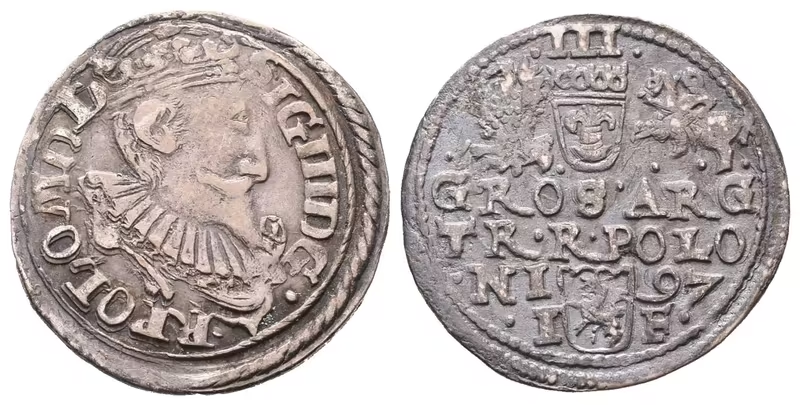
The second level is the existence of the royal mint at Olkusz, which was put into operation at the end of the 16th century and operated approximately until the beginning of the 17th century. In this period small circulating denominations and silver coins for the lively market were struck in Poland, among others. With Olkusz collectors particularly associate strikings of the trojak (three-groschen) type, but other denominations also appear. For collectors it is attractive that these are coins from a specific minting site that had a clear connection to local metal, and which operated in a period when the emphasis in monetary practice was on the organisation of striking and the control of quality.
Mining, mint and numismatic connections
When collecting Olkusz strikings it is worth following above all the legibility of the legends, the quality of the relief and the natural surface, because silver may be sensitive to improper cleaning. At the same time there is a range of variants given by differences in dies, titulature and details of design, which makes Olkusz coins an interesting field also for more advanced collectors. Olkusz thus represents a town where one can "read" the entire chain of value: from the ore through the metal and smelting infrastructure to the finished coin which carried trust in the currency into everyday circulation.
In our auction and shop
- Code: SPOL89-F1597O
Polsko, III Groš 1597, Olkusz
Polsko, Zikmund III. Vasa, 1587 - 1632 III Grosz 1597, Olkusz, Kop.1055, Iger O.98.1. var. , pěkná zachovalost, patina