Salzburg mint
The Salzburg mint was a minting workshop in Salzburg, in which the coins of the archbishops of Salzburg — ecclesiastical princes of the Holy Roman Empire — were struck. Its strikes are typified by ecclesiastical symbolism, heraldry and Latin legends, and reflect the economic strength of a country linked with salt and trade.
The Salzburg mint grew out of an environment in which the archbishops of Salzburg combined spiritual authority with secular rule. As territorial lords they disposed of a range of sovereign rights, and among the most visible was the minting right — the possibility of striking their own coins. Within the imperial framework this was not a mere technical service to the market but also a sign of sovereignty: a coin with the state device and the archbishop's titulature functioned as everyday evidence of who ruled in the country and what order applied there.
Salzburg had a long-standing strong economic background. A key role was played by salt, the mining of and trade in which brought significant revenues. Precisely where tolls are collected, goods flow and money turns over quickly, the need for stable currency grows. The mint thus had practical significance for the everyday market, but also political significance for representation and administration. In times when strikes of many issuers met in the Alpine space, the good reputation of Salzburg coins was at once an advantage both for merchants and for the rule itself.
History
In the early modern period coinage production in the empire repeatedly adapted to monetary changes, metal prices and regional agreements. The Salzburg mint therefore alternated the composition of denominations according to current needs: at times the emphasis was on small currency, at others on higher and more representative strikes. In the long term, however, a common line is maintained — the union of an ecclesiastical principality with its own symbolism and an emphasis on the legitimacy of the issuer.
A turning point came at the beginning of the 19th century, when, as a result of secularisation and political transformations, a number of ecclesiastical states broke up. With this also closed the era in which the archbishops of Salzburg acted as independent issuers of coins. The strikes of the Salzburg mint thus today represent material evidence of an age when ecclesiastical rule had fully secular competences in the region.
Strikes, features and numismatic significance
Strikes of the Salzburg mint are usually recognisable at first sight thanks to ecclesiastical thematics and heraldry. Frequent are motifs of the cross, ecclesiastical insignia or saints, and almost always the device or arms of the archbishop and country appear. The legends are predominantly Latin, often abbreviated, and their titulature helps to identify the particular issuer and date of striking. For some issues even small marks and separators in the legend may be important, because they suggest die variants.
For collectors and researchers Salzburg is attractive as a combination of "state" coin and ecclesiastical identity. The coin carries not only a denomination and an economic function but also a pronounced political message: the archbishop is not only a spiritual authority but a sovereign with his own rights. For this reason Salzburg strikes are often studied at the same time as a source for the economic history of the Alpine space and as an illustration of how administration, trade and the symbolism of power were interlinked in the imperial lands.
In our auction and shop
- Code: XF03-DE
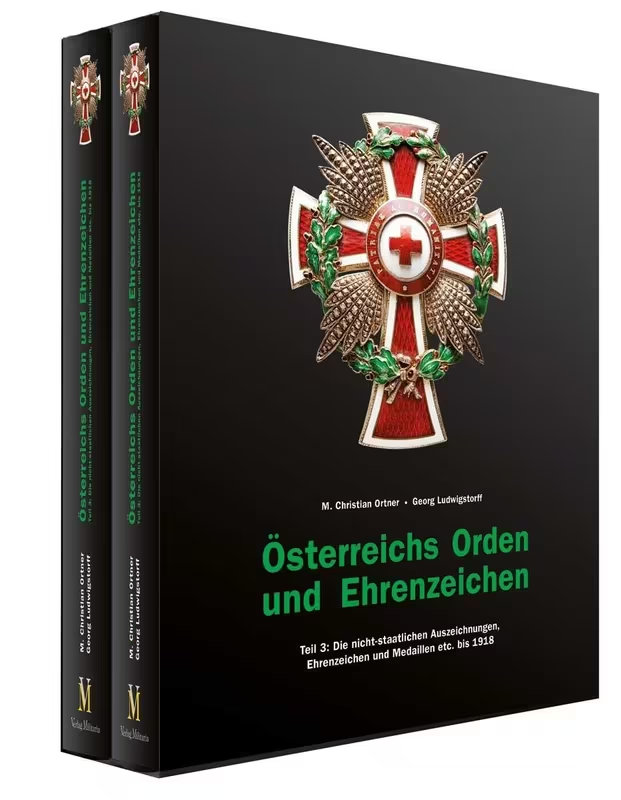
Österreichs Orden und Ehrenzeichen, Teil III: Die nicht-staatlichen Auszeichnungen, Ehrenzeichen, Medaillen etc. bis 1918
Ortner, M. Christian, Ludwigstorff, Dr. Georg Österreichs Orden und Ehrenzeichen. Teil III: Die nicht-staatlichen Auszeichnungen, Ehrenzeichen, Medaillen etc. bis 1918 Německé vydání, 2 svazky, cca 600 str. S tímto dvojitým svazkem je nyní k dispozici…