Sovrano
The sovrano is a gold trade coin struck in the Habsburg dominions, particularly in the Austrian Netherlands and later in northern Italy. It originated as an imitation of the English sovereign and served mainly for larger payments and international trade, not for everyday small-denomination circulation.
The sovrano belongs to those coins that did not arise out of a need for everyday money but as a practical instrument of commerce. In the European monetary world of the early modern period, alongside domestic denominations, large and trustworthy coins of precious metals increasingly took hold, which could be accepted even beyond borders. It is precisely this logic that lies behind the appearance in the Habsburg lands of a coinage that consciously drew inspiration from a foreign model - the English sovereign.
The English sovereign was originally introduced as early as the end of the 15th century under the reign of Henry VII and gradually became a symbol of the representative gold coin. The Habsburg minting of the sovrano followed on from this type, though in a different political and economic environment. In the 18th century the Habsburgs administered extensive territories with very diverse traditions and monetary customs, and the trade coin was one way of practically simplifying larger payments while at the same time offering a coin with a generally understandable gold character.
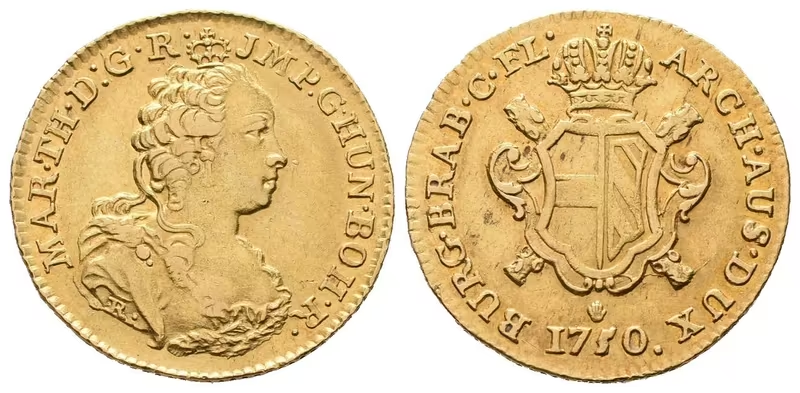
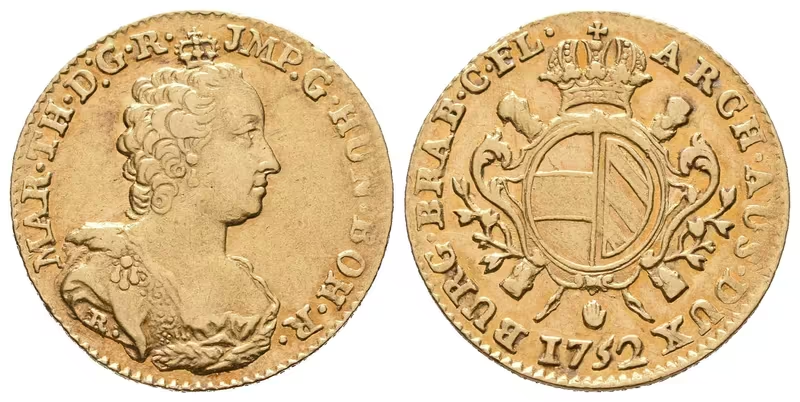
Under the reign of Maria Theresa, the sovrano began to be minted from 1749 in the Austrian Netherlands, under the French-sounding designation souverain d'or. This issue weighed approximately 5.53 g and remained in this form until 1800. The very fact that the coin also bore a French name captures the reality of the Habsburg possessions at the time: it was a multinational environment where several languages were used in trade and administration and where the currency had to be practical and accepted across regions.
In the 19th century the minting of the sovrano changed. A heavier variant weighing roughly 11.332 g appeared, which began to be struck from 1820 in the mints of Milan, Venice and also Vienna, under the reign of Francis I (who had earlier ruled as Francis II of the Holy Roman Empire). The shift of the centre of minting to northern Italy corresponded well to the conditions of the time: Lombardy and the Veneto were economically important regions with lively commerce, where a gold coin of higher value found easy use.
History
It is essential to note that the sovrano fulfilled primarily the role of a trade coin. This usually means that it was used in larger transactions, in cross-border traffic, in settling obligations, and as a form of value that could be more easily accepted even outside a narrowly local environment. In Italy the sovrano moreover had a firmly established relationship to the silver currency, with one sovrano corresponding to 40 silver lire. Such anchoring helped circulation: a merchant did not have to negotiate each time about what it was worth that day, but could rely on an officially established conversion.
Minting of the sovrano in the Habsburg lands ended under the reign of Francis Joseph I in 1856. This closed the chapter of a coin that had been designed from the outset as a practical instrument for commercial payments - and at the same time as proof that even at a time when every state had its own denominations and traditions, there existed a strong need for a common language of value in the form of trustworthy gold coins.
The sovrano occurs in two basic weight versions, which are tied to different periods and regions. The older variant from the 18th century, associated with the Austrian Netherlands, weighs around 5.53 g and is often linked in the sources to the designation souverain d'or. The newer, heavier variant from the 19th century reaches approximately 11.332 g and is associated particularly with the Italian mints of Habsburg administration (Milan, Venice) and with Vienna.
Visually, the sovrano usually ranks among the representative gold strikes of its time: it bears the royal titulature and motifs corresponding to state symbolism, which were intended to express the authority of the issuer. In the case of trade coins, the appearance is also functional - it must be easily recognisable and readable even to people who do not know the local monetary conditions down to the last detail. For this reason, in the sovrano a clear legend and well-preserved details are valued, since they allow the type and period of minting to be reliably determined.
Specifications, appearance and collector significance
For collectors, the sovrano is attractive because it stands at the boundary of several worlds: it is a gold coin of the Habsburg Monarchy, yet at the same time it is closely linked to the Western European model and to the Italian economic environment. For collections focusing on the Habsburgs, it is interesting to track in which mints and in what form the sovrano appeared, and how its weight and practical role changed. In the Italian context, the firm relationship to the silver currency is also important, showing the effort to achieve a comprehensible conversion between gold and silver.
Because this is a gold trade coin, many pieces have survived in relatively good condition - gold wears down less from small payments than do small copper or silver denominations. Nevertheless, with the sovrano the overall state of preservation, cleanness of detail and natural surface without rough interventions remain decisive. A well-determined sovrano thus represents an interesting document of how monetary needs, trade and political administration of the Habsburg dominions were intertwined in the 18th and 19th centuries.
In our auction and shop
- Code: Z82J-AW1750
Marie Terezie, Sovráno 1750, Antverpy
Marie Terezie (1740 - 1780) Sovráno ( Souverain d'Or ) 1750, Antverpy, KM.14 (5,53 g)
- Code: Z82J-AW1752
Marie Terezie, Sovráno 1752, Antverpy
Marie Terezie (1740 - 1780) Sovráno ( Souverain d'Or ) 1752, Antverpy Au 0,919, 22 mm (5,53 g), Delm. 212, KM.17