Svatopluk of Olomouc
Svatopluk of Olomouc was a Přemyslid prince of the Olomouc branch of the family, first an apanage ruler in Moravia and from 1107 to 1109 also Bohemian prince. His short reign was full of disputes over succession, military campaigns, and ended in murder during an expedition to Silesia.
Svatopluk of Olomouc came from the Olomouc (Moravian) branch of the Přemyslids. He was the son of Otto I of Olomouc, and his mother was Euphemia of Hungary, which linked the Moravian apanage rulers dynastically with the Hungarian milieu. At the time when his power position was taking shape, there was no firm hereditary order according to primogeniture in the Přemyslid state. Disputes over the princely throne were repeatedly waged, in which dynastic claims, the support of magnates and the influence of the Roman-German rulers alternated. The Moravian apanages played a dual role in this: they were the family's home base, but at the same time a "reservoir" of candidates who could intervene in Prague politics at the right moment.
Even before his accession in Prague, Svatopluk was the prince of the Olomouc apanage. Olomouc and its surroundings represented an important centre of Moravia, and the apanage prince had to be able to deal with both the local elite and Prague. At the turn of the 11th and 12th centuries, the situation in Bohemia came to a head. On the princely throne was Bořivoj II, whose position was uncertain and provoked the opposition of some magnates. The Roman-German king Henry V also entered the game, because the Bohemian principality was part of the imperial political space, and confirmation of rule from outside had great weight in practice.
In 1107, Svatopluk managed to prevail in Prague and deposed Bořivoj. His accession is not usually interpreted as a peaceful "dynastic exchange" but rather as the result of power agreements, military force and support from the imperial side. The new prince then had to act quickly to maintain his position: stabilise relations with the magnates, secure support in Moravia and at the same time respond to surrounding threats. Silesia also played an important role, traditionally a contested space between Bohemian and Polish influence, where claims, payments and prestige clashed. It is reflected in sources that precisely the Silesian question and tensions with Poland were among the motives for repeated campaigns.
History
Svatopluk's rule is also associated with harsh internal political interventions. The prince sought to suppress real and supposed conspiracies, and thereby created a number of enemies for himself. In this context, action against the Vršovec family is mentioned, which was reportedly linked with the fear of support for the deposed Bořivoj and with the risk of Polish intervention. Whatever the extent of real threat, violent policy increased tension within the land and made Svatopluk's position more fragile: he relied on military force and the loyalty of part of the elite, but at the same time alienated another part.
The end of his rule came suddenly. In 1109 Svatopluk was murdered during a campaign in Silesia, traditionally said to have been near Głogów. The death of the prince in the field was not only a personal tragedy but also an immediate political turning point: in Bohemia the question of succession opened up again, and competing Přemyslid lines vied for influence. Vladislaus I eventually ascended the princely throne, while the Moravian apanages continued to function as both an important support and a source of future disputes. Svatopluk of Olomouc thus entered history as an energetic but controversial ruler whose short reign shows how unstable and violent the politics of an early mediaeval principality could be.
Svatopluk's politics can be understood as an effort to "lock in" power at a moment when the princely throne could be lost as quickly as it had been won. For this reason he relied on alliances, military campaigns and resolute action against opponents. Typical too is that his rule took place in a broader central European context: without reference to the empire and without rivalry with Poland, his era cannot be understood well. From Moravia he brought his home base, but Prague was the key to legitimate power, and it was the struggle for legitimacy that was one of the main motors of the conflicts of this epoch.
Rule, politics and numismatic legacy
In numismatics, Svatopluk of Olomouc is remembered above all for his denarii, which belong among the noteworthy strikes of early Bohemian coinage. At this time these were mainly silver denarii, whose significance was not only economic. The coin bore the name or title of the ruler and functioned as a visible record of authority: in a land with limited written culture and regional differences, the coin represented a "travelling charter" that disseminated the ruler's legitimacy among the people. With early denarii, moreover, the quality of engraving, the legibility of legends, the typology of motifs and the differences between dies are all studied, because precisely these details can indicate the organisation of the mint, the date of striking and the extent of the issue.
Svatopluk's denarii are also prized because his reign was short and politically turbulent. A short period of rule often means smaller quantities of coinage and rapid changes in the organisation of power, which may be reflected in the rarity of individual types. For collectors, therefore, what matters is not only the prince's name itself but also the specific type, the preservation and clear identification of the coinage. In sum, Svatopluk of Olomouc is an example of a ruler in whose case political history and numismatics naturally complement each other: coins help to "feel" his authority in material form, while history explains why his numismatic legacy is so attractive for Bohemian denarii.
In our auction and shop
- Code: RXSLOV-1994SV
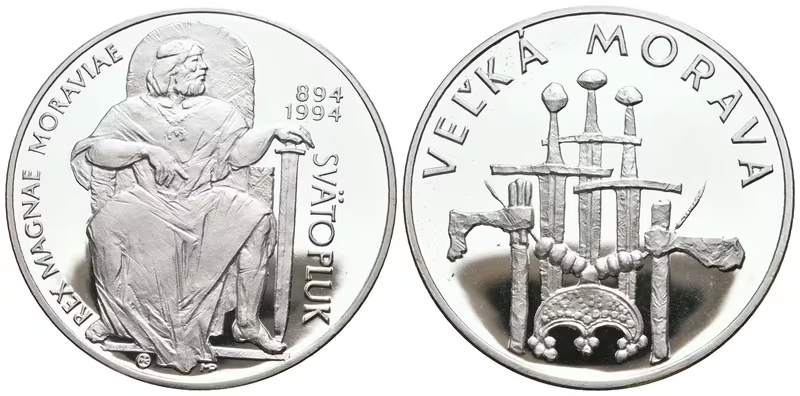
Slovensko - Kníže Svatopluk
Slovenská republika (1993 - ) AR Medaile 1994 - K 1000. výročí Velkomoravského knížete Svatopluka. Punc. Ag 0,900, 40 mm (37,70 g), PROOF, patina
Skladem 1 ks - Code: ZD-2020LUD
Sada mincí 2020 - Sv. Ludmila
Česká republika (1993 - ) Sada tří mincí 2020 (Lenka Nebeská) - Svatá Ludmila 3x Au 0,9999, 22 mm (7,78 g), náklad 200 ks, certifikát, etue, papírový přebal, PROOF Po svatém Janu Nepomuckém vzdává trojice zlatých mincí České mincovny hold dalšímu…