Kingdom of Sweden
The Kingdom of Sweden is a constitutional monarchy in Northern Europe, whose form of government is a parliamentary system with a hereditary sovereign. The long continuity of Swedish statehood is reflected in the history of Scandinavia, in the era of the "Swedish Empire", and in a distinctive tradition of coinage and trade.
The Kingdom of Sweden took shape as a mediaeval state formation in Scandinavia, where royal power gradually consolidated control over individual regions and clan federations. In the early period, both trading contacts in the Baltic area and Christianisation — which connected Sweden with the wider European culture and legal customs — played a part. The Middle Ages brought the alternation of dynasties and a growth in the significance of the nobility and ecclesiastical institutions, with the key issue being the position of the king vis-à-vis territorial elites and the emerging administration.
A notable milestone was the Kalmar Union (from the end of the 14th century), which for a time united Sweden, Denmark and Norway under a common crown. Tensions between Swedish interests and Danish dominance, however, led to repeated conflicts and ultimately to independence. A decisive turning point came in the first half of the 16th century, when Gustav I Vasa secured independence and laid the foundations of a more modern state administration. His rule is also associated with the Reformation and the strengthening of royal control over economic resources, which had a long-term impact on the functioning of the state and its finances.
In the 17th century, Sweden joined the ranks of European great powers. The period of the so-called Swedish Empire is connected with expansion in the Baltic area, the building of a strong army, and participation in the Thirty Years' War. Under the reigns of Gustav II Adolf and his successors, Sweden became an actor in European politics, but at the same time bore the high costs of long conflicts. In this period the state administration and the tax system developed significantly, as great-power ambitions required stable revenues and control over resources.
History
The beginning of the 18th century brought a turning point in the form of the Great Northern War and the gradual weakening of Sweden's standing. Domestically, there followed a period in which the balance of power between the king and the estates institutions shifted. In the 19th century, Sweden then developed as a modernising state with an emphasis on reforms, industry and education. The transformation of the political system towards parliamentary decision-making and the expansion of civil rights was likewise fundamental. In the 20th century, the monarchy settled into a constitutional form, and Sweden became known for a stable democratic environment and an emphasis on social and institutional continuity.
The history of the Kingdom of Sweden thus combines several distinct layers: the mediaeval roots of the Scandinavian monarchy, the great-power chapter of the modern period, and the long transition to a modern parliamentary monarchy. To understand Swedish statehood it is important to note that changes often proceeded evolutionarily — through reforms, administrative practice and negotiation between institutions — which strengthened trust in the order and rules on which the state rests.
The Kingdom of Sweden today is a constitutional monarchy in which the sovereign performs a predominantly representative role and political decision-making rests with parliament and the government. State symbolism draws on traditional heraldic motifs and on the country's clearly recognisable identity, which is also reflected in public space, institutions and a long cultural tradition.
State, symbolism and coins
From the numismatic perspective, Sweden is interesting for its exceptionally rich history of coinage. Swedish strikes reflect the development of the state and the economy: from mediaeval coins through modern issues to contemporary currency. Typically, coins bear the marks of rulers, the state coat of arms and motifs that express the continuity of the monarchy. For collectors, it is also valuable that Swedish coins often "read" history well: changes in titulature, the style of portraits or the state emblems show political and dynastic turning points, while material and denominations reveal the economic conditions of the period.
Swedish coins and medals are therefore not only a means of payment but also a visual source. In a small format they capture the way the state wished to present itself, what values it emphasised, and how its power and society changed over the centuries.
In our auction and shop
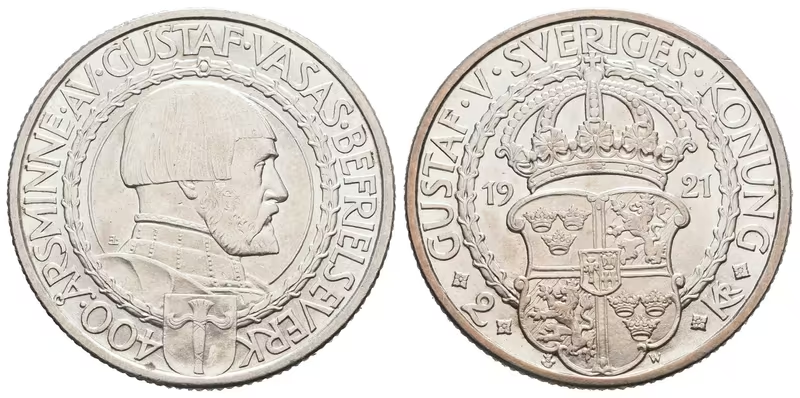
- Code: SSVED96-B1921
Švédsko, 2 Koruna 1921
Gustav V. (1907 - 1950) 2 Kronor 1921 W - Gustaf Vasa, 400. výročí Švédské války za osvobození , KM.799, luxusní zachovalost, ražební lesk, patina, nep. rysky
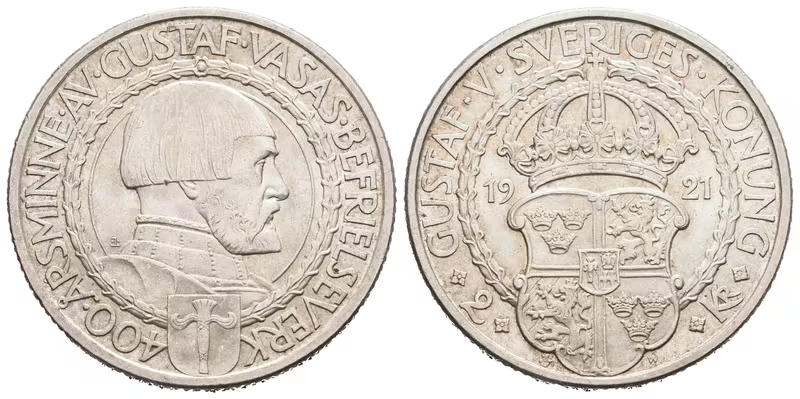
Skladem 1 ks - Code: SSVED96-B1921.1
Švédsko, 2 Koruna 1921
Gustav V. (1907 - 1950) 2 Kronor 1921 W - Gustaf Vasa, 400. výročí Švédské války za osvobození , KM.799, luxusní zachovalost, ražební lesk, patina, nep. rysky
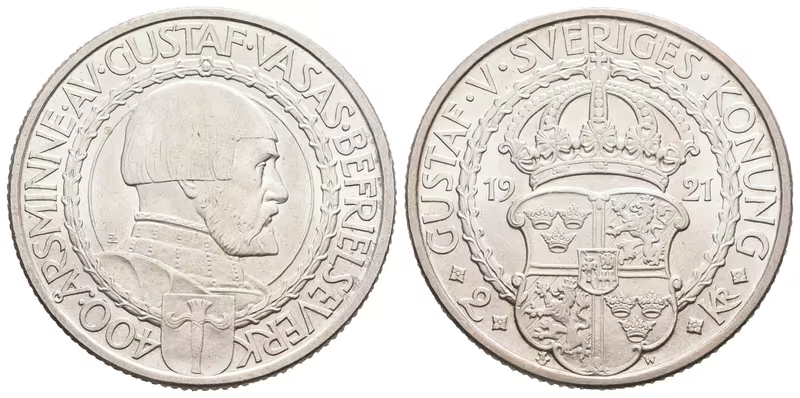
Skladem 1 ks - Code: SSVED96-B1921.2
Švédsko, 2 Koruna 1921
Gustav V. (1907 - 1950) 2 Kronor 1921 W - Gustaf Vasa, 400. výročí Švédské války za osvobození , KM.799, luxusní zachovalost, ražební lesk, patina, nep. rysky
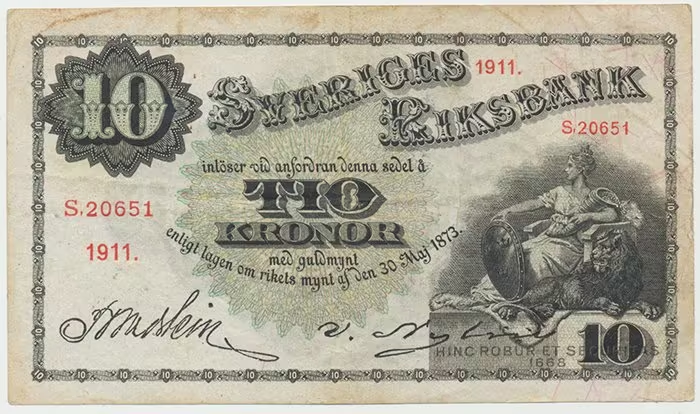
Skladem 1 ks - Code: BSVED027F