Thaler
The thaler (Czech tolar, English thaler or taler) is a large silver coin of Central European provenance, whose minting began in 1518 in the Jáchymov valley on the Bohemian side of the Ore Mountains and which, in the course of the 16th to 19th centuries, became the most important silver trade coin of continental Europe. From the German word thaler — derive…
The direct prototype of the thaler was the Jáchymov Joachimsthaler, struck from 1518 by the mint of the Counts Šlik in Jáchymov (German Joachimsthal). The first strike is documented on the basis of the find of the first dies of 1518; the official opening of the mint is dated to 1519 after receipt of the minting privilege from the Bohemian king Louis II Jagiellon. The coin contained approximately 27.2 g of silver at a fineness of 93.1% and a total coin weight of 29.23 g, which corresponded to the earlier-struck Tyrolean guldengroschen of 1486 and the Imperial guldener of 1524. The obverse bore the figure of Saint Joachim, the reverse the Bohemian lion and the legend JOACHIMSTHALER LANDESMÜNZE; the coin quickly established itself in long-distance trade thanks to its constant weight and fineness, whereas German and Italian local strikes were variable.
Joachimsthaler 1518–1520
The key imperial standard was brought by the Augsburg Imperial Minting Ordinance of 1566. It established the uniform striking of the Reichsthaler, the so-called Imperial thaler coin, as nine pieces from one Cologne mark of pure silver (around 234 g) — that is, a content of pure silver of approximately 25.98 g at a total coin weight of 29.23 g and a fineness of 833 thousandths. The Reichsthaler became established as the longest-maintained standard of medieval silver coinage in Europe and functioned for more than three centuries. From this norm are derived also the related strikes: the Dutch rijksdaalder, the Danish and Swedish rigsdaler / riksdaler, the Swiss taler. The Reichsthaler also influenced the North American colonies: colonial Massachusetts and New York in the 17th century accepted Reichsthalers and Spanish pesos de ocho as circulating coinage, and the word dollar took root in the English-speaking environment precisely from these contexts.
Reichsthaler 1566 and the Augsburg standard
An important milestone was the Austrian monetary reform of 1750 (formally confirmed by the Convention Treaty of 1753), which introduced the so-called Konventionsthaler — the basic Austro-Bavarian thaler with a weight of 28.07 g and a content of 23.39 g of pure silver (fineness 833). From this standard derives the most famous thaler of modern European numismatics — the Maria Theresa thaler. The coin was first struck in 1741 with the portrait of Maria Theresa and the Habsburg double-headed eagle on the reverse; after her death in 1780 it continued to be struck with the fixed date 1780 as the so-called Levantine thaler for trade with the Ottoman Empire, North Africa, Abyssinia (Ethiopia), Aden and the Arabian Peninsula. In some regions of the Red Sea and Abyssinia, merchants accepted no coin other than the Maria Theresa thaler well into the 20th century. The coin is still being struck by the Austrian mint with the date 1780, and by 2000 some 389 million pieces had been struck.
Konventionsthaler 1750 and Maria Theresa
The last unified German thaler was the Vereinsthaler from the monetary treaty of 1857 between the states of the German Confederation, Austria and Liechtenstein. It established the striking of 30 Vereinsthalers from one Zollverein pound of pure silver (500 g), that is, 16.67 g of pure silver per coin at a weight of 18.52 g and a fineness of 900 thousandths. The Vereinsthaler functioned until the unification of Germany in 1871 and the definitive transition to the gold mark currency after the reform of 1873; old thalers still circulated as 3 marks until 1907. For commercial practice these changes meant the end of the great thaler era, but numismatically, by contrast, the period 1857 to 1873 is the period of the highest quality of thaler minting, with portraits of German princes and Imperial cities.
Vereinsthaler 1857 and the end of minting
The etymological legacy of the thaler reaches further than that of any other European coin of the modern period. From the German thaler arose, in Dutch, the daalder, in Low German daler, and subsequently in English the dollar — today the official name of the currency of more than twenty states of the world, including the American, Australian, Canadian, Hong Kong, New Zealand and Singapore dollars. In Russian, from the form Joachim arose the yefimok — the Russian designation for the Western European thaler from the starting variant in Pskov. In Czech, the word tolar designates both the Jáchymov strike and the Maria Theresa thaler, and from 1991 to 2007 also the Slovak koruna, designated as the Slovak tolar (after 1993 renamed back to koruna) and the Slovenian tolar (1991–2007). The word dinar — from Latin denarius via Arabic forms — then designates the currencies of a number of states of the Middle East and North Africa, and etymologically belongs to the wider family stretching from the ancient denarius via the Carolingian denier to the thaler and the dollar. Original collectors' Šlik Joachimsthalers and the first Konventionsthalers belong among the most valuable Renaissance silver coins of Europe.
Etymological legacy: tolar, dollar, dinar
In our auction and shop
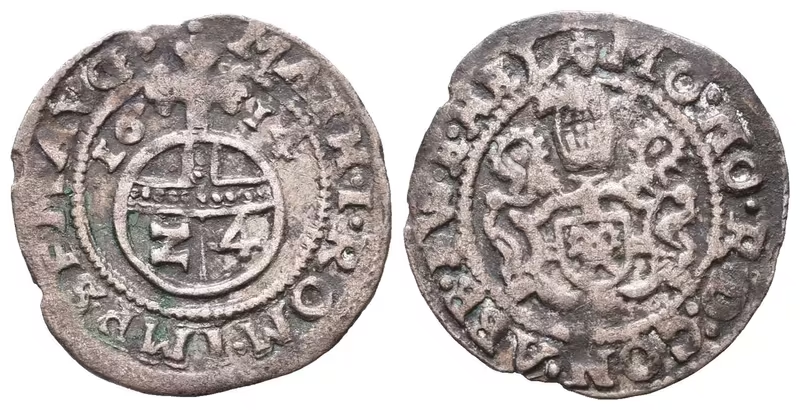
- Code: NAWERD-1614
Werden - Helmstedt, 1/24 Tolaru 1614
Opatství Werden a Helmstedt. Konrad von Klocht, 1601-1614. 1/24 Thaler 1614 (Groš) s tit. Matyáše, Grote.23, patina, vady střížku_RRR!
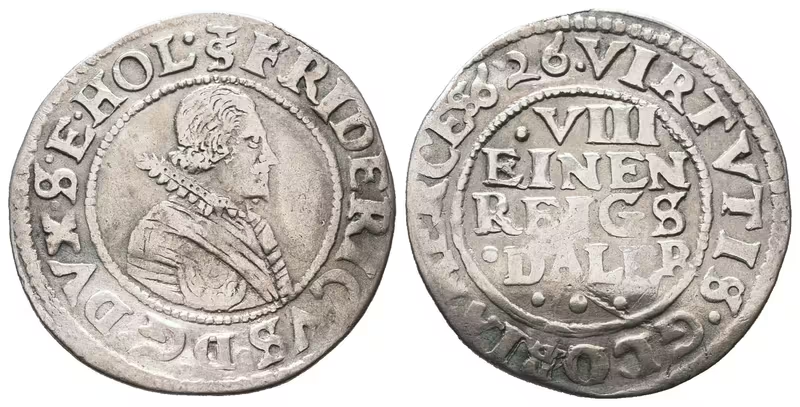
Skladem 1 ks - Code: NAHOGO-1626
Holstein - Gottorp, 1/8 Tolaru 1626
Schleswig-Holstein-Gottorp , Friedrich III., 1616 - 1659 1/8 Thaler 1626, KM.75, Lange 336 var., pěkná zachovalost, patina, zvlněný_R!
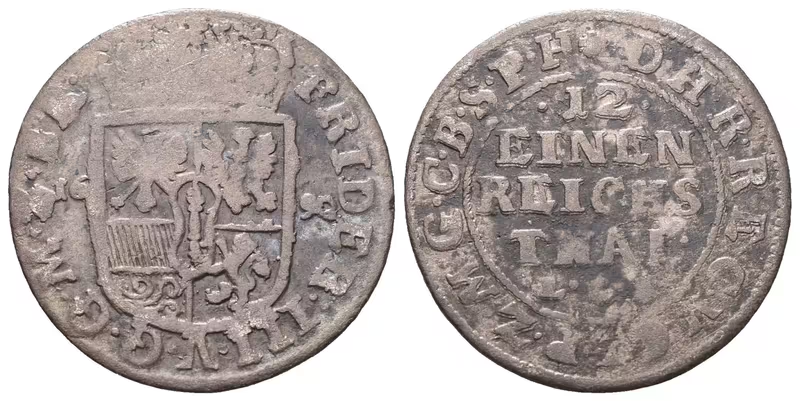
Skladem 1 ks - Code: NAPRU91-G1690
Prusko, 1/12 Tolar 1690 LCS
Braniborsko-Prusko, Friedrich III. (1688 - 1701) 1/12 Thaler 1690 (2 Groše) LCS, Berlín, v. Schrötter 530, var. s letopočtem na Rv., oxidace
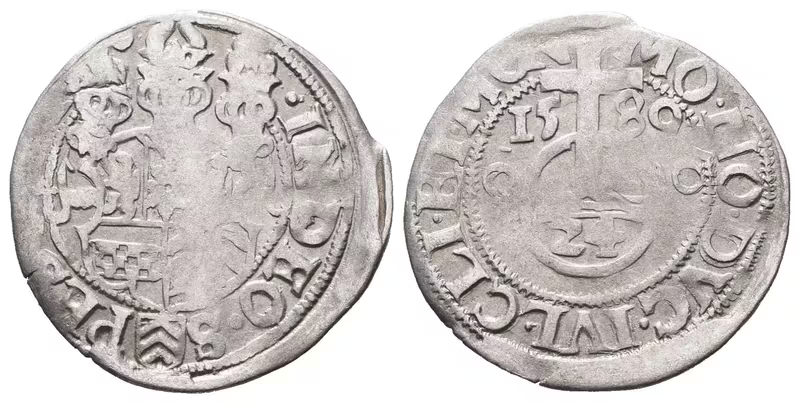
Skladem 1 ks - Code: NAJULI-1580
Jülich-Cleve-Berg, Groš 1580
Jülich - Cleve - Berg, Wilhelm V., 1539 - 1592 1/24 Thaler (Groš) 1580, MB.9_R!
Skladem 1 ks