Vatu
The vatu is the national currency of the Republic of Vanuatu, an island state in the South Pacific. It is used in cash and non-cash payments, and in international dealings is listed under the code VUV.
The vatu is linked to the emergence of the modern state of Vanuatu and to the need to unify the monetary circulation on islands that long had a complex administrative past. The territory of present-day Vanuatu was known as the New Hebrides until 1980 and had the unusual status of a so-called condominium — that is, the joint administration of two powers. This arrangement was reflected even in everyday life, including money: alongside local issues and banking practice, various currency influences from the region historically operated here.
After independence was declared in 1980, the newly formed republic sought to build its own institutions and symbols of statehood. Money in this respect is a highly visible tool: the currency bears the name of the state, state emblems and motifs intended to represent the country's identity. The introduction of an own currency was therefore not merely a technical measure but also a step intended to strengthen sovereignty and facilitate the functioning of the internal market. The vatu was introduced in the early 1980s as a unified currency replacing earlier monetary arrangements and enabling clearer pricing of goods, wages and public expenditure.
History
The Vanuatu economy is characterised by a large share of services (including tourism) and at the same time dependence on the import of a range of goods. This is reflected in the monetary environment: the currency has to be practical for everyday payments in the domestic economy and at the same time 'legible' for foreign trade and visitors. The vatu is straightforward in this respect — it is normally quoted in whole units, which reduces the need for small fractional denominations and corresponds to local price reality.
For numismatics it is important that currencies of small island states often show an interesting combination of practical function and representation. The motifs on coins and banknotes tend to be deliberately chosen to depict nature, traditional culture, crafts and symbols of statehood. In the case of Vanuatu, elements appear in circulation that recall the oceanic environment, local customs and the country's history. From a historical point of view the vatu is already a 'currency of independence': its existence is tied to the modern state and the period after 1980, not to colonial administration.
Denominations, circulation and practical use
The vatu is used in the form of both banknotes and coins. In everyday practice amounts are stated in whole units, since the currency is not normally divided into smaller fractions. In cash circulation this means that the emphasis is on denominations covering everyday purchases, transport and services. Banknotes and coins usually bear inscriptions and motifs drawing on state symbolism and local culture, so that they are easily recognisable and at the same time represent the country abroad.
From the point of view of currency management it is important that the issue of currency and monetary stability are linked to the central institutions of the state. For investors and collectors, on the other hand, what matters is that with the currencies of smaller states, commemorative strikes and thematic issues may have a stronger cultural dimension than a 'purely' economic one. In the numismatic context the vatu therefore represents an interesting topic especially for collections focused on modern oceanic states, post-decolonisation monetary systems and visually appealing motifs linked to nature and traditional society.
In our auction and shop
- Code: SVANU-B1993
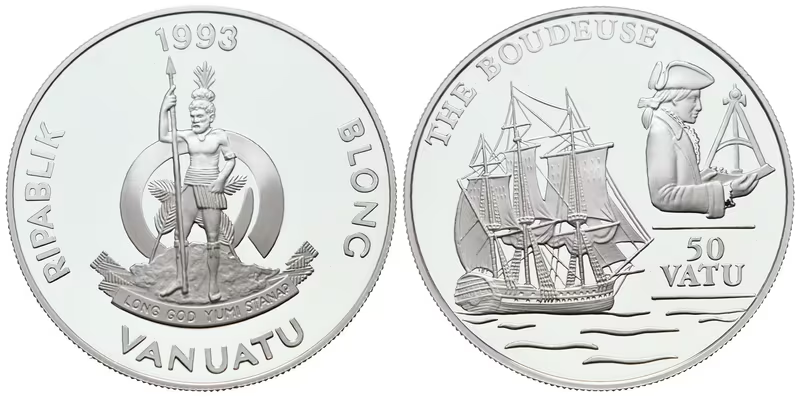
Vanuatu, 50 Vatu 1993 - Fregata Boudeuse
Republika Vanuatu (*1982) 50 Vatu 1993 - Fregata Boudeuse, KM# 16 Ag (.925), 38,6 mm (31,47 g), proof, v kapsli. Emise: 15 000 ks. Stříbrná pamětní mince. Lit.: KM# 16.
Skladem 1 ks - Code: ZNMS2008SOKTATES
20 vatů 2008 - Sokrates, PROOF
Vanuatská republika 20 vatů 2008 - Sokrates, Au 0,999 11 mm (0,5 g), kapsle, certifikát autentičnosti, PROOF
- Code: BVANU08A
- Code: ZSVAN-2009
Vanuatu, 50 Vatu 2009 - Palác Potala v Tibetu
Vanuatu 50 Vatu 2009 - Palác Potalav Tibetu Au 0,999, 13,92 mm (1,00 g), PROOF, certifikát Z cyklu Nejmenší zlaté mince světa