Vanuatu
Vanuatu is a Pacific island state in Melanesia with a unique monetary history that includes traditional means of payment made from boars' tusks, the colonial coinage of the New Hebrides and the modern vatu. Vanuatu coins, especially investment silver mintages and collector issues of unusual shapes, represent a fascinating combination of Melanesian culture…
Before the arrival of Europeans, the inhabitants of Vanuatu used a complex system of traditional means of payment. The most valuable were boars' tusks shaped into a circular form (namangi or livatu), whose value increased with age and curvature. Mats woven from pandanus leaves, feathers of rare birds and special stones were also used. This system functions to a limited extent to this day in ritual payments — bride price, compensation, the acquisition of titles. The circular boar's tusk has remained a national symbol and appears on modern coins.
The first European coins were brought by sandalwood traders in the first half of the 19th century. Spanish and Mexican silver eight reales, British pounds and French francs were used. In 1906 the archipelago became the joint British-French Condominium of the New Hebrides. This unique arrangement meant the parallel use of British pounds and French francs. There was no local currency — all payments took place in one of the two colonial currencies.
The first coins of their own were struck only in 1966 — silver 100 francs with a portrait of General de Gaulle for the French part and a pound with Queen Elizabeth II for the British part. In 1970 joint coins of the New Hebrides followed, with bilingual inscriptions and neutral motifs — local fauna and flora. These rare colonial coins circulated only briefly until independence.
History
Independence in 1980 brought the introduction of a national currency — the vatu (VUV). The name comes from a local word for "stone" used as a traditional means of payment. The first Vanuatu coins were struck in 1983 in denominations of 1, 2, 5, 10, 20 and 50 vatu. They depicted national symbols — the boar's tusk, the traditional canoe, local crops (yam, coconut, coffee). The coins were struck by the Royal Mint in London to high quality.
Since the 1990s Vanuatu has been issuing collector and investment coins. In 1992 a programme of one-ounce silver coins with motifs of indigenous culture began. From 2015 Vanuatu has been minting innovative coins of unusual shapes — the first was a coin in the shape of a coconut. Coins in the shape of a shell, a tropical leaf and a traditional mask followed. These unconventional mintages aroused great interest among collectors.
Modern Vanuatu coins are struck by prestigious world mints — the Perth Mint in Australia and B.H. Mayer in Germany. They specialise in limited editions using modern technologies — colour printing, holograms, embedded crystals. Popular are series dedicated to ocean conservation, endemic species and Melanesian mythology. Although Vanuatu has no mint of its own, its numismatic programme is among the most interesting in the Pacific.
Characteristics of Vanuatu coins
Vanuatu coins combine Melanesian tradition with modern elements. The dominant symbol is the boar's tusk in a circle — the official state emblem. On the coins traditional artefacts appear — the nakamal (men's house), the tamtam (slit drum), ritual masks. Nature motifs include endemic species — the coconut crab, the lorikeet parrot, sea turtles. The inscriptions are in Bislama (the local creole), English and French.
Technologically, Vanuatu coins use the latest processes. The series of unusual shapes uses special striking techniques, the colour coins use photorealistic printing and the investment mintages contain pure silver of 999/1000 fineness. Vanuatu was among the first countries to issue 3D coins with raised elements and coins glowing in the dark with a luminescent layer. Limited editions often contain real pearls or volcanic sand.
The rarest Vanuatu mintages include the colonial coins of the New Hebrides from 1966–1979, the first vatu from 1983, the silver 50 vatu marking independence, the investment Melanesian Chief in kilogram silver, and limited editions of unusual shapes. A record-setting example is the 2020 Yasur Volcano-shaped coin with real volcanic ash.
In our auction and shop
- Code: SVANU-B1993
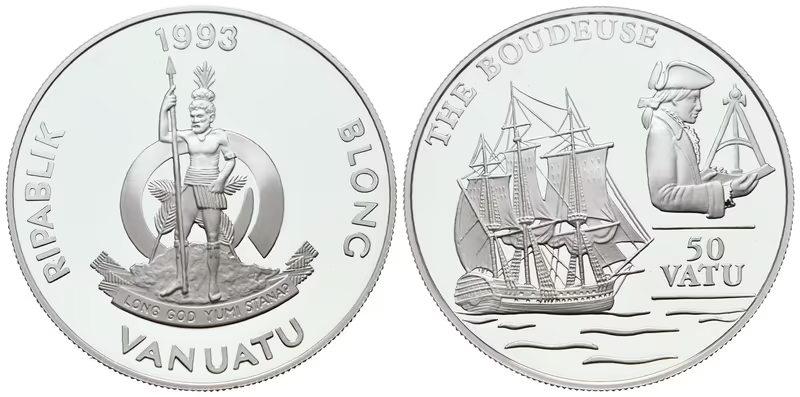
Vanuatu, 50 Vatu 1993 - Fregata Boudeuse
Republika Vanuatu (*1982) 50 Vatu 1993 - Fregata Boudeuse, KM# 16 Ag (.925), 38,6 mm (31,47 g), proof, v kapsli. Emise: 15 000 ks. Stříbrná pamětní mince. Lit.: KM# 16.
Skladem 1 ks - Code: BVANU08A
- Code: ZSVAN-2009
Vanuatu, 50 Vatu 2009 - Palác Potala v Tibetu
Vanuatu 50 Vatu 2009 - Palác Potalav Tibetu Au 0,999, 13,92 mm (1,00 g), PROOF, certifikát Z cyklu Nejmenší zlaté mince světa
- Code: ZSVAN-2009A
Vanuatu, 20 Vatu 2009 - Pantheon v Římě
Vanuatu 20 Vatu 2009 - Pantheon v Římě Au 0,999, 11 mm (0,5 g), PROOF, certifikát Z cyklu Nejmenší zlaté mince světa