William I of Prussia
William I of Prussia was Prussian king (1861–1888) and from 1871 the first German emperor, under whose rule a unified Germany emerged. He entered history as a monarch who based the state's power on the army and administration and worked together with Otto von Bismarck on fundamental changes in the European balance.
William I of Prussia (1797–1888) grew up in an environment shaped by the Napoleonic Wars and the subsequent reforms of the Prussian state. From his youth he was linked to the army, and military discipline and an emphasis on service to the state became a lasting part of his identity. In Prussian politics he long remained rather in the background, but he gradually gained influence as a representative of the conservative, monarchical direction that emphasised order, authority and stable institutions.
He ascended the throne in 1861 after his brother Frederick William IV. The very beginning of his reign was marked by a sharp conflict over the form of the army and the state budget. William sought an extensive army reform that was to increase numbers and improve organisation and training. He encountered resistance from parliament, however, which feared the strengthening of the monarchy and the rise in expenditure. In this situation the key role of Otto von Bismarck became evident; William summoned him to head the government. Bismarck managed to "push through" the conflict by tough political tactics and created the conditions for the state to enforce the reform, even though this meant long-term tension between government and parliament.
William's era is closely associated with the unification of Germany "from above", led by Prussia. The process unfolded in several steps and was supported by successful wars that strengthened Prussian prestige and induced the other German states to accept Prussian leadership. First came the conflict with Denmark (1864), then the decisive clash with Austria (1866), after which Prussia gained a dominant position in the German space. The final act was the Franco-Prussian War (1870–1871), which raised a wave of German patriotism and created the political conditions for the proclamation of the empire.
History
On 18 January 1871, William I was proclaimed German emperor at Versailles. The symbolism was deliberate: the new state was being created at the height of military victory and in a space associated with the prestige of France. Although William is often perceived as the "face" of unification, the real political architecture was largely directed by Bismarck. William was a monarch of a rather traditional type, who at times wavered before Bismarck's toughness, but in key moments he stood by him. The result was a new power entity that quickly influenced European relations and became one of the decisive players of the late 19th century.
In the last years of his life William's reign merged with the era of stabilisation of the empire, industrial development and the modernisation of society. The monarch retained authority as a symbol of unity and military tradition, even though the everyday management of the state was in the hands of the chancellor and the administrative apparatus. William died in 1888; he was succeeded by Frederick III and shortly afterwards by William II, which opened another chapter of German history.
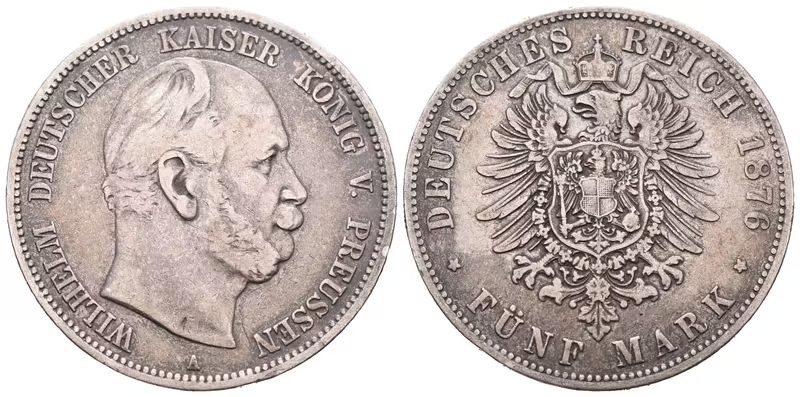
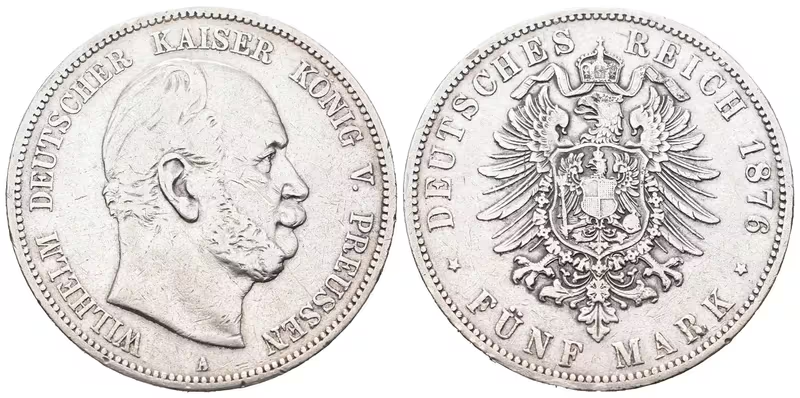
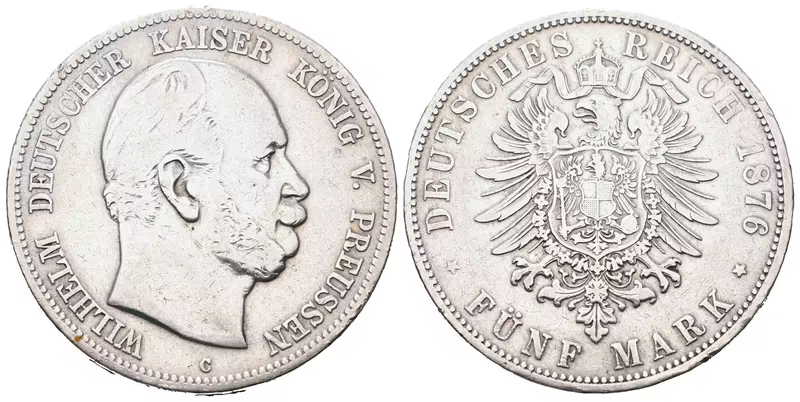
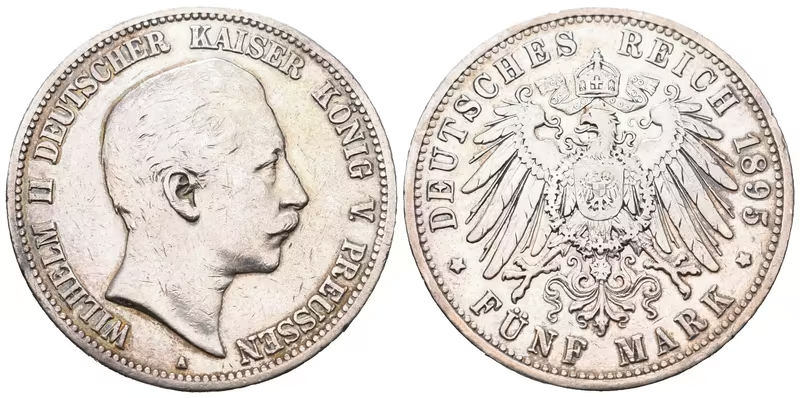
William I of Prussia belongs to the monarchs whose period is very clearly defined for numismatics and grateful for collectors. On Prussian coins of the 1860s his portrait appears with the titulature of Prussian king; after 1871 the titulature changes and the coins of the German Empire bear the designation of emperor and imperial symbols. This very change is attractive for collectors, because on the coins you can see the "transition of the regime" and the birth of a new state framework.
Portrait on coins and collecting connections
Most often collected are the silver and gold denominations bearing William's portrait, struck at various mints marked with letters. For more ordinary pieces, condition is the deciding factor: the sharpness of the hair and beard on the portrait, the legibility of the legend and a natural surface without traces of cleaning. For rarer years and mints, precise attribution is the key, because the same denomination may, depending on the mint mark, have a markedly different availability.
For a thematic collection several approaches suggest themselves: "William as Prussian king" (up to 1871), "William as emperor" (from 1871), or a collection focused on the unification of Germany, where coins are complemented by medals and commemorative strikes recalling the wars and the proclamation of the empire. In any case, it is an area that combines a strong historical story with well-recognisable coin types, and it is therefore popular even with collectors who are just beginning with German coins of the 19th century.
In our auction and shop
- Code: NBPRU-BX1876A.2
Prusko, 5 Marka 1876 A
Prusko, Vilém I., 1861 - 1888 5 Marka 1876 A, Berlín, KM.503, J.97, oběhový stav
- Code: NBPRU-BX1876A.3
Prusko, 5 Marka 1876 A
Prusko, Vilém I., 1861 - 1888 5 Marka 1876 A, Berlín, KM.503, J.97, oběhový stav
- Code: NBPRU-BX1876C
Prusko, 5 Marka 1876 C
Prusko, Vilém I., 1861 - 1888 5 Marka 1876 C, Frankfurt am Main, KM.503, J.97, oběhový stav
- Code: NBPRU-BX1895A.1
Prusko, 5 Marka 1895 A
Prusko, Vilém I., 1861 - 1888 5 Marka 1895 A, Berlín, KM.523, J.129, patina, rysky