Witten
The witten (also witte, wittenpfennig or veerling) was a mediaeval North German coin which represented the value of four pfennigs. The popular name was connected with its "white" appearance, which arose from oxidation of the copper component of the alloy.
The witten spread in the 14th century in the space of northern Germany, where municipal coinage played a major role in trade and everyday circulation. The striking is attested from the period after 1330 - first in Lübeck and soon afterwards also in other important port cities such as Hamburg and Wismar. Further Hanseatic and North German mints followed, including Lüneburg, Rostock and Stralsund. Although the composition of individual issues could differ, the coins had a common appearance and were tied to contemporary agreements on minting standards within the Wendish coinage area.
In period documents the witten is also encountered under the descriptive designation "pfennig of four pfennigs", which captures both its accounting and practical role. It was therefore not an arbitrary conversion, but a denomination which was intended to make it easier for the user to pay in higher small-change values without having to manipulate large quantities of the smallest pfennigs.
History
The witten was not limited only to a narrow circle of cities of the Wendish coinage union. Similar coins also appeared outside it, for example in Pomerania and Holstein, where North German monetary customs naturally interwove with local practice. From a numismatic viewpoint this is an important trace: it shows that some denominations spread according to trading ties and trust in the coin, not only according to the boundaries of individual lordships.
During the 15th century the witten was gradually displaced by other denominations (for example the dreiling, sechsling or schilling), which better corresponded to the development of monetary circulation. Within the original coinage circle it then appeared again only briefly at the beginning of the 16th century. Subsequently the witten was imitated also in further territories, which is a phenomenon typical of coins that were intelligible and "well accepted" in circulation - imitations often target precisely established and known types.
Appearance, value and identification
The basic definition of the witten is the value of four pfennigs, often indicated directly on the coin. As material, copper alloys with a silver content were used (so-called billon), with the reaction of the copper component on the surface possibly creating a lighter, "whitish" impression that gave the coin its popular name. In numismatic description, therefore, not only the denomination and inscription but also the style, purity, weight, and especially the mint are observed, since individual cities struck wittens in slightly different variants.
For collectors the witten is also interesting as a coin of the Hanseatic and North German milieu: it often bears city motifs, arms or legends that help to determine the origin more precisely. In catalogue practice it is therefore useful to state not only "witten" but also the specific city and period of striking, since precisely this determines the correct classification and the occurrence of variants.
In our auction and shop
- Code: NE-Z1920WIT
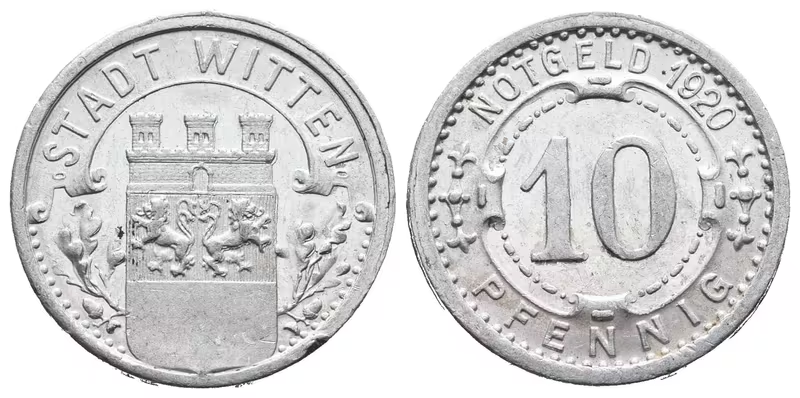
Nouzové ražby, 10 Pfennig 1920 - Witten
Nouzové platidlo - Německo 10 Pfennig 1920 - Wiesbaden, Al 21 mm